
Sustainability Management
Sustainability means preserving intact environmental, social and economic systems with long-term viability at global, regional and local level. The Volkswagen Group can influence these systems in various ways and actively takes responsibility to help safeguard their sustainability. The vision is to become a mobility provider with positive added value for nature and society. Our sustainability management is an important pillar in the continuous improvement of our sustainability performance. The related structures, processes, and responsibilities are codified in the Group policy on sustainability management.
The Chair of the Board of Management of Volkswagen AG has overall cross-functional responsibility for sustainability. Support in this regard is provided by the members of the Board of Management in line with their responsibility for specific management systems relating to sustainability, and from the Chief Sustainability Officer at Group level. The Group Sustainability department reports to Group and Product Strategy and the Office of the Corporate Secretary, which in turn reports to the CEO. The purpose of incorporating sustainability into the strategic arm of the Company is to help improve the Company’s resilience through the creation of solid foundations for sustainable development and resistance to external influences.
Sustainability and the Group sustainability strategy regenerate+ are part of the Group’s Top 10 program and are managed through the strategic management structure of the Group strategy. In order to make progress on the dimensions and focus topics of our Group sustainability strategy as transparent as possible in line with the Group strategy and the objectives of the Group’s Top 10 program valid for the fiscal year, the strategic objectives and milestones are structured using the OKR (Objectives and Key Results) method, and are measured regularly. Accordingly, strategic objectives and envisaged key results are defined for all dimensions and focus topics. The intention is for them to be realized largely through time-limited projects and work packages, each of which is measured by the metrics and other key performance indicators. The level of achievement is monitored on an ongoing basis, and the overall situation presented twice a year to the Board of Management, among others. In this way, the relevance of the focus topics, and their objectives, milestones, projects and work packages, are reviewed regularly at Group level. Their focus is continuously monitored and adjusted as necessary.
Metrics have been defined for regenerate+ to aid its systematic implementation and to make progress transparent. The targets and metrics of the Group sustainability strategy are used not only for internal management purposes, but are also discussed often with partners, society, and the capital market.
In addition to this, the Group Sustainability department coordinates all sustainability-related activities and the Group-wide, cross-functional network for sustainability. Communication with Group functions, brands and companies is structured via clearly defined core processes. The objective is to create transparency regarding external requirements and to translate these requirements into corporate action with the aim of continually improving the Group’s sustainability performance.
The central core processes include development of the Group sustainability strategy and materiality assessment, stakeholder management, ESG ratings, sustainability policies and reporting on sustainability matters related to the Group sustainability strategy.
In addition, the individual board-level management functions are responsible for and manage the function-specific sustainability topics. Responsibility for implementing policies that address impacts, risks, and opportunities lies with the relevant Group function. If resolutions on topics relevant to sustainability are recommended to the Board of Management, their impact on sustainability strategy issues must be assessed and agreed in advance with the Chief Sustainability Officer.
The Supervisory Board of Volkswagen AG supervises and advises the Board of Management in the management of the Company and is directly involved in the decision-making process, in particular in decisions of fundamental importance to the enterprise for which its consent is required. Supervision and advisory activities on the part of the Supervisory Board also extend to sustainability topics. For example, the Audit Committee deals with matters such as the audit of the sustainability report and the monitoring of processes relating to the sustainability report. The Supervisory Board takes this prior examination and the findings of the audit of the sustainability report by the auditor engaged for the purpose into account when it also considers the sustainability report within the scope of its examination of the management report. In addition, the Supervisory Board has appointed an ESG officer. This role is currently held by Mr. Hans Dieter Pötsch. Ms. Susanne Wiegand, Mr. Hans Dieter Pötsch and Mr. Ferdinand Oliver Porsche, track and monitor the latest developments in the area of sustainability reporting and the auditing and assurance thereof, and bring this expertise to the work of the Supervisory Board and Audit Committee of Volkswagen AG. Regular status reports in accordance with the statutory Board of Management reporting obligations, as well as the requirements stipulated by the Supervisory Board, ensure that the Supervisory Board is informed at all times about all developments and changes relevant for its duties. When necessary, the Supervisory Board consults renowned external experts who support the Supervisory Board with their specialized knowledge and objective assessments.
At brand and company level, the brand sustainability management carries out the cross-functional coordination of sustainability topics. It refines the brand-specific sustainability strategy and is responsible in its own right for its content, implementation and management, as well as for reporting on sustainability matters within the brand. It is also the outward representative for the brand on the subject of sustainability and liaises with the Group Sustainability department in this respect.
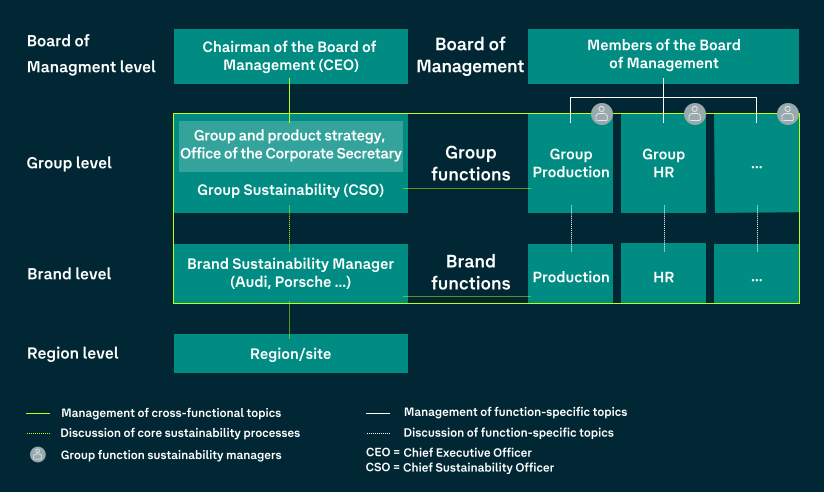
The Board of Management of Volkswagen AG regularly reviews the results of the interdisciplinary core sustainability processes to obtain an overview of the company’s sustainability performance. In the 2025 reporting year, for example, the results of the double materiality assessment were confirmed by the Group Board of Management in this context. In addition, the Audit Committee of the Supervisory Board reviewed the results of the materiality assessment.
These results were also compared with the objectives of the Group sustainability strategy regenerate+, where they served as input for an assessment of the general resilience of the strategy and to ensure that the impacts, risks and opportunities identified are being taken into account in an appropriate manner.
The review initially focused on a qualitative assessment of the coverage of the impacts, risks and opportunities identified with regard to regenerate+. With their time horizon of ten years or more, the strategic targets and ambitions of regenerate+ fall under the definition of the long-term time horizon stipulated in the ESRS. In addition, the realization of short and medium-term intermediate targets and actions is the responsibility of the respective specialist functions and is reported in the topical standards.
This comparison demonstrated that regenerate+ covers all sustainability-specific topics in the long term that are of relevance for the strategic development of holistic sustainability performance. The only exceptions are a small number of topic-specific impacts, risks and opportunities, for example in the customers topic area, and the political engagement and lobbying activities topic area, which are covered by specific activities in the relevant departments or brands. Risks are mitigated via the policies in the Group departments. Established management tools, such as the Risk Management System, are available to facilitate the identification of potential risks at an early stage.
In addition to the analysis described above of the coverage with regard to regenerate+, a resilience analysis was carried out in 2024 of the material impacts, risks, and opportunities in the areas of Climate Change (ESRS E1) and Biodiversity and Ecosystems (ESRS E4). These analyses show the business and operating models to be resilient in principle in the short, medium and long term. Details of the approach and findings of the respective resilience analyses are provided in the “Climate Change” and “Biodiversity and Ecosystems” chapters under Environmental Information.