
Climate Change
The Volkswagen Group is committed to the Paris Climate Agreement and aims to become a net carbon-neutral company by 2050.
MATERIAL IMPACTS AND RISKS AND THEIR INTERACTION WITH STRATEGY AND BUSINESS MODEL
IMPACTS AND RISKS RELATING TO CLIMATE CHANGE MITIGATION AND ENERGY
| Description | Impact/Risk/ Opportunity | Actual/Potential Impact | Value Chain | Time Horizon | ||||
|
Climate Change Mitigation |
|
|
|
|
||||
|
The Volkswagen Group aims to reduce greenhouse gas (GHG) emissions across its value chain. The greatest effects can be found in the downstream value chain due to the transition to e-mobility in the use phase of vehicles and the resulting increase in the proportion of electric drivetrains. Upstream GHG emissions can be reduced by switching to more climate-friendly processes and products. Within its own operations, GHG emissions can be reduced by developing products with a low GHG footprint, for example by using sustainable materials or developing high-efficiency engines. |
|
|
|
|
||||
|
|
|
|
||||||
|
GHG emissions arise in particular during the use phase, that is, when our customers use their vehicles. GHG emissions also arise from the mining and processing of raw materials, the manufacture of components in the supply chain, and the Company’s own operations. |
|
|
|
|
||||
|
The risk of failing to meet statutory worldwide fleet emission targets, for example due to an insufficient transition to electric drivetrains or lack of market resonance, was defined as a material transition risk for the Volkswagen Group. |
|
|
|
|
||||
|
Climate Change Adaptation |
|
|
|
|
||||
|
The upstream supply chain is monitored and examined based on processes and data for both the short term and the long term. Based on current climate change predictions, the Volkswagen Group’s upstream supply chain will also be more exposed to climate-related hazards in the future. Consequently, there may be supply disruptions and adjustments to production programs at the Group’s production sites. This was identified as a material physical risk in the double materiality assessment. |
|
|
|
|
||||
|
Energy |
|
|
|
|
||||
|
The positive effects in reducing the use of fossil fuels stem from the use of renewable energy – primarily to power vehicles – by making changes to production and making adjustments to the supply chain. These include, for example, a higher proportion of electrically powered vehicles charged using renewable energy; using green electricity at production sites; and setting upper limits for CO2 emissions per relevant component. |
|
|
|
|
||||
|
|
|
|
||||||
|
The impact stems from the continued use of fossil fuels along the value chain, as their production and use are associated with GHG and other emissions. |
|
|
|
|


|
|
Opportunity |
|
Positive |
|
Actual Impact |
|
Upstream |
|
Short-term |
|||||||||
|
|
Risk |
|
Negative |
|
Potential Impact |
|
Own Operation |
|
Medium-term |
|||||||||
|
|
Downstream |
|
Long-term |
|||||||||||||||


The processes for identifying potential impacts are described in the “Procedure for and results of the double materiality assessment” section in the “General Information” chapter.
Process description and results of the climate risk analysis
Transition risks
Possible transition risks and opportunities were identified using a scenario analysis and on the basis of additional internal sources within the double materiality assessment (see the “Procedure for identifying material information” section of the “General Information” chapter for further information).
The time horizons of the analysis correspond to the general definitions in this report. The connections between the service lives of capital goods and the time horizons from strategic planning are set out in the “Procedure for identifying material information” section of the “General Information” chapter.
The “Announced Pledges” scenario (APS) and the “Net Zero Emissions by 2050” (NZE) scenario from the International Energy Agency (IEA) were used for the scenario analysis. The main sources used were the IEA report “Net Zero Roadmap: A Global Pathway to Keep the 1.5°C Goal in Reach −2023 Update”, and the “Global EV Outlook 2024”. The reports take into account the latest progress reports of the Intergovernmental Panel for Climate Change (IPCC) at the time of preparation, and therefore the current state of climate science. The IEA’s “Global Energy and Climate Model” on which they are based, models not only the transformation of the transportation sector, but also additional sectors relevant for the Group’s value chain and business model, such as energy and raw materials production.
The ambition level of the NZE scenario is aligned with the ideal goal of the Paris Climate Agreement of limiting global warming to 1.5°C; the scenario provides for a limited overshoot of the 1.5°C target, with a decline in the global temperature rise to around 1.4°C by 2100.
This makes it suitable for estimating a maximum expected intensity and speed of the transition events, and thus the maximum risk exposure. However, due to its normative nature and limited practical applicability, it is not used as a guideline for strategy development. The IEA’s APS scenario, on the other hand, is based on the currently published commitments of government actors. It corresponds to a global temperature increase of well below 2°C. As part of strategy development, the Volkswagen Group also investigated trajectories with lower intensity and speed of transition events to address uncertainties regarding the forms of risk driver (see the “Strategy: Climate change resilience” section for further information). This did not reveal any additional risks.
The IEA scenarios consider various time horizons. Specific projections relating to the transportation sector in particular are made for 2030, 2035 and 2050. The focus of the analysis was on development until 2030 for the medium-term time horizon and until 2035 for the long-term time horizon.
Several relevant transition events were identified based on the scenarios. The scenarios are based on the assumption that governments around the world will be implementing ambitious climate policies, including carbon pricing, stricter fleet emission standards, and bans on new registrations of internal combustion engine vehicles in key markets. The expansion of incentive schemes to promote battery-electric vehicles is also anticipated.
In terms of the market, the scenarios assume that increasing availability and decreasing costs will be additional factors driving the demand for battery-electric vehicles – provided that the charging infrastructure is expanded quickly. Under these assumptions, electric vehicles will account for between half and two-thirds of passenger cars sold worldwide in 2030, depending on the scenario. However, this development may vary widely between regions.
This will cause increased demand for battery raw materials and sustainably produced and circular materials in the medium to long term, which may result in limited availability and price increases.
From a technological perspective, the scenarios assume that current battery technology will continue to develop and that energy efficiency will continue to improve across all sectors. This could noticeably reduce emissions from the upstream value chain.
The transition events were mapped along the value chain and were analyzed qualitatively in terms of impacts on strategy and business model in the form of potential risks and opportunities. These were compared with the risks and opportunities formulated in the double materiality assessment.
The evaluation was performed in the double materiality assessment by the relevant departments in consultation with Group risk management and sustainability management (see the “Procedure for and results of the double materiality assessment” section of the “General Information” chapter).
Material risks resulting from the need for sustainable raw materials are described in the chapter “Resource Use and Circular Economy”.
Physical risks
The assessment of climate-related risks for the Group’s own sites involved examining climate-related hazards for around 200 of the most important sites. These included all production sites in addition to key sales, administration and development sites. To assess climate-related physical risks in the upstream value chain, climate hazards were examined for approximately 1,000 key supplier sites.
The analysis was conducted with a software tool that uses the geo-coordinates of the sites. Both chronic hazards such as heat and cold stress, and acute physical hazards such as river flooding and storm surges, were analyzed.
The periods examined were based on those of the software tools employed and were largely in line with the periods used in this report. The short term period corresponds to the status quo view in the tool. The medium term period refers to development until 2030 and corresponds to the Group’s strategic planning period, including capital allocation planning. The long-term time period refers to development until 2050, to reflect the potential service lives of the assets.
The IPCC Shared Socioeconomic Pathway (SSP5-8.5) scenario was used for the forecast. This represents a high emission scenario based on the current state of climate science, and therefore plausibly reflects the maximum expected risk exposure in terms of severity and likelihood of occurrence. It predicts global warming of 3.3°C to 5.7°C by the end of the 21st century and is based on intensive use of fossil fuels, economic growth, and energy-intensive lifestyles.
With regard to our own operations, it was determined that some of the sites analyzed are already exposed to relevant climate hazards, such as river flooding or storm surges. Additional stress factors (for example heat stress, cold stress, precipitation) were also analyzed as part of the risk analysis.
Overall, based on the expected financial impacts for the Volkswagen Group over all time horizons considered, the risk of direct damage and a resulting production outage was deemed not material in the materiality assessment.
In the upstream value chain, it was found that nearly one-seventh of the supplier sites examined are already exposed to relevant climate hazards, such as river flooding or storm surges.
Particularly in the high emission scenario, many climate hazards such as flooding would increase significantly in the coming decades, which could lead to more frequent and more severe future disruptions in the supply chain.
Depending on the severity and duration of the delivery delay, the component groups affected and the specific sourcing situation, longer and more extensive operational disruptions cannot be ruled out and could potentially affect multiple production lines and/or locations. This was identified as a material risk over all time horizons in the double materiality assessment.
Interaction with strategy and business model
The material impacts and risks identified with respect to climate change mitigation and energy have an effect on the Group’s business model and strategy. A detailed strategic classification of material impacts and risks is provided in the “Strategy: climate change and transition plan” section.
Information on the future adaptability of the strategy and business model with a view to material transition risks is provided in the “Strategy: climate change resilience” section.
The material impacts and risks are addressed through policies, actions and targets at various levels. The focus is on mitigating negative impacts, reinforcing positive impacts, and avoiding or mitigating material risks.
The policies and overarching actions regarding the material positive and negative impacts described in the areas of climate change mitigation and energy are presented in the “Climate change mitigation and energy efficiency” section. The section on “Use of renewable energies” describes additional actions relating to the impacts from the Group’s own operations and the upstream and downstream value chain, including the use phase of products.
Further details and examples of implementation of the actions can be found in the “Actions and resources: Climate change” section. The actions set out in the “No decarbonization without e-mobility”, “Increasing vehicle efficiency”, “Net CO2e-neutral use phase” and “Contribution to climate-friendly logistics and hard-to-abate sectors” sections addresses impacts from the use phase of the products. The actions set out in the “Climate change mitigation in manufacturing”, “Zero Impact Logistics”, and “Decarbonization of the dealership networks” sections relate to impacts in own operations and parts of the downstream value chain. The actions relating to the upstream supply chain are presented in the “Requirements for decarbonization in the supply chain” section.
Policies and actions to manage material risks are presented in the “Strategy: Climate change resilience” section.
The target set out in the “Reduction of Scope 3 GHG emissions in the use phase” section also contributes to the identified material transition risk. The same applies to the actions presented in the sections “No decarbonization without e-mobility” and “Increasing vehicle efficiency”.
Strategy: Climate change and transition plan
Climate change strategy
Sustainability will remain a significant topic in the business world and will continue to gain in importance, driven by the increasingly noticeable consequences of climate change, greater awareness of sustainable lifestyles among customers and, not least, underlying conditions such as the Paris Climate Agreement.
Decarbonization is a core component of the Group’s activities and plays a key role in the Volkswagen Group decarbonization strategy. Our decarbonization strategy applies to the entire Group. We have not yet implemented a Group-wide decarbonization plan within the meaning of ESRS E1 paragraph 16, since the TRATON GROUP and Everllence (formerly MAN Energy Solutions) do not have transition plans. The following actions and metrics for implementing the decarbonization program focus on the passenger cars and light commercial vehicles area of the vehicle-related business. The transformation driven by digitalization and electrification requires extensive investment, which is incorporated in the Group strategy and taken into account in medium-term planning.
Operationalizing the decarbonization program
Our decarbonization program covers the entire life cycle of our products. It is implemented via a clear hierarchy of actions, which is configured as follows for the passenger cars and light commercial vehicles segment: The top priority is to take action to avoid CO2e emissions. In second place are actions with which the Group aims to gradually shift the energy supply to renewable energy across the entire value chain and in all phases of a vehicle’s life. Finally, unavoidable CO2 equivalent (CO2e) emissions are compensated in selected cases through climate change mitigation projects that meet the highest international standards. Further information is provided in the “GHG removals and GHG mitigation projects” section.
Within the hierarchy of actions, the Volkswagen Group defines four material decarbonization levers for achieving the emission reduction targets. These decarbonization levers are explained in more detail in the “Actions and resources: Climate change” section. Concrete actions for this target achievement are described for example in the sections on “Climate change mitigation in manufacturing” and “No decarbonization without e-mobility”.
Commitment to the Paris Climate Agreement and our climate targets
We are committed to the Paris Climate Agreement1. It is our aim to be a net carbon-neutral company by 2050. We plan to achieve this through the hierarchy of actions described above, with clear priority placed on first reducing and avoiding emissions, and only applying offsetting actions for emissions that are difficult to avoid or completely unavoidable. We have already set this target for 2040 for production and the associated Scope 1 and 2 emissions. For more information, see the “Reduction of Scope 1 and 2 GHG emissions” section. There are further certified targets for the use phase (Scope 3, category 11), which are described in more detail in the “Reduction of Scope 3 GHG emissions in the use phase” section.
Strategic implementation through Group-wide sustainability management
A Group-wide sustainability management system that includes the issue of climate change mitigation is established in the Volkswagen Group. The related structures, processes and responsibilities are documented in an internal Group policy.
The progress of the transition plan is measured through the strategic metrics, which include Scope 1, 2 and 3 emissions, the decarbonization index (DCI) and the proportion of electric vehicles (see the “GHG emissions” section as well as the “General Information” chapter for further information). These metrics are also used to track the progress of the Group sustainability strategy regenerate+.
Activities with respect to the EU Taxonomy
Detailed information on the EU Taxonomy is provided in the “EU Taxonomy” chapter.
Production capacity and technical equipment
Production capacity and technical equipment that focus on the manufacture of vehicles with internal combustion engines run the risk of losing value and potentially becoming “stranded assets” during the transition to a decarbonized economy. The share of these investments in Scope 1 and 2 is secondary compared to the Company’s Scope 3 emissions, as it is largely limited to the production of vehicles. The Group counters this risk by focusing its investment program on innovative production concepts that serve the transformation of the Company.
Exposure to coal-, oil- and gas-related activities
The Volkswagen Group focuses on the manufacture, sale and marketing of motor vehicles and mobility solutions. The Company’s main area of economic activity is the manufacture of motor vehicles. The investments in this economic activity are the only ones classified as material. The analysis of economic activities revealed that activities involving coal, oil, and gas primarily take place in the context of vehicle-related business and are attributable to this business.
Disclosure on EU Paris-aligned Benchmarks
The exclusion criteria for EU Paris-aligned Benchmarks were reviewed in the context of the Climate Benchmark Regulation, and it was determined that Annex 12.1 does not apply. Paris-aligned EU benchmarks are indices subject to specific criteria and compiled by providers in line with such criteria in addition to their own. In addition, there is no knowledge of any exclusions by administrators of EU Paris-aligned Benchmarks pursuant to Annex 12.2.
Responsibilities for sustainable implementation
In-depth information on responsibilities is provided in the “Sustainability management” section of the “General Information” chapter.
Strategy: Climate change resilience
The resilience analysis was performed in the year 2024 and is based on the results of the climate risk analysis (see the “Process description and results of the climate risk analysis” section) and the materiality assessment (see the “Procedure for identifying material information” section of the “General Information” chapter). The critical assumptions made regarding the development of the sector derived from the scenario analysis were also included. The resilience analysis covers the key elements of the business model and focuses on impacts, risks and opportunities identified as material and their material drivers along the value chain. Several aspects were taken into account to assess the resilience of the Volkswagen Group: operational control mechanisms with regard to the material impacts, risks and opportunities, their inclusion in corporate planning and strategy, as well as the capacities required for a more far-reaching alignment of the business model. The time periods correspond to those in the “General Information” chapter in the “Notes on use of the ESRS” section, and are used in the same way as they were in the double materiality assessment. For the long-term time horizon, we are focusing on the period through 2035, the target year for the Group’s current strategy.
A key element in increasing resilience to climate change is the positioning of decarbonization as a cornerstone of the Group’s strategy, as explained above in the “Strategy: Climate change and transition plan” section. In addition, climate change mitigation is firmly anchored in the Group sustainability strategy regenerate+ and is measured and managed using relevant metrics, including the decarbonization index (see the “Targets: Climate change” section).
The Konzern-Steuerkreis Flotten-Compliance (KSK FC – Group Steering Committee for Fleet Compliance) is responsible for managing fleet-related greenhouse gas emissions. It includes experts from all passenger car brands and relevant departments. The KSK FC monitors compliance with regulatory requirements and can initiate in particular short- and medium-term actions, for example in sales management, in the event of potential deviations. The regulatory requirements and market development forecasts are also factored into the medium- and long-term planning process.
The central lever for complying with ambitious fleet limits is the further electrification of our product range (see the “Actions and resources: Climate change” section). The relevant targets are defined with the brands in the planning process, and capital expenditure requirements and necessary adaptations to the production sites are identified over a five-year time horizon. Uncertainties remain with regard to the speed and consistency at which electrification is being driven forward by regulatory actions in the various markets. As a result, a number of different scenarios were examined during the development of the Group strategy. Specific courses of action were developed and evaluated on this basis, allowing the Group to adapt flexibly to different conditions in the regulatory environment.
The operational control mechanisms presented and their explicit inclusion in the integrated planning primarily have an impact in the short-term, while the adjustment to the Group strategy described above will have a medium- to long-term impact.
The Group has sufficient capacity to implement the adjustment measures. In recent years, a double-digit number of sites have already been successfully converted to the production of battery-electric vehicles or the components required for them. This approach serves as a blueprint for the further transformation of the Group’s sites. Implementation of the Group strategy to reduce emissions in the context of the decarbonization strategy, requires extensive retraining and upskilling actions, some of which are already being implemented. A strategic approach is in place and regular discussions are held within the Volkswagen Group on training-related topics (see also the “Creation and expansion of digital training program” section in the “Employees and Non-Employees” chapter).
The Volkswagen Group has access to a range of money market and capital market instruments to cover its capital requirements, including for the further implementation of its decarbonization strategy (see the “Refinancing” section in the "Shares and bonds” chapter). The Volkswagen Group’s Green Finance Framework enables the Company to refinance EU Taxonomy-aligned capital expenditure, for example for developing and manufacturing all-electric vehicles, through sustainable financial instruments (see also the “Strategy: Climate change and transition plan” section).
The Volkswagen Group has implemented processes and methodologies in supply chain management that are intended to effectively mitigate short-term supply disruptions. These include an established crisis management structure in Procurement and cross-departmental coordination between Procurement, Quality Assurance, Development, Production, and Logistics. In conjunction with a worldwide supplier network, this may help to compensate for the loss of individual supplier locations in many cases. In the medium to long term, resilience to the impacts of climate-related hazards will be a key component of the procurement strategy.
Overall, the resilience analysis revealed that the company is addressing the material impacts and transition risks comprehensively, specifically and in an integrated way. The ability to adapt the business model to the challenges of climate change is therefore considered to be secured for the short, medium and long-term time horizons.
Due to the large number of Group sites, it has not yet been possible to conduct a comprehensive analysis of specific countermeasures at site level to assess physical climate risks. This has been done as part of the risk analysis for the EU Taxonomy for the relevant sites. More detailed information on this can be found in the “EU Taxonomy” chapter.
As a general rule, Business Continuity Management requires all operating units to carry out a risk assessment and, if necessary, to develop appropriate contingency plans. Furthermore, the Volkswagen Group continuously and regularly calls on its suppliers to make their own supply chains resilient to climate-related hazards.
In addition, the Group has already examined specific exposure to climate hazards and the countermeasures taken at some sites. This will gradually be rolled out at other production sites over the coming years. Another aspect of resilience is comprehensive coverage of the Group’s own assets with corresponding insurance policies, which are regularly reviewed and adapted to changing risk situations in consultation with insurers for the Group’s own sites.
As a result, it can be assumed that the sites analyzed in detail in the context of the EU Taxonomy are largely resilient to physical climate risks over the observed periods. In light of the existing overarching control mechanisms, the remaining sites and direct upstream value chain are assumed to be basically resilient. This resilience will be further strengthened in the medium term.
With regard to climate-related hazards in the indirect or further upstream supply chain, there are still uncertainties in the short to medium term that will be addressed in the future across the entire automotive and supplier industry.
Policy: Decarbonization
Decarbonization is a key focal point for the Group and is supported by a corresponding policy. This is based on scientific principles and aims to achieve the goals of the Paris Climate Agreement. That is why we derive our climate strategy from the requirements of the Greenhouse Gas (GHG) Protocol and the Science Based Targets Initiative (SBTi), among other frameworks. We are committed to the Paris Climate Agreement and have defined corresponding climate change mitigation targets. A detailed description of our commitment to the Paris Climate Agreement can be found in the “Strategy: Climate change and transition plan” section. Targets in this context are explained in the “Targets: decarbonization Climate change” section. The “Introduction to Environmental Management” chapter specifies the corresponding monitoring processes of the decarbonization policy.
The double materiality assessment identified impacts and risks for the “Climate Change” topical standard (see the “Material impacts and risks and their interaction with strategy and business model” section). The identified impacts and risks are analyzed using the risk management process described above and addressed with actions as part of the decarbonization policy. The Group sustainability strategy regenerate+ with a focus on decarbonization, the environmental mission statement goTOzero, and our supplier strategy, which we have anchored in the Code of Conduct for Business Partners, play a particularly important role in this. A detailed description of the relevant content can be found in the “Introduction to Environmental Management” chapter.
In addition to other material topics, energy and CO2 are focal points of the Zero Impact Factory strategic vision, under which the Volkswagen Group is pursuing goals including the gradual reduction of the absolute environmental impact of its production sites for passenger cars, light commercial vehicles and components, measured in impact points, by 2050. Moreover, the Volkswagen Group aims to ensure that its production sites meet at least 60% of the requirements from the internally developed Site Checklist in 2030. Energy and CO2 are two specific action areas here.
Reducing GHG emissions and using renewable energy sources are sustainability requirements in environmental protection for our suppliers and are stipulated in the Code of Conduct for Business Partners accordingly.
Climate change mitigation and energy efficiency
The topic of climate change mitigation is part of our Group sustainability strategy regenerate+ and one of the action areas of our environmental mission statement goTOzero. We systematically focus on the electrification of our products, decarbonization of our entire value chain and expansion of renewable energy generation to supply our sites and customers. We aim to achieve net carbon neutrality by 2050. Our primary focus is on reducing emissions and increasing efficiency. Once these actions, as outlined in the “Strategy: Climate change and transition plan” section, have been implemented, we intend to neutralize particularly hard-to-abate emissions through carbon offset projects. These remaining emissions account for less than 10% of the total. Our actions on these will be based on SBTi requirements.
A detailed description of the decarbonization levers and corresponding actions can be found in the “Actions and resources: Climate change” section.
Efficient use of energy in production enables cost savings and avoids environmental impacts while maintaining or increasing production performance. Reduced energy requirements have the potential to reduce the impacts associated with the provision of energy. A CO2e-free energy supply is not currently feasible for all aspects of global energy needs, so energy efficiency remains an important basis for effective climate change mitigation (a detailed explanation can be found in the “Conversion of energy supply” section).
Climate change adaptation
The current strategic focus in the area of climate change is primarily on decarbonization and the associated climate change mitigation, as well as on energy-related topics. The climate change mitigation dimension is part of our Group sustainability strategy regenerate+ and one of the action areas of our environmental mission statement goTOzero. Building on the risk assessment of our supply chain and sites, we are placing greater emphasis on developing policies and guidelines for climate change adaptation. These will be expanded and integrated into the strategy process in the future in line with the Increase Global Resilience imperative of our Group strategy (see the “Strategy: Climate change resilience” section for further information).
Use of renewable energies
A central element of the Group sustainability strategy regenerate+ is to achieve more than just a reduction of GHG emissions. In this context, the ramping up of e-mobility and expansion of charging networks and renewable energies go hand in hand with one another. In addition to the Volkswagen Group’s increased focus on e-mobility, we are concentrating on integrating renewably generated electricity in the use phase and switching the entire power supply for our plants to renewable energy.
The Volkswagen Group also has clear targets for decarbonization in the supply chain. For example, in new procurement contracts, suppliers of selected focus components are already contractually obliged to comply with CO2e limits. A detailed description of this can be found in the “Requirements for decarbonization in the supply chain” section. In our Code of Conduct for Business Partners, we require our suppliers to take appropriate actions to reduce air emissions that are harmful to the environment and health, including GHG emissions. With a view to improving the environmental compatibility of products and services, we require our suppliers to take proactive steps to reduce GHG emissions along the supply chain, for example by increasing their use of carbon-neutral energy sources. Suppliers that deliver products to the Volkswagen Group provide information to us when requested on the total energy consumption in megawatt hours (MWh) and CO2e emissions in tonnes (Scope 1, 2 and 3) at product level. This allows the Volkswagen Group to improve the environmental indicators of its products. We also recommend that our suppliers set science-based and time-bound emission reduction targets as well as targets for the use of renewable energies in line with the Paris Climate Agreement, and that they take actions to promote decarbonization along the supply chain. In addition, they are encouraged to commit to achieving net carbon neutrality by 2050.
Targets: Climate change
Overarching targets
The overarching Umweltentlastung Produktion (UEP – environmental improvement production) metric includes aspects such as the specific energy consumption and CO2e emissions needed to produce a vehicle or component. The corresponding metric is reported in the “Reduction of specific environmental impact of production” section of the “Introduction to Environmental Management” chapter.
The inclusion of GHG emissions and energy requirements also establishes a connection to the Impact Points method (see the “Reduction of absolute environmental impact of production” section in the “Introduction to Environmental Management” chapter). This concerns, for instance, Scope 1 and 2 emissions and the use of fossil, nuclear, and renewable energy.
The Site Checklist (see the “Addressing qualitative environmental aspects in production” section in the “Introduction to Environmental Management” chapter) is also clearly linked to the topic of climate change through its Energy and CO2e action area. The main focus is on decarbonization and energy efficiency. Specific Site Checklist criteria relating to energy efficiency in production include optimization of the electrical base load during non-production periods, or climate control and ventilation based on use. Criteria relating to decarbonization include external procurement and internal generation of renewable energy.
Reduction of Scope 1 and 2 GHG emissions
The Volkswagen Group has set itself the target of reducing absolute GHG emissions in production (Scope 1 and 2) by 50.4% worldwide by 2030 compared with base year 2018. The Group met this target ahead of time, in 2024. The Scope 1 and 2 target set for 2030 is in line with the 1.5°C pathway of the SBTi and was also validated by the SBTi. Base year 2018 was defined in the course of certification by the SBTi and based on its requirements.
This year continues to be seen as a representative year for production as the structure (type and number of sites) has not changed significantly since then. The baseline value for GHG emissions in 2018 was 9.03 million tonnes of CO2e. Starting in 2030, regular updating of the base year is planned in order to reflect changes in the corporate structure. The target is based on the definitions for Scope 1 and 2 emissions under the GHG Protocol and the ESRS. The reduction targets are accounted for using the market-based method and relate to the GHGs: CO2, methane (CH4), nitrous oxide (N2O), sulfur hexafluoride (SF6), hydrofluorocarbons (HFCs) and chlorinated hydrocarbons (CHCs). The data for monitoring the target is collected annually via the Environmental Information System (EIS) in accordance with the internal standard 98000, which is based on the current ESRS specifications. The data is part of the internal Decarbonization Report Production, which is also used for internal target tracking, among other things. For information on stakeholder engagement, see the “General Information” chapter.
By the end of 2025, the Volkswagen Group had already reduced absolute GHG emissions (Scope 1 and 2 combined) by 60% compared with 2018 and therefore already met its 2030 target for reducing greenhouse gases. Based on the reduction actions currently planned, such as the conversion of energy supply (additional reduction of around 10%) and the increase in energy efficiency (additional reduction of around 8%), an additional 18% reduction in emissions is expected by 2040. Further actions are being identified and evaluated on an ongoing basis.
Reduction of Scope 3 GHG emissions in the use phase
The Volkswagen Group aims to reduce CO2e emissions in the use phase (Scope 3) in the passenger car and light commercial vehicle sector by 30% from 2018 to 2030, which the SBTi confirmed as in line with the limitation of global warming to a maximum of 2°C. The use of battery-electric vehicles plays an important role in achieving this target, in combination with the use of renewable electricity. This is crucial because, to date, around 70% of the CO2e emissions from a vehicle with a conventional powertrain arise in the use phase (well-to-tank and tank-to-wheel). The Volkswagen Group is anticipating continuous growth in e-mobility worldwide, which should help to achieve this target. The baseline value for emissions in the use phase (Scope 3 category 11) is 191.5 g/CO2e per vehicle-kilometer for 2018 after the recalculation of the base year. This was determined based on the requirements of the SBTi Standard and the GHG Protocol.
The objectives were set in line with the requirements of the SBTi, which develops climate roadmaps for various sectors based on scientific findings, and aims to quantify the ambition of the Paris Climate Agreement and implement it in every sector.
In addition, potential discrepancies in the emissions reports are recorded and evaluated in accordance with the GHG Protocol, which provides for a recalculation of company emissions if material new findings or changes have occurred. Details on the recalculation of historical emissions can be found in the “CO2e emissions over the entire life cycle (DCI)” section. The DCI measures the average CO2e emissions per vehicle over the whole life cycle of the Volkswagen Group’s light-duty vehicle portfolio and is used as a strategic KPI for managing and monitoring the achievement of Group-wide climate targets.
In determining and reviewing internal goals, the Volkswagen Group also considers future developments, such as changes in market requirements and general political and environmental conditions, to work toward ensuring that the emission reduction targets are feasible and constructive even when conditions change. Continuous adjustments to calculation parameters are a contributing factor here.
Increasing energy efficiency at production sites
The Volkswagen Group has set itself the goal of implementing actions to improve energy efficiency at its global production sites from 2018 to 2030, with the aim of saving a total of 4.9 million MWh of energy annually. This target is based on certifying production sites in accordance with ISO 50001 Energy management systems. All energy targets are tracked as part of the internal Decarbonization Report Production. For information on stakeholder engagement in setting energy targets, see the “General Information” chapter. Information on the actions implemented and the energy efficiency achieved in 2025 can be found in the section “Energy efficiency in manufacturing”.
Generating renewable electricity
The Volkswagen Group is actively driving the energy transition at its own sites and has set itself the goal of generating 1.2 million MWh of electricity per year from renewable sources by 2030. The plan is to generate this energy directly at the Group’s production sites worldwide or in their immediate vicinity. A total of 608,720 (574,801) MWh of electricity was generated from renewable sources in 2025, which represents significant progress compared with the base year 2020 (200,000 MWh).
Procurement of electricity in production
The Volkswagen Group aims to ensure that 100% of the electricity it purchases externally for its plants worldwide, with the exception of China, comes from renewable sources by 2030. As of 2025, the Group has already improved from 90.9% to 95 (94)% relative to the base year 2020. The goal in China is to supply production sites with 100% carbon-neutral electricity by 2030. This may include electricity from nuclear sources due to the short supply of renewable energy in some provinces of China. This target helps to reduce our greenhouse gas emissions and is therefore in line with the Paris Climate Agreement.
Reduction of carbon emissions in the retail and service network
The Volkswagen Group has also set itself the ambitious target of reducing the carbon emissions of its global dealership and service partner network for all Group brands as part of the initiative to operate a retail and service network with the lowest possible negative environmental impacts. Based on the first measurement, taken in 2020, in which CO2 emissions amounted to a baseline value of 3.22 million tonnes, these emissions are to be reduced by at least 30% by 2030, at least 55% by 2040 and at least 75% by 2050. The reduction is measured in absolute percentages and covers the entire retail network, which includes both own retail and the dealerships and service partners under contract of all Group brands worldwide.
CO2 emissions are recorded annually directly at the dealerships based on the actual consumption figures of the energy sources. The calculation is supported by internal carbon emission factors in order to achieve a standardized figure, and is linked to the DCI. This target derivation method was developed with the input of external experts and is based on sources such as the National Energy and Climate Plan (NECP), the International Energy Agency (IEA), the Energy Information Administration (EIA), the China Energy Outlook and Statista.
Data to determine the emissions inventory of dealers is collected in accordance with internal standards and norms and is validated annually to ensure it is up to date. This means that the carbon emissions of the entire retail network are measured annually and the results compared with the defined target pathway. The tracking process also includes a regular reconciliation with legal requirements, in order to make any necessary adjustments.
Annual metrics are recorded and reviewed using a business intelligence tool (WINSTON) in order to track milestones and deviations from targets. In 2024, the Group’s absolute carbon emissions had already been reduced by 1.02 million tonnes, of CO2 compared with the base year (2020).
Key decarbonization levers to achieve the GHG emission reduction targets
Achieving the Volkswagen Group’s GHG emission reduction targets is based on four primary decarbonization levers: (1) e-mobility, (2) conversion of energy supply, (3) energy efficiency and (4) decarbonization in the value chain. Further information on this is provided in the “Actions and resources: Climate Change” section.
Plans to achieve targets through new technology
Technology is the key to progress in the Group sustainability strategy regenerate+. As the Volkswagen Group, we are one of the few companies in the world that is taking the strategic expansion of technology leadership in e-mobility largely into its own hands – from cell and battery research to the development and production of electric vehicles.
The Volkswagen Group aims to make use of new technologies not only in its own value chain but also further afield. It is also supporting decarbonization in other sectors in conjunction with Everllence. For example, the company supplies the shipping and energy industry with engines that can be powered by climate-neutral fuels and converts diesel or heavy fuel oil engines to future fuels. Everllence is also a system supplier in carbon capture, utilization and storage, hydrogen, and heat pump technology.
Consideration of climate scenarios with respect to the decarbonization levers
The Volkswagen Group’s climate targets are derived from the SBTi requirements for the transportation sector and are therefore based on factors including the climate scenarios included in those requirements. For example, the SBTi climate scenarios are based on the IEA climate scenarios, as well as other sources. Consequently, the material decarbonization levers were identified based on an analysis of the DCI and the emissions inventory.
The Volkswagen Group also uses model data and assumptions in a variety of contexts to make forward-looking statements. As a member of the IEA Transport project working group, for example, we use the IEA APS, Stated Policies Scenario (STEPS) and NZE scenarios, which are based on the GEC model (the IEA’s Global Energy and Climate Model). We are concentrating on the 2030 target year, which represents a milestone on the path to the goal of Group net CO2e neutrality by 2050 and acts as a reference for internal metrics. The scenario analysis focuses on the areas of production, sales and technology, the impact of products, and materials procurement.
CO2e emissions over the entire life cycle (DCI)
The decarbonization index (DCI) is a reliable measuring instrument that makes our progress and interim results in the area of decarbonization transparent and comprehensible and is recorded using software developed in-house. The methodology is based on the GHG Protocol and measures the CO2e emissions by the brands that produce passenger cars and light commercial vehicles in the regions of Europe (EU27, United Kingdom, Norway and Iceland), China (including the Chinese joint ventures) and the USA over the entire life cycle. In this index, the use phase is calculated over 200,000 km per vehicle and with reference to region-specific fleet values without statutory flexibilities. The intensity of the CO2e emissions from the electricity used to charge battery-electric vehicles is also calculated on the basis of region-specific energy mixes. Vehicle maintenance is not taken into account here. Our vehicle life cycle assessments, which provide the data used to calculate supply chain and recycling emissions, have been verified externally and independently in accordance with the ISO 14040 and ISO 14044 standards. Scope 3 also includes emissions from other Group entities and regions in some categories (see “Metrics on Scope 3 GHG emissions” in the “Metrics: Climate change” section for a detailed description). The DCI calculation methodology is regularly adjusted depending on internal and external requirements, such as new test cycles for fleet emissions. Published DCI values can therefore also be adjusted to the new methodology and changed to facilitate the presentation of a time series that is methodologically consistent.
In the reporting year, the DCI value averaged 46.3 (48.6) tonnes of CO2e per vehicle. This represents a reduction of 2.3 tonnes of CO2e per vehicle compared with the previous year (after recalculation). While the clear shift in the portfolio towards vehicles with electric drivetrains slightly increases emissions in the supply chain, it results in considerably lower emissions in the use phase.
The GHG Protocol requires the recalculation of corporate emissions in the event of material new findings or if changes occur. There may be various reasons to remeasure previous years’ emissions to enable a fair comparison with current emissions. These include structural changes in the company, changes in the calculation method, an increase in the precision of emission factors, activity data, and findings regarding significant errors. At the Volkswagen Group, changes to the calculation are decided annually in a set process. A recalculation of the previous year (2024) and the base year of the current climate change mitigation targets for Scope 3 GHG emissions (2018) and for all DCI values since 2018 was carried out in the reporting year. Changed calculation assumptions were generally taken into account for the recalculation if the expected overall effect on the DCI was more than 0.1 tonnes of CO2e per vehicle or more than 1 million tonnes of CO2e on a category of Scope 3 GHG emissions in the base year of the current climate change mitigation targets (2018).
The recalculation includes the following topics:
- update of LCIA factors to IPCC AR6 (recalculation for categories 1 and 11) (since 2025)
- extrapolation of known logistics emissions to global Group production of passenger cars and light commercial vehicles in the Scope 3 inventory (since 2025)
- use of company-specific cutting rates for steel and aluminum components in production instead of generic data (aluminum since 2022, steel since 2023) and calculation of generic life cycle assessments with zero percent recycled aluminum content (since 2022). All new vehicle life cycle assessments in the Volkswagen Group are calculated on the basis of the new calculation assumptions. Because life cycle assessments for vehicles based on the previous calculation assumptions are still being used to calculate supply chain emissions, recalculation of the base year value is subject to a phase-in.
Based on the recalculation described in the above list, the chart below shows homogenized performance of the DCI since 2018 in terms of the data basis and calculation method. The DCI values for 2018 and 2019 were calculated using a simplified method based on Scope 3 GHG emissions. The values for the past years displayed in the chart differ from the DCI values published in those years due to the calculation adjustments explained in the above list. Furthermore, calculation errors from the previous year’s report have been rectified by adjusting the production volume for deriving the 2018 DCI figure from Scope 3 GHG emissions for the use phase, and correcting the phase-in factor for supply chain adjustments (effect in 2018: −0.7 t CO2e per vehicle).
|
|
Unit |
|
2025 |
|
2024 |
|
Notes |
|---|---|---|---|---|---|---|---|---|
|
|
|
|
|
|
|
|
|
Decarbonization index │GRI 305-4 WLTP |
|
tonnes of CO2e per vehicle |
|
46.3 |
|
48.6 |
|
The metric includes brands producing passenger cars and light commercial vehicles in the Europe (EU27, United Kingdom, Norway and Iceland), China and USA regions. The main drivers of change in the reduction in the DCI by 2.3 tonnes of CO2e per vehicle are portfolio shifts. The DCI for 2024 and 2025 is reported without taking offset measures into account. To enable comparability, the DCI reported in 2024 (48.0 tonnes of CO2e per vehicle) was adjusted to new calculation assumptions as part of the recalculation of the base year. |
DECARBONIZATION INDEX
In tonnes of CO2e per vehicle

Actions and resources: Climate change
With regard to the hierarchy of actions described in the transition plan, four material decarbonization levers were defined as part of efforts to further decarbonize the Volkswagen Group. The Volkswagen Group has identified actions for implementation along these decarbonization levers to mitigate climate change.
The first material decarbonization lever is e-mobility. As technology advances, the automotive industry is rapidly forging ahead with the associated transformation toward e-mobility and digitalization. The market for electric vehicles is expected to continue to grow in the next few years, meaning that the cost-efficient and sustainable production of battery systems and the expansion of the charging infrastructure will be crucial to success. From today’s perspective, around 90% of the decarbonization targeted by the Volkswagen Group can be realized through electrification of the fleet and switching to renewably generated energy. Consistent charging with 100% electricity from renewable sources alone would reduce all CO2e emissions by almost half compared to the normal EU power mix. The Volkswagen Group’s initiative means that the same amount of electricity generated through renewable sources is fed into the grid as the Volkswagen e-vehicle fleet consumes over its lifetime. It is therefore possible to guarantee that the Volkswagen fleet’s use phase is almost net CO2e-free.
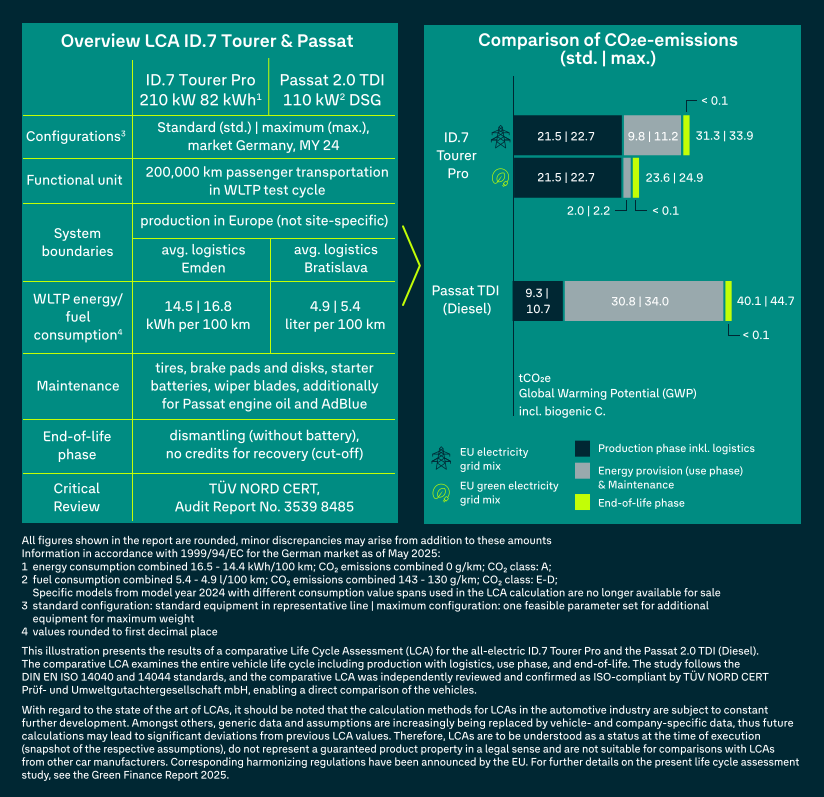
The Volkswagen Group’s second material decarbonization lever is conversion of energy supply. The Volkswagen Group is increasingly focusing on switching the power supply for its production sites to renewable energy. Moreover, the Volkswagen Group directly supports the expansion of renewable energy on an industrial scale by establishing new wind farms and solar parks in various regions of Europe, among other projects. The energy attribute certificates (EACs) of the installations are obtained for ten years under long-term contracts and provide guarantees of origin for the renewable electricity. In this context, the Volkswagen Group supports, among other projects, both solar parks in Germany and Spain and wind farms, for example, in Sweden. The wind farm supported by Volkswagen in northern Sweden, for which the Volkswagen Group has purchased 70% of all EACs, is one of the largest onshore wind farms in Europe.
Increasing energy efficiency is the third material decarbonization lever. Energy-efficient vehicle production is therefore a core element of the Zero Impact Factory strategic vision. Various actions are being implemented at production sites to increase energy efficiency, including improvements to ventilation technology, installation of LED lighting, load-dependent dryer control and the implementation of utilization-dependent plant control.
Value chain decarbonization is the fourth material decarbonization lever to achieve the GHG emission reduction targets. We consider the impacts of our products throughout the entire life cycle and at all stages of their value chain. This includes the manufacturing process with the associated extraction of raw materials, material manufacturing, supplier processes and our own production at our sites; the customer use phase including the necessary supply of charging electricity and fuel, and ultimately the dismantling of the scrap vehicle at the end of its life cycle.
No decarbonization without e-mobility
The Volkswagen Group cannot achieve decarbonization without a transition to e-mobility. Battery-electric vehicles (BEVs) play a central role here, as they do not cause any local emissions during use by our customers and their CO2e footprint is better throughout their life cycles than comparable vehicles with internal combustion engines (gasoline or diesel). The consistent electrification of our fleet paves the way to net carbon-neutral mobility for our customers, too.
Our battery-electric vehicles are manufactured at 19 sites in Europe, China and the USA. The Modular Electric Drive Matrix (MEB) and Premium Platform Electric (PPE) serve as the technical backbone of the electrification campaign. The e-offensive is to be continued with the Scalable Systems Platform (SSP) modular vehicle platform, which is currently still under development, with the aim of offering BEVs across all brand groups.
The Volkswagen Group systematically pursued its e-offensive in 2025, and will continue to do so in coming years. The reporting year saw the market launches of further all-electric models under various Group brands, including the Volkswagen GTX variant of the ID.3, the e-Transporter, the Audi A6 e-tron and the Škoda Elroq.
We are also working on improving efficiency in many models, such as with the highly efficient APP550 modular electric drive first introduced in the ID.7. This modular electric drive will gradually be deployed in additional models, for example in other ID. models, the Škoda Elroq and Enyaq, the Audi Q4 e-tron and the Cupra Tavascan. The entire ID. family has also been upgraded in terms of sustainability, for example by using recycled materials such as SEAQUAL polyester yarn made from recycled marine plastic. In addition, we are taking the next steps in the area of portfolio transformation by fundamentally realigning the entire architecture of our vehicles, for example through the Volkswagen Group’s partnership established in 2024 with US battery-electric vehicle manufacturer Rivian. The aim of the partnership is to develop next generation software-defined vehicle (SDV) architectures to be used in the future vehicles of both companies. The joint venture builds on Rivian’s existing software and electrical architecture to facilitate the joint development of best-in-class architectures and software for the SDVs of both partners.
Conversion of energy supply
Climate change mitigation in manufacturing
Volkswagen is also paying particular attention to transforming its own electricity generation. The conversion of the power plants in Wolfsburg from coal to natural gas for the Wolfsburg North/South cogeneration plant, which commenced in 2018, was completed at the end of 2021. Commissioning of the new gas and steam turbine facilities in the Wolfsburg West cogeneration plant was completed in December 2023. The last coal blocks in the Wolfsburg West cogeneration plant were shut down on April 1, 2024.
The Volkswagen Group is pushing ahead with efforts to supply its own plants with electricity from renewable sources. In 2025, around 74.5 (66.9)% of total global electricity consumption was accounted for by electricity from renewable sources. Compared with the previous year, this is a rise of 7.6 (10.6)%.
Net CO2e-neutral use phase
The Volkswagen Group is committed to achieving a net CO2e-neutral use phase for its BEVs fleet by promoting the expansion of renewable energy use. It is particularly important to ensure that the use phase of the vehicles is net CO2e-neutral in the long term, as a large proportion of CO2e emissions are generated during operation when our customers are using the vehicles. Consequently, the use of electricity from renewable sources plays a key role. In the EU, for example, almost half of the EU power mix is of non-renewable origin. The Volkswagen Group offsets the share of gray electricity (electricity from fossil energy sources) in the power mix of the entire fleet charging processes, as determined by a transparency study. To this end, VW Kraftwerk GmbH, Wolfsburg/Germany concludes long-term (ten-year) purchase agreements for green electricity certificates (EAC) with new renewable energy plants using a balance sheet approach. During the contract period, the EAC of the plants are withdrawn from the market. In this way, the calculated amount of gray electricity share is offset in the balance-sheet during the defined use phase of 200,000 km. This ensures almost net CO2e-neutral mobility for our customers in Europe during the use phase.
Energy efficiency
Increasing vehicle efficiency
In addition to the increase in renewable energies, decarbonization is also being driven by the increase in vehicle efficiency. This efficiency is basically controlled and continuously implemented by system options designed to reduce energy consumption during vehicle operation. For example, one of the options available via the driving mode selection supports fuel-efficient driving. In addition, manual-transmission vehicles offer recommendations for changing gear. An e-route planner is an optional feature in the electric ID. models for efficient route planning.
Energy efficiency in manufacturing
Increasing energy efficiency is an important element of our decarbonization strategy. A total of 10,485 (9,113) actions had already been implemented by 2025, achieving annual savings of 4.0 (3.5) million MWh. In reporting year 2025 alone, actions with a potential saving of approximately 0.5 (0.5) million MWh were implemented, including, for example, improvements to ventilation technology, heat recovery, load-dependent dryer control and the implementation of utilization-dependent plant control.
Decarbonization in the value chain
Battery production capacity
The Volkswagen Group is one of the few automotive manufacturers around the world to adopt a hands-on approach to the battery as a core e-mobility technology.
The establishment of the subsidiary PowerCo SE in 2022 integrated the development and production of battery cells into the Group’s own value chain, thus keeping a substantial part of the added value of the battery-electric vehicle within the Group.
From the new European battery hub in Salzgitter, this company manages the development of international factory operations, further development of cell technology, vertical integration of the value chain and supplies of machinery and equipment to factories.
The battery activities are primarily intended to substantially reduce the complexity and cost of this key technology so as to make battery-electric vehicles attractive and affordable for as many people as possible. They also enable a greater degree of technological independence. The central key concepts of PowerCo SE are the unified cell and the standard factory concept.
The first cell factory in Salzgitter commenced operations in 2025 and delivered the first cells for further validation within the Group. Two more cell factories are currently being built in Valencia/Spain and St. Thomas/Canada. PowerCo SE uses climate-friendly electricity to operate its cell factories. It has concluded the first long-term purchase agreements for the Salzgitter gigafactory with green electricity producers. The green electricity supply, which began in the reporting year, will amount to around 240 GWh from wind power and around 65 GWh from solar energy per year. Over the entire ten-year term, this will total around three TWh of green electricity that will be used to operate the Salzgitter gigafactory. As cell production is very electricity-intensive, using carbon-free electricity is a powerful lever for decarbonizing the process. In Salzgitter alone, the agreed contracts are expected to save around 115,000 tonnes of CO2e annually compared to the German electricity mix (based on data from 2023).
PowerCo SE is firmly committed to reducing CO2 emissions along the entire value chain of battery cell production. Strict sustainability requirements are already imposed on suppliers in the upstream supply chain and systematically monitored. These include, among other things, the use of certified electricity from renewable energy sources and compliance with defined CO2 thresholds. Continuous decarbonization actions are also planned in logistics in order to gradually reduce transportation emissions and holistically support the company’s climate goals.
PowerCo SE is pursuing ambitious decarbonization strategies in cell production. In addition to using CO2- or CO2e-free electricity, it aims to implement further actions to increase energy efficiency. These include the dry coating process and optimizations in clean rooms and dry rooms, as their high energy consumption offers particular potential for reducing emissions. Another goal is the introduction of close-to-production recycling for the reuse of production waste, which can help reduce material consumption and indirect emissions.
Requirements for decarbonization in the supply chain
The new contracts being awarded for high-voltage batteries for the European market require Volkswagen Group suppliers of relevant components to comply with CO2e limits at component level. In the case of existing supply contracts with battery manufacturers for current MEB vehicle projects, suppliers are required to use certified electricity from renewable sources in their production.
CO2 is defined as a technical feature in new vehicle projects. Suppliers within the EU are given binding CO2 targets, which they must demonstrate compliance with at all times. This applies, for example, to batteries for the new mechatronics platform. Meeting these targets requires actions in production and the upstream supply chain, such as the use of renewable energies, but also all other actions to reduce emissions.
In this way, the Volkswagen Group is specifically reducing emissions in the supply chain and the carbon footprint of its electric models. Volkswagen Group China is also working together with its suppliers on a more sustainable supply chain. Together with suppliers and partners, they are developing a roadmap for the transition to 100% renewable energies by 2030. To date, more than 500 suppliers have already signed a declaration committing to switching to electricity from renewable energy sources.
Zero Impact Logistics
The Volkswagen Group aims to further expand the shift of transport from road to rail in order to make logistics net carbon neutral in the long term. On electrified routes in Germany and other European countries, rail transportation in routine operation is almost entirely powered by green electricity from renewable energy sources. This is achieved in close cooperation with rail transport companies and contributes substantially to reducing greenhouse gas emissions along the value chain.
One example of environmentally conscious design is the transportation of high-voltage batteries for electric vehicles at the component site in Braunschweig. There the batteries are loaded onto trains fully automatically and then transported efficiently to the Zwickau plant using electricity from renewable sources.
The Volkswagen Group is also forging ahead with the transition to lower-emission solutions in road transportation. The targeted expansion of the truck network includes increased use of all-electric battery-powered trucks and the integration of biogenic fuels. These actions make an important contribution to decarbonizing logistics and complement the rail strategy in a viable way, especially in areas where shifting to rail is not possible.
In intercontinental vehicle transport, Group Logistics is focusing on a more environmentally friendly fleet strategy. Up to twelve roll-on/roll-off charter ships are used for North Atlantic traffic. Up to six of these are powered by low-emission liquefied natural gas (LNG). The ships are equipped with modern two-stroke dual-fuel engines with high-pressure technology from Everllence, which almost completely eliminate methane slip. This makes them more climate-friendly than other LNG ships.
In addition, the dual-fuel engines used will enable future operation with non-fossil fuels such as biogas (bio-LNG), synthetic e-gas, or biofuel based on renewable energies. This opens up additional potential for further reducing CO2 emissions in maritime transport.
The Volkswagen Group has also been using two charter ships powered by biofuel on European sea routes since 2021. This fuel is obtained from used cooking oils and fats – waste and residual materials from the catering and food industries that are unsuitable for further processing into food or animal feed. Using this biofuel causes significantly less CO2 than conventional fossil fuels. As such, it plays an important role in making maritime logistics more sustainable.
Decarbonization of the dealership networks
Since 2022, the CO2 emissions of the entire retail and service network have been recorded annually in category 14 “Franchises” of the Scope 3 GHG emissions.
To enable them to identify and successfully implement the correct actions for decarbonization and to reduce our impact on the environment, we provide the businesses with manuals, training – such as web-based training – as well as videos on customer communication and marketing materials. In addition, the Volkswagen Group has developed a cross-brand certification system for the entire retail network, known as the goTOzero RETAIL certification. This is based on established systems such as the ISO 14001 standard, as well as building certifications and rating systems, and also covers a dealership’s core business. Since the introduction of goTOzero RETAIL in 2023, several dealerships have already achieved gold and platinum certification levels. All 50 key retail markets, which alone account for 95% of the worldwide retail and service network, are to progressively participate in the goTOzero RETAIL certification. Currently, the scope of the certification is being expanded to “Full ESG”, with a focus on environmental topics. The success and progress of the goTOzero RETAIL project is demonstrated through regular internal and external communication.
In addition to the certifications, an energy and resource consulting concept has been developed, which is available to all markets and partner companies. Where economically and technically feasible, the Volkswagen Group strives to achieve the maximum possible energy efficiency and the use of renewable energy for newly constructed and existing retail and service buildings.
Charging and energy activities
The Volkswagen Group is consistently driving the expansion of the charging network worldwide. The Charging and Energy area plays an important role in the Volkswagen Group’s e-mobility strategy as part of the Group’s Top 10 program, and is developing integrated energy solutions for private and commercial customers worldwide through its own brands. The Volkswagen Group is accelerating the expansion of the charging infrastructure worldwide through Electrify America (North America), Elli (Europe) and the CAMS joint venture (China), as this remains a material prerequisite in ramping up e-mobility and decarbonizing individual mobility. In order to facilitate the use of electricity from renewable sources for charging and the expansion of renewable energy, the Volkswagen Group is increasingly committed to sustainable energy projects and is developing new business models in the energy sector. The aim is to charge battery-electric vehicles with electricity from renewable sources and thereby exploit their full potential.
Europe
As a charging and energy company operating across Europe, the Elli brand has set itself the task of supporting private and commercial clients with intelligent hardware and software solutions in the sustainable energy transition and advancing the decarbonization of society as a whole. The product range is broad and includes AC wallboxes and flexible fast-charging stations (Flexpole), public charging services, software solutions, energy trading and electricity supply. With the launch of a pilot project for bidirectional charging, Elli unveiled a DC charging solution at the IAA Mobility 2025; this solution connects home solar systems and electric vehicles via a modular software platform developed by Elli.
The Elli brand also offers the Volkswagen Group’s customers and commercial and private clients outside the Group access to one of Europe’s largest charging network with over a million charging points – using only a single app or charging card. In addition, the Volkswagen Group is actively expanding fast-charging points in Europe via joint ventures. IONITY, a company established by the Volkswagen Group and other manufacturers, had set up more than 5,900 fast-charging stations across Europe by the end of 2025.
The process of decarbonizing society increases the need for storage solutions for regenerative energy, in order to ensure stability and efficiency in the electricity grid. Vehicle batteries can act as a key standalone vehicle component and energy storage unit in this regard. Elli’s medium-term vision for the future is a managed battery network, in which batteries such as those in large-scale storage, electric vehicles and residential or commercial buildings can be connected to form a standardized, networked virtual power plant to harness renewable energy efficiently. Furthermore, Elli has expanded its portfolio to include energy trading as a service product for external customers, offering companies a reliable partner for structured and sustainable energy procurement.
North America
Electrify America is the largest public hyper-fast-charging network in the US. It made a significant contribution to the establishment of a national network of fast-charging points for communities and highways, and to the increasing introduction of zero-emission vehicles. Since installing its first charging station in May 2018, Electrify America’s fast-charging network in North America has grown to more than 1,000 charging stations and over 5,000 (4,700) hyper-fast charging points.
Electrify America’s leadership in energy and charging innovation was also recognized across the industry in 2025. The company received the Reuters Automotive D.R.I.V.E. Honours for Innovation Award; the Electric Innovation Scalable Catalyst Award from the Electric Innovation Initiative; the Inc. Best in Business Award in the category “Best in Innovation”; and the EV Charging Innovation Excellence Award at the Battery Show North America for its use of battery energy storage systems (BESS). To date, Electrify America has commissioned more than 170 BESS facilities, providing a total of over 65,000 kilowatt hours of energy storage capacity – the largest BESS deployment supporting hyper-fast charging in North America.
Electrify America is the largest open network of DC fast-charging points for battery-electric vehicles in the USA to enter into a VPPA for renewable energy generation. Electrify America Solar Glow™ 1 contributes to the additionality of energy generation from renewable sources.
China
As of December 31, 2025, the CAMS joint venture has installed 1,519 (1,621) charging stations with more than 11,700 (13,000) charging points in China and has more than 9.19 million registered users. In addition, CAMS has initiated a collaboration with Xpeng’s charging network in China to integrate Xpeng’s charging point data for Volkswagen Group companies. This partnership has improved both the coverage and density of the charging infrastructure for the Group’s vehicle users.
Dependency on resources for implementation of actions
The sustainable transformation requires extensive investment in digitalization and electrification. Among other things, digital transformation ensures that actions for climate change mitigation can be implemented. The budget designated for this purpose is also determined by the sustainability of the transformation, among other factors.
The cost-intensive transformation is also associated with the financing and attractiveness of the Volkswagen Group for investors seeking sustainable investment opportunities. Since 2020, the Volkswagen Group has had a Green Finance Framework in place for various forms of financing, such as green bonds, which define the framework for financial instruments geared to sustainability.
In the reporting year, we refinanced taxonomy-aligned capital expenditure from fiscal years 2022 to 2024 based on the Green Finance Framework updated in October 2022 by issuing green bonds in the amount of €2.8 billion and a green loan of €1.0 billion.
The Volkswagen Group has issued a total of €14.3 billion in green bonds and a green loan to refinance capital expenditure for BEVs since 2020. In 2022, the Volkswagen Group published a revised Green Finance Framework that was further developed in particular through the integration of the EU Taxonomy. As in the previous Green Finance Framework, the Volkswagen Group continues to focus on the inclusion of only BEVs in sustainable financing. Under the updated Green Finance Framework, only taxonomy-aligned investments are considered. This links our corporate objective of net carbon neutrality by 2050 with our financing strategy. The funds raised under the Green Finance Framework are specifically used to refinance environmentally friendly projects such as e-mobility. This not only fulfills the Clean Transportation category of the Green Bond Principles of the International Capital Market Association (ICMA) but is also in line with the Sustainable Development Goals of the United Nations and the European Union. Ratings firm Sustainalytics has confirmed that the updated Green Finance Framework complies with the ICMA’s Green Bond Principles and the Green Loan Principles of the Loan Market Association (LMA). In addition, Volkswagen Financial Services AG has been publishing its own Green Finance Framework since 2023. The funds generated under this framework are used exclusively for refinancing BEV credit and lease contracts.
Taxonomy-related CapEx and OpEx
Expanding e-mobility is the most important lever for our transformation. Our actions to expand e-mobility are in line with economic activity 3.3. Manufacture of low-carbon technologies for transport. The relevant disclosure requirements of ESRS E1 paragraph 29 (c) can be found in the “EU Taxonomy” chapter of the report.
Differences concerning operating expenditure and capital expenditure
The data disclosed under this standard on capital expenditure (CapEx) and operating expenditure (OpEx) is in line with the information reported on CapEx and OpEx in the “EU Taxonomy” chapter. There are therefore no differences to disclose.
Metrics: Climate change
Group standard 98000 sets out indicators for emissions and energy which are tracked uniformly by all sites worldwide. They include GHG emissions such as carbon dioxide (CO2), sulfur hexafluoride (SF6), nitrous oxide (N2O), chlorinated hydrocarbons (CHCs) and hydrofluorocarbons (HFCs). The data collected with respect to energy includes generation, purchase and use of fossil, nuclear and renewable energy sources, including the use of combustible materials.
We also use the unit CO2 equivalent (CO2e), which is a unit of measurement that allows the climate impact of different greenhouse gases to be presented in a comparable manner. Since gases such as methane (CH4), nitrous oxide (N2O), and fluorinated gases contribute to global warming to varying degrees, their impact is converted into a common unit based on their global warming potential (GWP): the amount of CO2 that has the same warming effect as the respective greenhouse gas.
Energy consumption and mix
For the purposes of data collection, the energy consumption and energy mixes of the worldwide production sites are recorded annually. Both self-generated energy and energy procured from external suppliers (purchased electricity) are taken into account. In addition, the renewable and nuclear shares of the energy mix are recorded separately. The relevant portion that comes from non-fuel-based renewable sources such as wind power or photovoltaics is also recorded. The Volkswagen Group’s quality criteria must be observed and appropriate documentation provided when procuring renewable energies. Quantitative metrics for energy consumption and mix are described in the following (see table):
|
|
|
|
2025 |
|
2024 |
||||||||||
|---|---|---|---|---|---|---|---|---|---|---|---|---|---|---|---|---|
|
|
Unit |
|
Volkswagen Group |
|
Companies with operational control |
|
Volkswagen Group |
|
Companies with operational control |
||||||
|
|
|
|
|
|
|
|
|
|
|
||||||
Total energy consumption |
|
million MWh |
|
19.2 |
|
5.1 |
|
19.0 |
|
5.5 |
||||||
Total energy consumption of Volkswagen Group & companies with operational control |
|
million MWh |
|
24.3 |
|
24.6 |
||||||||||
Energy consumption from fossil sources |
|
million MWh |
|
11.4 |
|
3.4 |
|
11.9 |
|
3.7 |
||||||
Coal and coal products |
|
million MWh |
|
0.0 |
|
1.0 |
|
0.8 |
|
1.0 |
||||||
Crude oil and petroleum products |
|
million MWh |
|
0.9 |
|
0.03 |
|
1.1 |
|
0.02 |
||||||
Natural gas |
|
million MWh |
|
9.3 |
|
1.0 |
|
8.7 |
|
1.1 |
||||||
Fuel from other fossil sources |
|
million MWh |
|
0.1 |
|
0.0 |
|
0.1 |
|
0.0 |
||||||
Purchased energy from fossil sources |
|
million MWh |
|
1.1 |
|
1.4 |
|
1.2 |
|
1.6 |
||||||
Energy consumption from nuclear sources |
|
million MWh |
|
0.04 |
|
0.1 |
|
0.04 |
|
0.1 |
||||||
Energy consumption from renewable sources |
|
million MWh |
|
7.8 |
|
1.6 |
|
7.1 |
|
1.7 |
||||||
Fuel – renewable |
|
million MWh |
|
1.2 |
|
0.5 |
|
1.0 |
|
0.5 |
||||||
Purchased energy – renewable |
|
million MWh |
|
6.5 |
|
1.1 |
|
6.0 |
|
1.2 |
||||||
Purchased energy – renewable, electric |
|
million MWh |
|
5.5 |
|
1.1 |
|
5.7 |
|
1.1 |
||||||
Share of renewable electricity purchased bundled1 |
|
% |
|
90.3 |
|
18.3 |
|
65.4 |
|
0.9 |
||||||
Share of renewable electricity purchased unbundled1 |
|
% |
|
9.7 |
|
81.7 |
|
34.6 |
|
99.1 |
||||||
Self-generated energy – renewable, non-fuel2 |
|
million MWh |
|
0.1 |
|
0.0 |
|
0.1 |
|
0.0 |
||||||
|
||||||||||||||||
Contractual instruments for the procurement of renewable electricity
A distinction is made regarding procurement of electricity from renewable sources between bundled and unbundled procurement. Bundled means that the certificates of origin, renewable energy certificates or green electricity certificates are purchased together with the green electricity product (not separately) from a supplier. Unbundled means that electricity and guarantees of origin are supplied separately.
A distinction is currently made between the following contracts:
- On-site power purchase agreements
- Off-site power purchase agreements
- Other contracts
Energy intensity
Energy intensity is the quotient of total energy consumption over sales revenue. Sales revenue is taken from the consolidated financial statements, where more detailed information can be found. Energy intensity is reported excluding the companies with operational control.
|
|
Unit |
|
2025 |
|
2024 |
||||
|---|---|---|---|---|---|---|---|---|---|---|
|
|
|
|
|
|
|
||||
Energy intensity for activities in high climate impact sectors (energy consumption per sales revenue) |
|
kWh/€ |
|
0.06 |
|
0.059 |
||||
Total energy consumption from activities in high climate impact sectors1 |
|
million MWh |
|
19.2 |
|
19.0 |
||||
Sales revenue from activities in high climate impact sectors |
|
€ million |
|
321,913 |
|
324,656 |
||||
Total sales revenue (financial statements) |
|
€ million |
|
321,913 |
|
324,656 |
||||
|
||||||||||
High climate impact sectors to determine energy intensity
All activities within the Volkswagen Group contribute to vehicle production and relate to NACE code C.29.10 (Manufacture of motor vehicles). They are therefore associated with activities in high climate impact sectors.
Energy generation
Self-generated energy includes energy from plants owned, rented, or leased and operated by the Volkswagen Group (for example, power plants, cogeneration plants, boiler houses). This also applies to the company’s own energy generation systems operated by third parties.
|
|
|
|
2025 |
|
2024 |
||||||||
|---|---|---|---|---|---|---|---|---|---|---|---|---|---|---|
|
|
Unit |
|
Volkswagen Group |
|
Companies with operational control |
|
Volkswagen Group |
|
Companies with operational control |
||||
|
|
|
|
|
|
|
|
|
|
|
||||
Total energy generation |
|
million MWh |
|
6.1 |
|
0.3 |
|
6.4 |
|
0.3 |
||||
Total energy generation of Volkswagen Group & companies with operational control |
|
million MWh |
|
6.3 |
|
6.7 |
||||||||
Non-renewable energy generated1 |
|
million MWh |
|
5.2 |
|
0.2 |
|
5.6 |
|
0.2 |
||||
Renewable energy generated1 |
|
million MWh |
|
0.9 |
|
0.05 |
|
0.8 |
|
0.05 |
||||
|
||||||||||||||
GHG emissions
Metrics on Scope 1 and Scope 2 GHG emissions
Scope 1 GHG emissions are direct GHG emissions that are generated by the Volkswagen Group through sources it controls itself, such as through the use of fuels at the sites. Direct biogenic CO2 emissions (Scope 1) are emissions that result from the use of biogenic fuels at the sites. The Verband der Automobilindustrie (VDA – German Association of the Automotive Industry) emission factors are used to calculate the emissions.
Scope 2 GHG emissions are indirect CO2 emissions from energy generation that are generated as a result of purchasing energy from external power plants, cogeneration plants and boiler houses and that are released elsewhere. Scope 2 GHG emissions are calculated using both the market-based and location-based methods in accordance with the GHG Protocol. Indirect location-based biogenic CO2 emissions are emissions that result from the use of biogenic fuels by external energy suppliers, for example generation of electrical energy or heat, and are assessed using local emission factors. The current VDA emission factors are used to calculate the emissions.
|
|
|
|
2025 |
|
2024 |
||||
|---|---|---|---|---|---|---|---|---|---|---|
|
|
Unit |
|
Volkswagen Group |
|
Companies with operational control |
|
Volkswagen Group |
|
Companies with operational control |
|
|
|
|
|
|
|
|
|
|
|
Scope 1 GHG emissions |
|
million tonnes of CO2e |
|
2.4 |
|
0.3 |
|
3.0 |
|
0.3 |
Total Scope 1 GHG emissions of Volkswagen Group & companies with operational control |
|
million tonnes of CO2e |
|
2.7 |
|
3.3 |
||||
of which: TRATON GROUP |
|
million tonnes of CO2e |
|
0.2 |
|
0.0 |
|
0.1 |
|
0.0 |
Everllence |
|
million tonnes of CO2e |
|
0.05 |
|
0.0 |
|
0.03 |
|
0.0 |
Scope 1 biogenic GHG emissions |
|
million tonnes of CO2e |
|
0.4 |
|
0.2 |
|
0.4 |
|
0.2 |
Share of Scope 1 GHG emissions in regulated ETS |
|
% |
|
82.2 |
|
14.3 |
|
84.4 |
|
18.2 |
Scope 2 GHG emissions |
|
million tonnes of CO2e |
|
2.6 |
|
1.4 |
|
2.6 |
|
1.6 |
Total Scope 2 GHG emissions |
|
million tonnes of CO2e |
|
4.0 |
|
4.2 |
||||
of which: TRATON GROUP |
|
million tonnes of CO2e |
|
0.3 |
|
0.0 |
|
0.3 |
|
0.0 |
Everllence |
|
million tonnes of CO2e |
|
0.03 |
|
0.0 |
|
0.03 |
|
0.0 |
Scope 2 biogenic GHG emissions |
|
million tonnes of CO2e |
|
0.5 |
|
0.1 |
|
0.4 |
|
0.1 |
Scope 2 GHG emissions |
|
million tonnes of CO2e |
|
0.4 |
|
0.6 |
|
0.5 |
|
0.7 |
Total Scope 2 GHG emissions |
|
million tonnes of CO2e |
|
0.9 |
|
1.1 |
||||
of which: TRATON GROUP |
|
million tonnes of CO2e |
|
0.1 |
|
0.0 |
|
0.1 |
|
0.0 |
Everllence |
|
million tonnes of CO2e |
|
0.01 |
|
0.0 |
|
0.01 |
|
0.0 |
Methodologies, assumptions and emission factors used to measure Scope 1 and Scope 2 GHG emissions
The GHG emissions (Scope 1 and 2) of the production sites are calculated annually pursuant to the requirements of the GHG Protocol and the ESRS. Provider-specific factors are applied for market-based CO2 emission calculation, whereas VDA country emission factors are used for location-based calculation.
The total GHG emissions of the site are determined by adding all relevant emissions, each multiplied by their global warming potential. The CO2 emission factors for on-site consumption of primary energy sources for heat or power generation are calculated from the heating values or calorific values of the fuels and the efficiency of the on-site generation system.
Identifying and disclosing material Scope 3 categories
Metrics on Scope 3 GHG emissions
In line with the Scope 3 standard (GHG Protocol) published by the World Business Council for Sustainable Development and the World Resources Institute and the ESRS, we are reporting the CO2e emissions for all 15 Scope 3 categories in 2025. Whereas in the previous year there was a separate table for each business area, the table below shows the Scope 3 GHG emissions of the Volkswagen Group, including the Chinese joint ventures, based on the methodological guidance on recording and calculation presented in the “Methodologies, assumptions and emission factors used to measure Scope 3 GHG emissions” section.
Categories 2, 6, 7, 8 and 13 are reported at Group level, while categories 1, 3, 4, 5, 9, 10, 11, 12 and 14 are collected separately for the business area Passenger Cars and Light Commercial Vehicles (brand groups Core, Progressive and Sport Luxury), Commercial Vehicles (TRATON GROUP: Scania, MAN, VW Truck & Bus (VWTB), International) and Power Engineering (Everllence). Category 15 is reported for the Automotive division, in this case for the Commercial Vehicles business area only. The detailed methodological explanations are therefore provided either at Group or business area level. In categories 3 and 5, as well as in the total figure for the Group’s Scope 3 GHG emissions, the sum of the business areas differs from the total figure for the Group because emissions outside the three defined business areas are included in the Group figure. Light commercial vehicles under the MAN brand are currently within the reporting scope for both business areas Passenger Cars and Commercial Vehicles. The plan is to eliminate this double-counting in the next report.
Around 11.8% (12.1%) of total Scope 3 emissions fall under the emission category Purchased goods and services, while 85.2% (84.4%) arise due to the use of sold products (well-to-wheel emissions).
In million tonnes of CO2e |
|
2025 |
|
2024 |
||||
|---|---|---|---|---|---|---|---|---|
|
|
|
|
|
||||
Total |
|
883.74 |
|
824.00 (812.01)1 |
||||
of which: Passenger Cars and Light Commercial Vehicles |
|
386.53 |
|
398.76 (391.33)1 |
||||
Commercial Vehicles |
|
304.91 |
|
357.82 (353.25)1 |
||||
Power Engineering |
|
178.71 |
|
50.16 |
||||
Category 1: Purchased goods and services |
|
104.44 |
|
99.95 (96.91)1 |
||||
of which: Passenger Cars and Light Commercial Vehicles |
|
96.85 |
|
91.50 (87.35)1 |
||||
Commercial Vehicles |
|
6.82 |
|
7.32 (8.44)1 |
||||
Power Engineering |
|
0.77 |
|
1.13 |
||||
Category 2: Capital goods |
|
8.33 |
|
9.71 |
||||
Category 3: Fuel- and energy-related emissions |
|
1.29 |
|
1.34 |
||||
of which: Passenger Cars and Light Commercial Vehicles |
|
1.09 |
|
– |
||||
Commercial Vehicles |
|
0.11 |
|
– |
||||
Power Engineering |
|
0.02 |
|
– |
||||
Category 4: Upstream transportation and distribution |
|
6.73 |
|
7.75 (5.64)1 |
||||
of which: Passenger Cars and Light Commercial Vehicles |
|
5.82 |
|
6.50 (4.29)1 |
||||
Commercial Vehicles |
|
0.85 |
|
1.13 (1.23)1 |
||||
Power Engineering |
|
0.07 |
|
0.12 |
||||
Category 5: Waste |
|
1.64 |
|
1.28 |
||||
of which: Passenger Cars and Light Commercial Vehicles |
|
0.97 |
|
– |
||||
Commercial Vehicles |
|
0.59 |
|
– |
||||
Power Engineering |
|
0.03 |
|
– |
||||
Category 6: Business travel |
|
0.22 |
|
0.22 |
||||
Category 7: Employee commuting |
|
0.31 |
|
0.33 |
||||
Category 8: Upstream leased assets |
|
0.18 |
|
0.14 |
||||
Category 9: Downstream transportation and distribution |
|
Included in Category 4 |
||||||
Category 10: Processing of sold products |
|
0.20 |
|
0.20 (0.15)1 |
||||
of which: Passenger Cars and Light Commercial Vehicles |
|
Included in Scope 1 |
||||||
Commercial Vehicles |
|
0.20 |
|
0.20 (0.15)1 |
||||
Power Engineering |
|
Not material |
||||||
Category 11: Use of sold products |
|
752.57 |
|
695.16 (688.34)1 |
||||
of which: Passenger Cars and Light Commercial Vehicles |
|
279.15 |
|
297.97 (296.90)1 |
||||
Commercial Vehicles |
|
295.59 |
|
348.26 (342.52)1 |
||||
Power Engineering |
|
177.83 |
|
48.92 |
||||
Category 12: End-of-life treatment of sold products |
|
0.91 |
|
1.15 (1.16)1 |
||||
of which: Passenger Cars and Light Commercial Vehicles |
|
0.45 |
|
0.54 |
||||
Commercial Vehicles |
|
0.47 |
|
0.61 (0.62)1 |
||||
Power Engineering |
|
Not material |
||||||
Category 13: Downstream leased assets |
|
4.42 |
|
4.23 |
||||
Category 14: Franchises |
|
2.49 |
|
2.54 |
||||
of which: Passenger Cars and Light Commercial Vehicles |
|
2.20 |
|
2.25 |
||||
Commercial Vehicles |
|
0.29 |
|
0.29 |
||||
Power Engineering |
|
Not material |
||||||
Category 15: Investments |
|
0.01 |
|
0.01 |
||||
|
||||||||
Biogenic Scope 3 GHG emissions at Group level
Biogenic CO2 is reported for Scope 3 category 11 for Passenger Cars and Light Commercial Vehicles, and Commercial Vehicles. The data on the biofuel proportion and average emission factors is taken from representative generic databases. In the reporting year, biogenic Scope 3 GHG emissions amounted to 26.81 million tonnes of CO2.
Methodologies, assumptions and emission factors used to measure Scope 3 GHG emissions
Category 1: Purchased goods and services
Passenger Cars and Light Commercial Vehicles
The category 1 CO2e emissions relate to the supply chain emissions of all passenger cars and light commercial vehicles produced in the reporting year (including contract manufacturing since 2025, particularly from the cooperation with Ford). They were calculated on the basis of 73 production-volume-weighted life cycle assessments (LCAs). All vehicle LCAs for passenger cars and light commercial vehicles have been independently certified in accordance with ISO 14040/44, mainly by TÜV NORD CERT GmbH. As of 2025, new life cycle assessments are calculated with IPCC AR6 emission factors.
The Volkswagen Group uses the electricity grid mix as standard for assessing the production phase of vehicles and, at the same time, includes certificates for renewable energies from suppliers to highlight joint decarbonization efforts. This combination of location-based and market-based approaches may result in a minor degree of double counting of the renewable energy share. A fully market-based approach will be possible as soon as the relevant emission factors are available in the databases the Volkswagen Group uses.
Figure in the base year (2018): 100.57 million tonnes of CO2e
Commercial Vehicles
Emissions from purchased goods are calculated using volumes and weights of vehicles and components together with the corresponding CO2e emission factors. Purchased services (IT, supplies, packaging and sales marketing) are scoped out due to their minimal impact (<1%). All brands categorize comparable products into reference groups and apply LCA-based emission factors using their respective data sources.
Power Engineering
A spend-based approach is used for the Scope 3 calculation. This category’s CO2e emissions relate to the supply chain emissions of all goods and services purchased in the reporting year. They are calculated on the basis of the invoice volume in euros.
Category 2: Capital goods
The calculation of emissions from capital goods is based on financial data from the Volkswagen Group and the use of inflation-adjusted emission factors. As of 2025, these emission factors take account of average global inflation.
Figure in the base year (2018): 10.18 million tonnes of CO2e
Category 3: Fuel- and energy-related emissions (not included in Scope 1 or 2)
As of reporting year 2025, the business areas are presented separately. The Group figure includes emissions outside the three defined business areas.
Figure in the base year (2018): 1.51 million tonnes of CO2e
Passenger Cars and Light Commercial Vehicles
Energy consumption across the Volkswagen Group is recorded annually in the internal EIS and converted into CO2e using emission factors (according to IPCC AR6 since 2025) for the various energy sources from a representative generic database. The emission factors are regionally differentiated where possible.
Commercial Vehicles
This category includes upstream emissions from fuels and energy used at the sites. Energy consumption within the TRATON GROUP is recorded annually in internal environmental IT systems, differentiated by fuel type, and converted into CO2e using specific emission factors from the respective data sources for the relevant energy sources.
Power Engineering
Methodology same as Passenger Cars and Light Commercial Vehicles
Category 4: Upstream transportation and distribution
Passenger Cars and Light Commercial Vehicles
Categories 4 and 9 correspond to the CO2e emissions from energy source supply and use, both from inbound and outbound shipments and transportation processes between the sites (inter-plant transport). Transportation data is manually derived from internal transport IT systems for all modes of transport and manually recorded processes. Reduction actions are certified by TÜV NORD CERT GmbH. As of 2025, emissions are extrapolated to the entire Group production volume and thus also take into account the Chinese joint ventures. The previous reporting year’s emissions are reported for procedural reasons. The system includes a marginal proportion of biogenic emissions.
Figure in the base year (2018): 7.59 million tonnes of CO2e
Commercial Vehicles
This category includes emissions from inbound (upstream) and outbound (downstream) logistics across all modes of transport. The transport data comes from internal logistics systems as well as manually recorded processes for all transport types within the TRATON GROUP. The emission factors originate from different databases depending on the brand. Scania and VWTB use an activity-based calculation method. MAN applies a cost-based approach. For International, the calculation is carried out by an external service provider.
Power Engineering
The calculation is based on a distance-based approach. The figures from Logistics relate to the Everllence production sites’ in- and outbound shipments and transportation processes. Emissions are extrapolated on the basis of revenue data.
Category 5: Waste
As of this reporting year, the business areas are presented separately. The Group figure includes emissions outside the three defined business areas.
Figure in the base year (2018): 1.21 million tonnes of CO2e
Passenger Cars and Light Commercial Vehicles
Waste across the Volkswagen Group is recorded annually in the internal EIS and converted into CO2e using emission factors (according to IPCC AR6 since 2025) for the various waste streams from a representative generic database.
Commercial Vehicles
Waste generated across the TRATON GROUP is recorded annually in internal environmental IT systems and converted into CO2e using emission factors from different databases for the respective waste streams. Regional variations in waste management practices are reflected where applicable.
Power Engineering
Methodology same as Passenger Cars and Light Commercial Vehicles
Category 6: Business travel
The emissions are calculated based on Volkswagen AG’s actual air and rail travel among other factors, and extrapolated for the Group based on the number of employees worldwide. The radiative forcing index of air traffic is taken into account at a factor of 3.
Figure in the base year (2018): 0.71 million tonnes of CO2e
Category 7: Employee commuting
The emissions are based on a calculation that takes into account the number of employees (direct and indirect) of the Volkswagen Group worldwide, the region-specific, external, generic parameters for the modal split, transport-mode-specific emission factors, average commuting distances and working days.
Figure in the base year (2018): 1.01 million tonnes of CO2e
Category 8: Upstream leased assets
The calculation of emissions from leased assets is based on financial data from the Volkswagen Group and the use of inflation-adjusted emission factors. As of 2025, these emission factors take account of average global inflation.
Figure in the base year (2018): 0.14 million tonnes of CO2e
Category 9: Downstream transportation and distribution
Included in Scope 3 category 4: Upstream transportation and distribution
Category 10: Processing of sold products
Passenger Cars and Light Commercial Vehicles
Included in Scope 1
Commercial Vehicles
Emissions are calculated based on the assumption that processing emissions per vehicle is equivalent to production emissions per vehicle. Scope 1 and Scope 2 emissions are divided by the total number of vehicles sold and multiplied by the number of rigids sold.
Power Engineering
Not material for Everllence.
Category 11: Use of sold products
Passenger Cars and Light Commercial Vehicles
The CO2e emissions comprise the well-to-wheel emissions of all passenger cars and light commercial vehicles produced in 2025 (including contract manufacturing since 2025) at an assumed lifetime mileage of 200,000 km. Since 2025, the calculation has been based on average drivetrain-specific fleet emissions (g CO2/km) instead of weighted average fleet emissions, and average electrical energy consumption in the main markets of Europe (EU27, United Kingdom, Norway and Iceland), China and the USA, in accordance with the currently applicable driving cycles. Region-specific emission factors for fuel and electricity supply chains from a representative generic database are used to calculate the corresponding well-to-tank emissions (since 2025 according to IPCC AR6). Reduction actions are certified by TÜV NORD CERT GmbH.
Figure in the base year (2018): 414.87 million tonnes of CO2e
Commercial Vehicles
Emissions from the use of sold products by our customers represent the largest share of TRATON GROUP’s total emissions. For vehicles, CO2e emissions are calculated based on the number of vehicles, energy consumption, kilometers driven, and well-to-wheel emission factors. All brands apply the same overall approach, which relies on their product portfolios as well as operational, telematics, or development data. However, each brand has differently grouped vehicle classes due to variations in product portfolios. Scania uses production volume, while MAN, International, and VWTB use sales volume. The assumed use phase varies depending on the brand and model between 240,000 km and 1,600,000 km. Dynamic emission factors from different data sources are applied in the calculation, including emissions from AdBlue, CH4, and N2O. For external engines, Scania and MAN estimate fuel consumption using expert knowledge and multiply this by the corresponding CO2e emission factors; International and VWTB do not sell external engines.
Power Engineering
An average-based approach based on secondary data is used for the calculation. The CO2e emissions are calculated using well-to-wake emission factors. Systems commissioned in the year are taken into account by calculating their lifetime emissions. New products from Marine 4-Stroke, Power, Industries & Quest-One are also taken into account. Representative emission factors are used on both a region-specific and a sector-specific level.
Category 12: End-of-life treatment of sold products
Passenger Cars and Light Commercial Vehicles
The CO2e emissions relate to the potential end-of-life emissions of all passenger cars and light commercial vehicles produced in the reporting year (including contract manufacturing since 2025). They were calculated on the basis of 73 production-volume-weighted LCAs. All vehicle LCAs for passenger cars and light commercial vehicles have been independently certified in accordance with ISO 14040/44. As of 2025, new LCAs are calculated with IPCC AR6 emission factors.
Figure in the base year (2018): 1.15 million tonnes of CO2e
Commercial Vehicles
The category 12 emissions relate to the potential end-of-life emissions of all vehicles sold in the reporting year. Emissions are calculated by applying intensity factors from Scania’s and MAN’s life cycle assessment models to the total weights of each product group. The intensity factors are applied to common product groupings used by Scania, International and VWTB, while MAN uses a more detailed product classification.
Power Engineering
Category 12 is not reported for Everllence due to low materiality. This is based on the assumption that Everllence products are almost 100% recyclable at the end of their life. The CO2e emissions that arise from recycling are excluded using a cut-off-approach.
Category 13: Downstream leased assets
The calculation of emissions from leased assets is based on financial data from the Volkswagen Group and the use of inflation-adjusted emission factors. As of 2025, these emission factors take account of average global inflation.
Figure in the base year (2018): 2.96 million tonnes of CO2e
Category 14: Franchises
Passenger Cars and Light Commercial Vehicles
The previous reporting year’s emissions are reported for procedural reasons. The calculation is based on an annual evaluation of the CO2e emissions of the Volkswagen Group’s retail and service partners on the basis of the sites’ energy consumption and country-specific emission factors. The latter come from a representative generic database (since 2025 according to IPCC AR6). The data collected covers over 90% of the emissions from franchises that will subsequently be extrapolated to 100%.
Figure in the base year (2018): 3.22 million tonnes of CO2e
Commercial Vehicles
Franchise emissions for Scania and MAN are calculated using the average Scope 1 and Scope 2 emissions of a standard commercial site. This approach reflects typical energy consumption and operational characteristics. VWTB and International are not included in this category because they do not have franchises.
Power Engineering
Not material for Everllence.
Category 15: Investments
Due to low materiality, this category is not reported for the Passenger Cars and Light Commercial Vehicles business area as well as for Power Engineering. The Group figure is therefore the figure for the Commercial Vehicles business area. The emissions from Scania and MAN’s investments are calculated based on the companies’ equity interest in the investments. Scania and MAN identify their key interests and collect the required Scope 1 and Scope 2 data either from available reports, or if necessary, via questionnaires. VWTB and International are excluded as they provide no financial resources to external undertakings.
Material changes and their effect on the comparability of GHG emissions
Changes compared to the previous year’s reporting are explained in the “Metrics on Scope 3 GHG emissions” section, in the methodology description for each Scope 3 category.
As described in the “Targets: Climate change” section, significant changes in the recording of Scope 3 GHG emissions for Group categories and the Passenger Cars and Light Commercial Vehicles business area are identified in an annual process, quantified as part of the recalculation of the base year, and presented in the table on Scope 3 GHG emissions.
For the DCI, the entire time series since the base year for the current climate change mitigation targets (2018) is published on a comparable data basis.
The emissions from the supply chains are currently calculated primarily using secondary data, specifically industry averages. Immaterial changes to this data are not specifically assessed in terms of their impact on the overall outcome.
Scope 3 GHG emissions based on specific activities in the value chain
The vehicle model for passenger cars and light commercial vehicles and therefore all materials integrated in a vehicle and their weights are based on the vehicle bill of materials and therefore on primary data. Primary data from Tier-1 suppliers is available for individual hotspot materials or components. The same will apply in future for the battery (cell) production processes required in EU Batteries Regulation Article 7. As yet, there is no recognized or standardized method of indicating the proportion of these emissions. Neither an indication as a share of datapoints nor as a share of total GHG emissions is entirely meaningful, because, for example, the proportion of emissions from decarbonized hotspot parts is naturally decreasing.
Total GHG emissions
The total GHG emissions metrics are calculated from the sum of the total emissions of the Scope 1, 2 and 3 categories.
|
|
Unit |
|
2025 |
|
2024 |
||||
|---|---|---|---|---|---|---|---|---|---|---|
|
|
|
|
|
|
|
||||
Total GHG emissions – location-based1 |
|
million tonnes of CO2e |
|
890.4 |
|
831.5 |
||||
Total GHG emissions – market-based1 |
|
million tonnes of CO2e |
|
887.4 |
|
828.5 |
||||
|
||||||||||
GHG intensity
GHG intensity is calculated from the metrics for total GHG emissions and sales revenue. Sales revenue is taken from the consolidated financial statements, where more detailed information can be found. The GHG intensity metric is reported excluding the companies with operational control.
|
|
Unit |
|
2025 |
|
2024 |
||||
|---|---|---|---|---|---|---|---|---|---|---|
|
|
|
|
|
|
|
||||
Total GHG emissions per sales revenue – location-based1 |
|
kg CO2e/€ |
|
2.3 |
|
2.1 |
||||
Total GHG emissions per sales revenue – market-based1 |
|
kg CO2e/€ |
|
2.3 |
|
2.1 |
||||
Sales revenue used to calculate GHG intensity |
|
€ million |
|
321,913 |
|
324,656 |
||||
Total sales revenue (financial statements) |
|
€ million |
|
321,913 |
|
324,656 |
||||
|
||||||||||
GHG removals and GHG mitigation projects
GHG removal and storage
No actions have been implemented for the removal and storage of GHGs in the Group’s own business activities or value chain. If such actions are introduced in the future, a distinction is intended to be made between technology-based and nature-based solutions. Technology-based solutions should be based on specific counting, weighing and measurement of the GHGs removed from the atmosphere; assumptions, methodologies and frameworks shall not be applied. Nature-based solutions, on the other hand, should be based on assumptions, methodologies and frameworks of major established standards in the carbon market, such as VERRA and Gold Standard.
Metrics on GHG removal and storage
No metrics on GHG removal or storage are reported, as no actions for removing and storing GHGs have yet been implemented in the Group’s own operations or in the value chain.
Use of carbon credits
In line with the hierarchy of actions set out in the transition plan, the offsetting projects enhance our decarbonization strategy and, as explained in the transition plan, are an important factor in achieving the decarbonization targets.
It is currently not possible to meet global energy requirements with a carbon-free energy supply. Energy efficiency therefore remains an important basis for effective climate change mitigation and should always be the first lever.
Ultimately, the aim is to meet the remaining energy requirements in a manner that is as carbon efficient as possible (second priority lever). In this context, innovative energy concepts, the direct integration of renewable energies, and technological changes, such as electrification, must also be reviewed.
In the area of hard-to-abate emissions, the Volkswagen Group is considering using climate change mitigation projects to offset said emissions and, for example, to achieve net CO2e-neutral production (third priority lever). Emissions are considered to be hard to abate if avoiding them is either not currently technically possible or would be disproportionately expensive and therefore not economically feasible.
Role of carbon credits as part of the decarbonization strategy
The carbon offsetting approach is to be used for all emission categories from Scope 1 to Scope 3. Once all actions to increase efficiency and reduce emissions as outlined in our transition plan have been implemented, we intend to offset particularly hard-to-abate emissions through carbon offset projects. This will affect less than 10% of emissions and is based on the requirements of the SBTi.
Metrics on carbon credits
As a general rule, the carbon credits used by the Volkswagen Group must meet the highest quality standards. For this reason, they are only acquired from certain project types and from appropriately prequalified companies. The Volkswagen Group only accepts certain issuing standards for the carbon credits themselves.
The underlying projects are implemented in accordance with publicly verifiable and scientifically based methodologies. The results of these projects are verified by independent third parties.
Each carbon credit used by the Volkswagen Group represents -1 tonne of CO2e. After purchase, the carbon credit is generally transferred to the Volkswagen Group accounts and only then used thereafter (usually at a later date).
|
|
Unit |
|
2025 |
|
2024 |
|---|---|---|---|---|---|---|
|
|
|
|
|
|
|
Total carbon credits canceled in the reporting year |
|
tonnes of CO2e |
|
680,379 |
|
6,076,738 |
Share of projects to reduce CO2 emissions |
|
% |
|
0 |
|
0 |
Removal projects from biogenic reductions |
|
%/tonnes of CO2e |
|
0 |
|
0 |
Removal projects from technological reductions |
|
%/tonnes of CO2e |
|
0 |
|
0 |
Share of projects to reduce CO2 emissions |
|
% |
|
100 |
|
100 |
VERRA share |
|
%/tonnes of CO2e |
|
56/383,784 |
|
70/4,232,578 |
Gold Standard share |
|
%/tonnes of CO2e |
|
44/296,595 |
|
30/1,844,460 |
Share of projects within the EU |
|
% |
|
– |
|
– |
Share deemed the corresponding adjustment to Article 6 of the Paris Climate Agreement |
|
% |
|
– |
|
– |
Net zero target taking account of carbon credits
It is the Volkswagen Group’s aim to be a net carbon-neutral company by 2050. However, there are as yet no valid certification standards for a binding net zero target. This means that there are also no specific targets for the removal and storage of GHG emissions. Nevertheless, the Volkswagen Group has set itself the goal of basing its carbon offsetting actions on the requirements of the SBTi and the GHG Protocol and to limit their share to below 10%. When applying carbon offsetting, the Company will abide by internationally recognized standards.
Internal carbon pricing
We do not currently use an internal carbon price in investment decisions. However, we apply an abatement cost approach to support strategic decisions and to calculate and prioritize decarbonization actions in production. This involves considering abated GHG emissions in relation to net present value. This results in a value expressed in €/tonnes of CO2e. This assessment produces an abatement cost curve, from savings per tonne of CO2e (energy efficiency actions) to high costs per tonne of CO2e (use of synthetic fuels). This abatement cost curve helps to prioritize actions and estimate the total expenditure required to achieve the goal.
1 Due to changing political and economic conditions and volatile markets, it is not possible at present to reliably identify a 1.5°C climate transition pathway, for which there are currently no final requirements from the SBTi, particularly for Scope 3 emissions, which we cannot directly influence and which depend heavily on sales of all-electric vehicles.