
Resource Use and Circular Economy
The finite nature of natural resources as well as the social and ecological consequences of raw material extraction, make the development of a circular economy a key sustainability topic for us.
Material impacts and risks and their interaction with strategy and business model
Intensification of the circular use of materials helps to reduce the negative environmental impact of resource consumption and counteract the scarcity of raw materials, thus making it a central sustainability topic for the Volkswagen Group.
IMPACTS IN THE AREA OF RESOURCE INFLOWS, INCLUDING RESOURCE USE, RESOURCE OUTFLOWS AND WASTE
| Description | Impact/Risk/ Opportunity | Actual/Potential Impact | Value Chain | Time Horizon | ||||
|
Resource inflows, including Resource use |
|
|
|
|
||||
|
Using secondary/recycled materials reduces the use of non-renewable resources and makes resource use more sustainable, thus extending the service life of resources while reducing greenhouse gas emissions and making supply chains more resilient. |
|
|
|
|
||||
|
|
|
|
||||||
|
This impact arises from the extensive use of non-renewable resources in conjunction with the resource intensity of the automotive sector. |
|
|
|
|
||||
|
Raw material procurement costs will rise due to proposed future legal obligations to use specific recycled plastic recyclates. This could lead to a reduction in margins as well as in the profitability of the Volkswagen Group, if the price increases cannot be passed on to customers in full. |
|
|
|
|
||||
|
Fluctuating and, in some cases, limited availability of raw materials needed for battery production, as well as the tightening of statutory regulations for recycling used batteries, may result in higher purchase prices or even limit availability (e.g. of used batteries). This could lead to a reduction in margins as well as in the profitability of the Volkswagen Group, if the price increases cannot be passed on to customers in full. |
|
|
|
|
||||
|
Due to the upcoming tightening of legislation (Euro 7), it is likely that tires with excessive abrasion, and thus an excessive release of microplastics into the environment, will no longer be approved for use in the future, or that compensation payments will have to be made for such tires. Costs may rise as a consequence, as only a few tires are currently meet the anticipated threshold values. These tires could in turn become significantly more expensive, both due to higher raw material prices and increasing demand combined with current reduced availability. |
|
|
|
|
||||
|
Outflows |
|
|
|
|
||||
|
The Group contributes to the circular economy in a variety of ways, reducing resource outflow by promoting the reusability of products and extending the service life of products by offering repair services. |
|
|
|
|
||||
|
|
|
|
||||||
|
Product manufacturing that includes non-renewable resources, along with the current challenges in recycling and reparability within the downstream value chain, are reducing resource use. |
|
|
|
|
||||
|
Challenges such as the insufficient availability of recycled materials and quality issues with recyclates could, for example, result in failure to meet the proposed regulatory recycling quota. According to the current draft of the new Directive on end-of-life vehicles, this could lead to the non-issuance of type approval in the EU in the medium term. Furthermore, from a regulatory perspective, clarification is needed on how the goal of a circular economy will be governed in connection with banned materials in future. |
|
|
|
|
||||
|
Waste |
|
|
|
|
||||
|
Waste is generated from the extraction of raw materials, to production, to the end of the use phase of vehicles. |
|
|
|
|
||||
|
|
|
|


|
|
Opportunity |
|
Positive |
|
Actual Impact |
|
Upstream |
|
Short-term |
|||||||||
|
|
Risk |
|
Negative |
|
Potential Impact |
|
Own Operation |
|
Medium-term |
|||||||||
|
|
Downstream |
|
Long-term |
|||||||||||||||


Interaction with strategy and business model
The impacts and risks identified in the materiality assessment have an influence on the Group’s business model, strategy and value chain. The overarching topic is circular economy and resource inflows, which is strategically anchored within the Group sustainability strategy regenerate+. In addition, the Group Strategy Framework for circular economy was adopted at Group level in October 2025. Key elements of this include the increasing circular use of materials, the introduction and establishment of relevant circular economy strategies as well as the evaluation of new business models. In addition to access to and use of secondary materials in recycling, the framework also covers the topic of redesign, which aims to make circularity a mandatory consideration already during the development process and the planning of vehicle projects. There is also a legal imperative to ensure access to secondary and raw materials from end-of-life vehicles, for example through the Group’s own access to and recycling of these vehicles. Remanufacturing and used parts can also ensure that vehicle parts are available at fair market value even for price-sensitive target groups. In order to extend the service life of vehicle parts, the topic of second life is taken into account under reuse. New business models are continuously being explored with the individual Group brands, based on relevant circular economy strategies and prioritized according to scaling potential and synergy effects. The environmental mission statement goTOzero also focuses on further improving resource efficiency and approaches for reusing and recycling materials. In addition, the topic of resource efficiency is embedded in the Code of Conduct for Business Partners.
The Volkswagen Group responds to these impacts and risks to its business model, strategy and value chain in the area of circular economy and resource inflows by taking the following measures to mitigate negative impacts and risks and strengthen positive impacts:
The identified impacts and risks related to resource inflows, including resource use, affect the upstream value chain and the Group’s own operations. In the area of resource inflows, including resource use, the use of primary raw materials, for example, will be reduced through the use of recyclates and renewable raw materials as well as cross-brand working structures will be developed for a circular and resource-efficient business approach. The impacts and risks identified in connection with resource outflows related to products and services concern both the Group’s own business operations and the downstream value chain. In vehicle development, measures are being taken based on reparability and recycling, for example with plastic components labeled for easy identification later and to enable separation by material type.
The waste-related impacts identified are found along the value chain. To counteract these, production waste is recycled at Group sites, and a waste management system is implemented to reduce waste volumes and recycle unavoidable waste. By closing loops, the amount of waste generated is to be further minimized.
By taking additional actions throughout the entire life cycle of the product and therefore along the value chain, the Volkswagen Group counteracts the identified impacts and risks. These include, among other things, the shift toward new circular business models, which are to be examined and implemented.
Policy: Resource use and circular economy
The topic of resource use and circular economy play a key role in the Group Strategy and the Group sustainability strategy regenerate+ and are anchored in a corresponding policy.
Impacts and financial effects for the topic of circular economy were identified in the materiality assessment. These refer specifically to resource inflows, including resource use and resource outflows related to products and services, as well as waste. The identified impacts and risks have been addressed with the policy on resource use and circular economy. Central elements are the circular use of materials, joint development of recycling technologies, the use of secondary materials, improvements in resource efficiency, and reuse and recycling of materials and components.
The increasing circular use of materials helps to reduce the negative environmental impact of resource consumption and counteract the shortage of raw materials. This makes circular economy a key sustainability topic for the Volkswagen Group. At the same time, this development also offers many opportunities to develop new technologies through innovations in material design, recycling technologies and business models.
Conserving resources, secondary raw materials, sustainable procurement and renewable raw materials
In the nature dimension of the Group sustainability strategy regenerate+, work is underway to continuously optimize the vehicle-specific use of primary raw materials, for example by increasing circular material use. The finite nature of natural resources and the social and environmental consequences of mining raw materials make the development of a circular economy a central sustainability topic. The focus here is primarily on conserving resources.
The topic of circular economy is a core element of the environmental mission statement goTOzero. As part of this mission statement, the Volkswagen Group is setting itself targets including further improving its resource efficiency and promoting reuse and recycling approaches in the area of materials and water. This is to be achieved by using recycled material and renewable raw materials as well as by establishing closed loops for materials and water.
Resource efficiency is also addressed in the environmental protection in the context of environmental policy. The Volkswagen Group’s ECMS includes processes that support environmentally compatible waste management in production, recycling of waste and use of secondary raw materials.
Other drivers for establishing a circular economy are embedded in the strategic vision of the Zero Impact Factory program. The focus here is on material efficiency. Production processes are to be designed in such a way that materials are used and reused efficiently and sustainably, the volume of waste is reduced to a minimum and the waste that is generated is recycled.
The circularity and environmental compatibility of the vehicles is factored into account from the development stage onwards. The requirements for the development of vehicles and their components are specified in the Volkswagen Group’s environmental standards. One particular example of note here is the Volkswagen Group environmental standard for Vehicles, Recycling Requirements, Use of Recyclates, Recyclability Type Approval, which contains recommendations and guidelines on a circular design.
Other requirements include the preferential use of recyclates when they are technically suitable and available throughout the service life, as well as the legally required labeling of plastics in accordance with internationally applicable ISO standards.
The topics of resource efficiency, circular economy and waste management are central components of the Code of Conduct for Business Partners. Business partners are required to take appropriate actions to work towards efficient use of energy, water and raw materials, the use of renewable resources and minimal damage to the environment and health. In addition, the Code of Conduct for Business Partners calls on business partners to take appropriate and reasonable actions to prevent waste, to reuse resources, to recycle, and to dispose of residual waste, chemicals and wastewater in a safe and environmentally friendly manner. Such actions can be implemented in particular in the development, production stages, during the product lifespan recycling at the end of their useful life, and in further activities. Business partners must also comply with international agreements on cross-border movement of hazardous waste (for more information, see section “Actions and resources: resource use and circular economy”). Where technically viable and without compromising quality, the Volkswagen Group’s environmental standard on recycling encourages business partners to prioritize the use of secondary materials in their processes. Business partners should know and document the proportion of recycled content in their products. They should also endeavor to establish and promote closed loop systems.
Targets: Resource use and circular economy
Overarching targets
The overarching Umwelt Entlastung Produktion (UEP – Environmental improvement production) metric takes into consideration, among others, the amount of disposal waste per vehicle. The UEP target thereby requires the sites to reduce the volume of disposal waste.
Moreover, the Impact Points method takes into consideration all production waste. The metric assesses the environmental impacts that arise from the transport, handling and disposal of production waste. The overarching Impact Points target thus helps to improve waste management by taking account of higher-quality waste treatment practices.
The Site Checklist includes concrete criteria relating to the circular economy in production. This comprises, for example, implementing closed-loop recycling, achieving zero landfill thus completely avoiding disposal of waste to landfill, and substituting disposable packaging with reusable alternatives. The targets set for fulfilling the Site Checklist require the production sites to increase their resource efficiency and close material loops.
Increasing the proportion of circular materials in vehicles
The Volkswagen Group aims to use 40% circular materials in its passenger cars and light commercial vehicles by 2040 for vehicle projects with production starting from 2040 onwards (excluding China). By increasing its use of renewable, recycled and remanufactured materials, the Volkswagen Group intends to make a significant contribution to the circular economy, reduce the use of primary raw materials and extend the lifetime of valuable resources.
The Volkswagen Group is also already working intensively to meet the future statutory targets for improving the sustainability and environmental friendliness of its products. In accordance with the draft regulation on circularity requirements for vehicle design and on disposal of end-of-life vehicles, starting from around 2032 new vehicles must contain a specific share of post-consumer plastic recyclate (PCR), with an appropriate proportion coming from end-of-life vehicles (ELVs).
Another target under the currently defined requirements of the EU Battery Regulation concerns the battery cells in electric vehicles. From 2031, the regulation will initially require 6% of lithium, 16% of cobalt and 6% of nickel to originate from end-of-life traction batteries or battery production waste. From 2036, these proportions increase to 12% of lithium, 26% of cobalt and 15% of nickel.
Sustainable sourcing and use of renewable resources
The Volkswagen Group strives to increase the use of circular materials, with the growing deployment of renewable resources playing a central role. The target within the framework of the Sustainability Rating (S-Rating) can support the sustainable procurement of resources (for further information, see the “Sustainability Rating” section in the “Sustainability in the Supply Chain” chapter). The S-Rating assesses the degree of compliance with Volkswagen’s sustainability requirements by direct suppliers with a high sustainability risk. By 2040, over 95% of our relevant suppliers, based on sales revenue, should have a positive S-Rating. An intermediate target of 85% was defined for the 2025 reporting year and was exceeded with a result of 87%.
Sustainability requirements for suppliers
In line with the target of increasing the number of suppliers with environmental certification (see the “Overarching targets and metrics” section in the “Introduction to Environmental Management” chapter), 95% of the Volkswagen Group’s suppliers that operate a production site with more than 100 employees are to be certified in accordance with the environmental management system ISO 14001 or EMAS by 2040.
Expansion of circular product design
The Volkswagen Group generally develops targets where there is a connection to its strategies. The Volkswagen Group has not set any measurable outcome-oriented ESRS-related targets for expanding circular product design. The scope of the circular economy generally focuses on the use of circular materials. Vehicles are already developed on the basis of circular economy criteria, taking the entire life cycle into account. Importance is attached to the recyclability of the materials and the avoidance of pollutants (for more information see section “Policy: Resource use and circular economy” and “Actions and resources: Resource use and circular economy”).
Allocating targets to the waste hierarchy
The Volkswagen Group bases its treatment of waste on the waste hierarchy. Avoiding waste has top priority. Unavoidable waste must be subjected to recycling processes of the highest possible quality. The lower levels of the waste hierarchy provide for waste disposal in the form of incineration and, as the last option, landfilling.
The waste hierarchy is also taken into consideration in the Impact Points method. Waste with lower environmental relevance has lower eco-factors than waste with a potentially high environmental impact. As such, the Impact Points targets stipulate that waste be allocated to a higher-value recovery operation.
Actions and resources: Resource use and circular economy
Contribution to a circular economy
The longest possible service life of a vehicle is followed by material recycling in the vehicle's recovery phase, which is becoming increasingly important. Vehicles already have a long service life; the average age of an end-of-life vehicle in Europe is 19 to 24 years according to official statistics. The initial steps in the area of circular economy focused on batteries, steel, aluminum and plastics. The results from this are then used to further develop the overall circular economy strategy and to devise new business models. The topic of circular economy is also about strengthening the company’s resilience and minimizing dependencies.
Cross-divisional and cross-brand working structures have been developed at Group level for managing the topics to be developed. These build on the work of committees including the Group Steering Committee for the Environment and Energy, the Group Steering Committee for Product Recycling and the Sustainability Product Group Platform. In addition, information is shared among the employees active in waste management, who meet up regularly as part of a working group. The Volkswagen Group seeks to further intensify its efforts in the future for the transition to an economically and environmentally sound circular and resource-efficient business approach. To this end, the Group focuses on alliances and the implementation of joint projects with various partners such as suppliers, plant manufacturers, the recycling sector and universities.
Among other things, two alliances for sustainable raw material extraction can be highlighted here: the Global Battery Alliance and the Initiative for Responsible Mining Assurance (IRMA). Sustainable use of resources involves extracting these raw materials under fair and humane conditions and using them efficiently. This is why the Volkswagen Group supports the Global Battery Alliance, a partnership of over 140 companies, governmental and non-governmental organizations as well as researchers. Its main targets are socially and environmentally responsible extraction of raw material, transition to a circular economy by means of reuse and recycling, and innovation along the entire value chain. This alliance of companies, mining operators and non-profit organizations works to implement common standards for better conditions in industrial mining – for example, with regard to health and safety in the workplace or environmental protection. The IRMA standards are being gradually integrated into the Volkswagen Group’s own supply chain.
Actions over the course of the entire life cycle
The most important actions for the implementation of the strategic direction towards a circular-economy include further clarification of targets and indicators as well as the realization and scaling of circular material use. This applies to the most important components and materials, such as batteries, steel, aluminum and plastics.
To make our contribution to a circular business approach, the Volkswagen Group is continuously stepping up efforts to use material loops in production processes, as recycling is an important means of reducing environmental impacts and conserving resources. Material loops are being intensified, for example, with aluminum returns or by recycling waste.
For the Volkswagen Group, recycling starts with the development of new vehicles. The focus here is on the recyclability of the materials and avoidance of pollutants. Recommendations are also provided to enable efficient reparability of materials. All components made of plastic are labeled in accordance with internationally applicable ISO standards so that the plastics can later be identified and separated by type. In addition, the vehicle environmental standard includes design recommendations that allow materials to be more effectively separated from each other at the end of the vehicle’s life cycle. Likewise, all operating fluids can later be removed from the end-of-life vehicle and many components disassembled.
According to the Volkswagen Group’s environmental standard, the use of secondary materials obtained from production waste (pre-consumer recyclates) or end-of-life products (post-consumer recyclates) is to be prioritized, provided these materials meet the same quality standards as primary materials and sufficient quantities of secondary materials are available over the service life.
Sustainable supply chains
An extensive strategy program was launched in the area of Group Procurement Sustainability in 2022, aimed at, among other things, continuously strengthening sustainability. The main focal areas are the topics of circular economy and climate neutrality, fairness, equality and global governance. The first focus topic covers initiatives and projects relating to decarbonization, the circular economy, resource efficiency and biodiversity. Additional focal areas include implementing projects and partnerships in the field of circular economy and reducing CO2e emissions in the supply chain.
The Volkswagen Group is aware that its suppliers’ business activities can have an impact on people and the environment. To that end, the Group published its Responsible Raw Materials Report for the first time in 2021 and has done so annually since then. This report details the methodology and activities of the Volkswagen Group within the framework of the Raw Materials Due Diligence Management System.
The Volkswagen Group continuously works on responsible supply chains for 18 high-risk raw materials, including battery raw materials and rare earth elements. Since 2022, there has been a cooperation on rare earths with international representatives from industry, government ministries, science and technology. These include, among others, the Initiative for Responsible Mining Assurance (IRMA) and the OECD Due Diligence Guidance for Responsible Supply Chains. Cross-industry initiatives aim to define and implement specific sustainability criteria along the supply chain. The same applies to auditing possibilities. As part of the DRIVE Sustainability initiative, a risk analysis on human rights and environmental issues for various raw materials was carried out and published under the Raw Material Outlook. This analysis serves as one of several sources that the Volkswagen Group uses as part of its Raw Materials Due Diligence Management System (RMDDMS) to conduct its own risk-based assessments of its supply chains. The goal is to proactively identify social and environmental risks, as well as corruption, along the supply chain and take appropriate actions to mitigate them. The Volkswagen Group’s Responsible Supply Chain System (ReSC-System) is composed of interlinking elements that support the continuous improvement of sustainability performance.
There have been material specifications for leather since the start of 2022, with compliance mandatory for all new suppliers awarded contracts as of April 2022. The specifications call for disclosure of the country of origin of the raw material and provision of a leather-specific sustainability certificate – such as Leather Working Group (LWG) certification. As such, the Volkswagen Group obligates its suppliers to respect animal welfare and ensure responsible production and processing of leather. This includes, among other things, compliance with strict criteria regarding water consumption and the prevention of water pollution during the tanning process.
Leather is one of the 18 materials defined by the Volkswagen Group as high risk. To promote responsible sourcing of leather with regard to ecological and social aspects, as well as to mitigate the identified risks, the material-specific requirements specifications document for sustainable leather was created. The Volkswagen Group therefore requires transparent and responsible raw material supply chains as a prerequisite for future nominations (global and forward sourcing) of all procured leather, including direct and indirect quantities. Suppliers are required to adhere to the “Sustainable Leather” specifications document and provide proof of this prior to nomination.
Use of renewable raw materials
To reduce resource consumption, the Volkswagen Group already relies on raw materials from renewable resources during the design phase of its vehicles. Where possible, the Group’s brands use natural fibers such as flax, cotton, wood and cellulose.
Use of recyclates in vehicles
Using the highest possible proportion of recycled materials is very important for the Volkswagen Group. The Volkswagen Group’s environmental standards also state that recyclates or materials with a recyclate content are to be used preferentially in place of other materials where technically possible. In the ID. family, recyclates are already used in the following components: headliners, fabrics, carpets, seats, door trim panels and decorative inlays, among others. Some of the seat textiles for certain equipment lines are made of up to 100% recycled PET, mostly manufactured from former PET bottles.
The Volkswagen Group is researching a range of promising approaches and implementing them in series production with the aim of continuously reducing its environmental footprint further. One focus is on animal-free and recycled materials for interior equipment. As such, Volkswagen brand all-electric models are therefore to feature only animal-free materials as alternative in the interior as far as possible. For example, alternative materials made of marine plastic or old PET bottles (approximately 63 bottles, 500 milliliter each) are used in the seat covers of the Design and Comfort lines of the ID. Buzz People. The surface material of the seat covers is made of Seaqual® yarn, which contains 10% ocean waste and 90% recycled PES fiber. Seat covers made of ArtVelours Eco® contain 71% recycled content.
In-house expertise in battery recycling and conservation of resources
The Volkswagen Group has been intensively involved in research, development and validation of battery recycling processes, concepts and strategies since 2009. At the same time, a new industry for recovering raw materials from high-voltage batteries is emerging in Europe and worldwide. Against this backdrop, the Group is working closely with cell manufacturers and partners from the recycling industry to establish a closed value chain – known as a closed loop.
The aim is to systematically collect and process old batteries and to reuse the raw materials they contain in new generations of cells so that demand for new primary materials can be gradually reduced. Together with our partners, we are currently validating the technological and economic feasibility of various process routes, from used batteries to new battery salts. Returns from production waste and, in particular, from end-of-life batteries will play a key role in scaling this up in the future. However, as batteries are used for many years during their first vehicle life cycle, returns are not to be expected in any significant quantity until 2030.
Volkswagen AG is examining a variety of Re-X business models in order to maximize the environmental and economic benefits of each battery system over its entire life cycle and to actively help conserve resources. Re-X encompasses the various applications after the battery life of a first-life vehicle. These include reusing (spare parts in vehicles), repurposing (second life) and recycling (material recovery).
The Volkswagen Group is one of the few automotive manufacturers worldwide to fully integrate batteries as a core technology for future e-mobility into its own value creation process – from the procurement of raw materials to recycling. PowerCo SE’s cell factories play a key role in these efforts. They are designed to significantly increase material efficiency within production through close-to-production recycling of production waste. In addition, PowerCo aims to consistently expand the use of recyclates and, in collaboration with the Volkswagen Group, to forge ahead with end-of-life battery recycling.
The first cell factory in Salzgitter/Germany came on stream in 2025 and delivered the first cells for further validation within the Group. Two more cell factories are currently being built in Valencia/Spain and St. Thomas/Canada. All of the factories will use electricity generated with CO2-free or CO2e-free electricity and, moving forward, will be geared toward closed-loop recycling in the interests of establishing a circular economy. The first step focuses on the recycling and reuse of NMP (N-methyl-2-pyrrolidone) and active cathode material. PowerCo is pursuing a cross-site recycling strategy for cell chemistries such as nickel manganese cobalt (NMC) and lithium iron phosphate (LFP).
This starts with a sustainable recycling model for production waste that is fully compliant with environmental and regulatory standards. On this basis, PowerCo is working with strategic partners to establish a closed-loop system that enables efficient resource recovery in line with a recycling-as-a-service approach. This approach not only supports the circular economy, but also offers advantages in terms of cost optimization, regulatory compliance and environmental impact – thus creating added value for all parties involved.
To date, tools for engine production have been processed at the center of excellence for tools at the Salzgitter site in such a way as to make them suitable for reuse. The existing expertise in production tool preparation is also to be applied to battery cell manufacture in the future.
Aluminum closed loop
The Aluminum Closed Loop project, launched at the Audi plant in Neckarsulm/Germany in 2017, is the first closed loop for aluminum to be implemented across company boundaries. The offcuts from aluminum sheet-metal parts in the press shops are sent directly back to the suppliers, where the offcuts can be recycled or used to produce new material that Audi in turn sends through the press shop once again. Reprocessing aluminum waste can save up to 95% of the energy used in manufacturing when compared with using primary aluminum. In this way, Audi steadily avoids CO2e emissions, while also reducing the quantity of primary raw materials needed. The Audi Münchsmünster and Volkswagen Emden sites in Germany have been part of the aluminum closed loop process since 2024, along with the Audi plants in Ingolstadt/Germany, Neckarsulm/Germany and Győr/Hungary and the multibrand plant in Bratislava/Slovakia.
Internal and external recycling of production waste
Waste with recyclable content generated in production is increasingly being incorporated into closed-loop processes. For example, at the Volkswagen plant in Wolfsburg, plastic waste generated in the process of manufacturing gasoline tanks (co-extrusion) is treated and used for the production of diesel tanks (mono-extrusion). As a result, over 70 tonnes of material that would otherwise have been disposed of was reused in plastic tanks in 2025.
The Volkswagen Group aims to optimize the recycling processes even further by being actively involved in publicly funded research projects on recycling technologies. These projects are carried out in collaboration with partners such as universities and research institutes throughout Germany and aim to improve and automate individual process steps. This relates, for example, to dismantling batteries and recirculating raw materials multiple times.
One example of this is the research consortium HVBatCycle. The consortium, which was created in 2023, is funded by the German Federal Ministry for Economic Affairs and Energy (BMWE) and is set to operate for three years. Under the leadership of the Volkswagen Group, the consortium wants to prove that the most valuable components of traction batteries can be recovered and reused several times in succession through recycling. The aim is to permanently recover valuable materials, contributing to more sustainability and greater security of supply.
The Open Hybrid LabFactory (OHLF) in Wolfsburg is also involved in the scientific research of automotive material cycles. Funded by the German Federal Ministry of Education and Research (BMBF), the research campus provides a platform for dialogue between science and industry in order to accelerate research activities and their implementation in series production. The OHLF’s work is divided into four fields of research: design for circular economy, processes for reverse production, circular material concepts and overall system analyses and design.
Waste management
The Volkswagen Group’s approach to waste disposal in production aims to continuously reduce the quantity of waste generated, to repurpose unavoidable waste to a high standard and to close loops. The focus is on avoiding waste generation by optimizing production and auxiliary processes as well as increasing material utilization levels (material efficiency), prioritizing the repurposing of waste and reducing the quantity of waste for disposal. Digital systems are increasingly being used to optimize waste management. These systems make it easier to control waste management processes and facilitate state control of the disposal of hazardous waste in particular.
The Procurement department has established a Group-wide system for recovering waste materials that can generate income, for example, paper, plastics, wood, electronic components and metal. Efforts to avoid plastic waste have been stepped up with the Zero Plastic Waste project. This includes reusing plastic waste in diesel tank production.
Waste management also forms part of the Code of Conduct for Business Partners. As such, business partners must take appropriate and reasonable actions to prevent waste, to reuse resources, to implement recycling, and to dispose of residual waste, chemicals and wastewater in a safe and environmentally friendly manner. Such actions may be taken especially in the development or production stages, during product usage and end-of-life recycling, and during other activities. Our business partners in particular must also comply with national and international conventions on waste, particularly the 1989 Basel Convention on the Control of Transboundary Movements of Hazardous Wastes and their Disposal, and other applicable agreements and legislation at the national and international level.
Metrics: Resource use and circular economy
Resource inflows
Material and product inflows
A vehicle essentially consists of around 10,000 individual parts. Particular focus can be placed on the following components (see illustration) with regard to raw material criticality, supply chain risk and relevance to sustainability: steering wheels, alloy wheel rims, aluminum exterior parts, high-voltage batteries, permanent magnets, generators, wiring harnesses, brake discs, semiconductor-relevant material groups (such as infotainment systems, control units or radios), catalytic converters and seat modules (seat foams and covers). Every year, the Volkswagen Group purchases a wide range of raw materials, components and other goods.
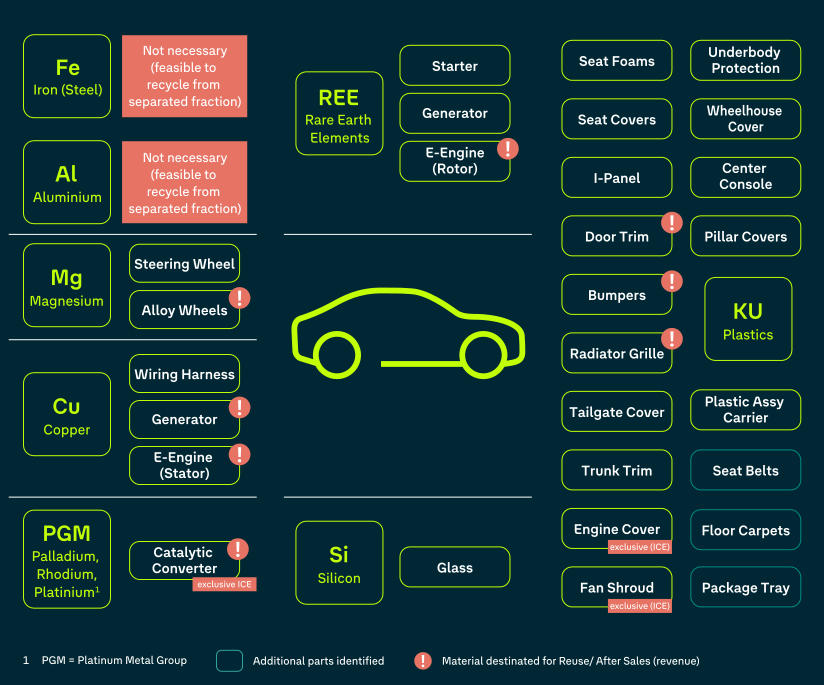
Critical raw materials and rare earth elements in operations and the value chain
As already mentioned in section “Actions and resources: Resource use and circular economy”, the Volkswagen Group uses raw materials from renewable sources to reduce resource consumption. Where possible, the Group brands use natural fibers such as flax, cotton, wood and cellulose. Such materials can be used when they meet all technical requirements and perform better than conventional materials in life cycle assessments.
The electric drive marks a key milestone on the path to low-emission mobility and thus contributes to change mitigation. At the same time, the production of electric drives brings different components into circulation, such as high-voltage batteries, as compared to conventional vehicle production. Depending on their cell chemistry, the raw materials these contain are predominantly valuable and their retention in circulation is important for many reasons. Reusing raw materials from batteries multiple times and thus keeping them in a closed loop helps the Volkswagen Group to reduce its carbon footprint, among other benefits, and simultaneously reduce its dependence on global raw material markets. The expectation is that this will also make a positive contribution to the company’s resilience.
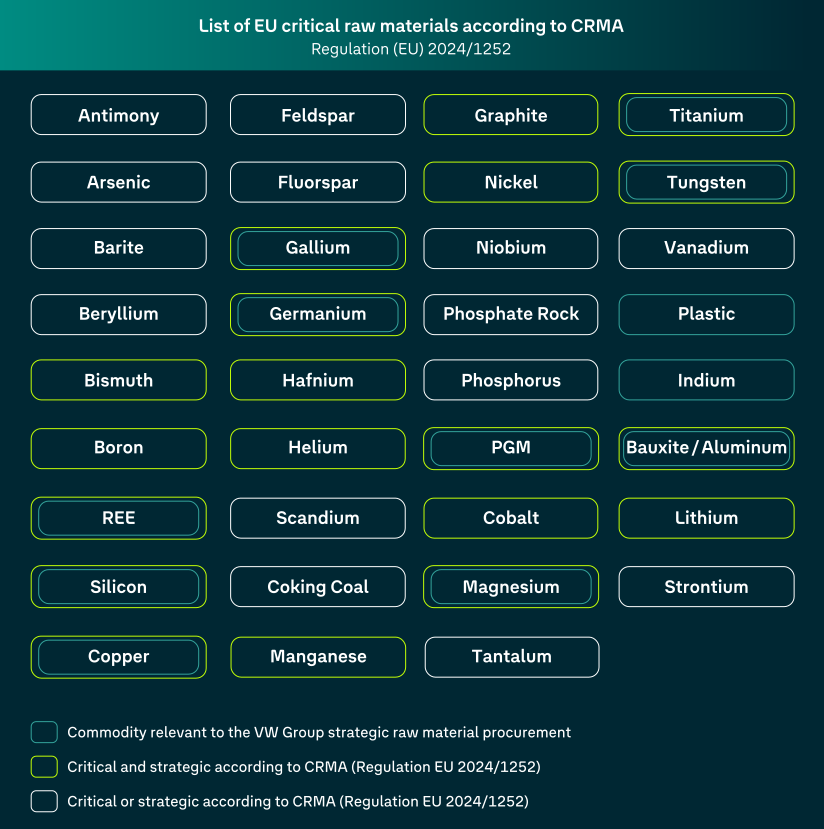
The Volkswagen Group wants to live up to its responsibility in the procurement of raw materials within the automotive industry. To that end, the Group published its Responsible Raw Materials Report for the first time in 2021 and has done so annually since then. In total, the management system currently covers 18 high-risk raw materials. These are the battery raw materials cobalt, lithium, nickel and graphite, the conflict minerals tin, tungsten, tantalum and gold (3 TG) as well as aluminum, copper, leather, mica, steel, natural rubber, platinum group metals, rare earths elements, and the recently added raw materials cotton and magnesium.
In terms of procurement, the following raw materials are currently purchased directly: steel, platinum group metals (PGMs), aluminum and plastics (both for in-house production only) and leather. Given the increasing complexity of supply chains and the geopolitical and material availability challenges in recent years, it is necessary to expand the range of directly purchased raw materials and establish an efficient Group-wide strategy for securing materials. In 2025, the Group raw material procurement process was set up to secure critical and strategic raw materials (contained in focal components). Nine different raw material groups are to be managed strategically. The groups consist of magnesium, rare earth elements (REE), aluminum, semiconductor materials (gallium, germanium, silicon, indium), tungsten, titanium, recycled materials (plastic, aluminum), copper, primary plastics and PGMs. The work start-up package prioritizes the topics of rare earth elements, magnesium and recycled materials. Further activities are then derived from these focal areas. The definition of these nine focal raw material groups is based on an internal criticality analysis that applies six different criteria and their economic relevance. The results were then compared with the Critical Raw Materials List from the EU Critical Raw Materials Act and confirmed accordingly (see illustration).
Water in Group operational processes and the value chain
The majority of our water consumption occurs within the supply chain, particularly in the extraction and processing of raw materials. Using the Code of Conduct for Business Partners, the Volkswagen Group exerts influence on the supply chain and requires its direct suppliers to ensure that they do not cause water pollution or excessive water consumption that could considerably impair the natural basis for food and drinking water or human health. Information on water withdrawal and water consumption as part of the Group’s own business operations can be found in the “Water” chapter under the heading “Actions at the production sites”.
New production sites in the reporting year
During the reporting year, resource inflows were generated through the establishment of a new production site in Rugao, China, for the manufacture of heavy commercial vehicles.
Methodology used to record quantitative resource inflows based on reference vehicle approach
The resource inflows for the vehicle-related business for reporting year 2025 were calculated using a reference vehicle/output-based approach. In this regard, a quantitative assessment of resource inflows is carried out based on the material-specific and substance-related description of the materials used in the vehicle. The Tiguan and ID.7 Tourer passenger car models were selected as sample reference vehicles to extrapolate the data for Volkswagen Passenger Cars, Volkswagen Commercial Vehicles, Škoda and SEAT/CUPRA. The latter, on account of its advanced technology, replaces the ID.4 used in 2024. The Q3 and Q4 e-tron models from Audi were selected to extrapolate the data for Audi, Lamborghini and Bentley starting from this reporting year. The reference vehicles were among the most produced vehicles in the reporting year. The results of the extrapolation have been consolidated and are presented in the table.
In terms of vehicle configuration, the most representative configurations based on sales data were used. The maximum vehicle weight was selected based on conservative assumptions.
The material offcuts created in production were not included for reporting year 2025 due to insufficient data availability.
The reference models are weighted based on production figures in the reporting year and extrapolated based on the ratio of production of internal combustion engine models to battery-electric vehicle models to determine the resource inflow metrics.
|
|
|
|
2025 |
|
2024 |
||||
|---|---|---|---|---|---|---|---|---|---|---|
|
|
Unit |
|
Battery-electric vehicles |
|
Internal combustion engine vehicles |
|
Battery-electric vehicles |
|
Internal combustion engine vehicles |
|
|
|
|
|
|
|
|
|
|
|
Total weight of products and technical and biological materials used |
|
tonnes |
|
1,782,194 |
|
8,403,399 |
|
1,185,989 |
|
8,639,279 |
Weight of technical materials |
|
tonnes |
|
1,779,644 |
|
8,387,149 |
|
1,184,705 |
|
8,622,796 |
Weight of biological materials |
|
tonnes |
|
2,550 |
|
16,250 |
|
1,283 |
|
16,483 |
Proportion of sustainably sourced biological materials |
|
% |
|
0.03 |
|
0.11 |
|
0.0 |
|
0.12 |
Weight of reused or secondary recycled components, products and materials used (minimum to maximum) |
|
tonnes |
|
225,283 – 455,177 |
|
1,387,806 – 2,202,596 |
|
147,764 – 295,493 |
|
1,413,941 – 2,264,010 |
Percentage of reused or secondary recycled components, products and materials used |
|
% |
|
12.6 – 25.5 |
|
16.5 – 26.2 |
|
12.5 – 24.9 |
|
16.4 – 26.2 |
Information about the resource inflows of other Volkswagen Group brands (Porsche and TRATON GROUP) can be found at the end of this chapter. There is no reporting on quantitative resource inflows for Everllence in 2025.
Methodology used to record technical and biological materials
The reference vehicle approach is also used to calculate technical and biological materials. The materials are recorded in line with the VDA 231-106 material classification. In this context, VDA categories 1 to 9, with the exception of category 7.1, comprise technical materials such as steel and polymer materials. Category 7.1 comprises biological materials such as leather and wood.
Methodology used to record sustainably sourced biological materials
The reference vehicle approach described above is also used to calculate the biological materials used that were sustainably sourced. The following definition applies to determining these biological materials: a biological material is deemed to be sustainably sourced if it is certified under a recognized and widespread certification system. Leather is considered to be sustainably sourced at the Volkswagen Group in line with this definition. In accordance with the sustainable leather specification document, suppliers must have a certificate from the Leather Working Group (LWG) or comparable certification from a similar organization.
Biological materials are recorded pursuant to VDA category 7.1 as modified organic natural materials, which includes leather as well as organic natural materials such as wood and cotton fleece. To identify the leather within VDA category 7.1, a structured analysis was carried out for weight-relevant parts per vehicle so as to list all materials that indicate a leather material based on their pure substances (for example, collagen). These pure substances were identified for both the Tiguan and the ID.7 Tourer, which indicates that both vehicles contain leather.
There are no biofuels used for non-energy purposes with respect to our product.
Methodology used to record proportion of secondary materials
The reference vehicle approach defined above is used to calculate the proportion of secondary material inflows. The materials are recorded in line with the VDA 231-106 material classification.
To calculate the proportion of secondary materials in vehicles, the Volkswagen Group has developed a standardized process that follows an internal work instruction. The proportion of secondary materials is determined in accordance with DIN EN ISO 14021 using a system-based method. In VDA categories 1 to 3, the proportion of secondary materials is determined based on data from the association, and in VDA categories 4 to 9, based on supplier data. The resulting proportion of secondary materials in the vehicle is presented as a range. The results reflect the data available at the time the data is collected.
Packaging also plays a role in the context of resource inflows in relation to the product. In this context, the vehicle is considered the product. Accessories and other materials are not included. Packaging as defined by the ESRS refers to materials passed on to the user or consumer. Although the Volkswagen Group does use packaging materials when transporting vehicles to dealerships, this material is removed prior to handing over the vehicles to users and consumers. Therefore, the transport protection materials pursuant to the ESRS definition are not to be understood as packaging and are not included in the report.
Avoidance of double counting in reuse and recycling
Reused components are not currently used in production, so double counting of reused and recycled components can be ruled out.
Methodology used to record quantitative resource inflows of the Porsche AG Group
To determine the total material consumption for the vehicles produced, the percentage-based material composition is evaluated for each model series of a representative vehicle. The evaluation categories are taken from VDA 231-106 “Material classification in motor vehicle construction: Structure and nomenclature”. Ultimately, the total number of vehicles produced and the average weight per model series can be used to determine higher-level totals for material consumption per material group. Leather is the most relevant biological material in Porsche vehicles. The quantity of secondary materials in the vehicles produced is estimated for two reference vehicles (internal combustion engine and BEV) using association data and then extrapolated to the total production.
|
|
Unit |
|
2025 |
|
2024 |
||||
|---|---|---|---|---|---|---|---|---|---|---|
|
|
|
|
|
|
|
||||
Total weight of products and technical and biological materials used |
|
tonnes |
|
538,180 |
|
621,679 |
||||
Weight of technical materials |
|
tonnes |
|
– |
|
– |
||||
Weight of biological materials |
|
tonnes |
|
– |
|
– |
||||
Proportion of sustainably sourced biological materials |
|
% |
|
0.3 |
|
0.2 |
||||
Weight of reused or secondary recycled components, products and materials used1 |
|
tonnes |
|
57,195 |
|
– |
||||
Percentage of reused or secondary recycled components, products and materials used1 |
|
% |
|
10.6 |
|
– |
||||
|
||||||||||
Methodology used to record quantitative resource inflows of the TRATON GROUP
The total weight of vehicles is calculated either based on supplier data on the weight of the parts or by directly weighing the vehicles. To calculate the overall value, the weight data for each product group is averaged and multiplied by the production volume. The total weight of the products is divided into material groups and the corresponding proportion of secondary materials is applied.
|
|
Unit |
|
2025 |
|
2024 |
|---|---|---|---|---|---|---|
|
|
|
|
|
|
|
Total weight of products and technical and biological materials used |
|
tonnes |
|
2,260,894 |
|
2,473,853 |
Weight of technical materials |
|
tonnes |
|
– |
|
– |
Weight of biological materials |
|
tonnes |
|
– |
|
– |
Proportion of sustainably sourced biological materials |
|
% |
|
– |
|
0.00 |
Weight of reused or secondary recycled components, products and materials used |
|
tonnes |
|
557,193 |
|
604,511 |
Percentage of reused or secondary recycled components, products and materials used |
|
% |
|
25 |
|
24.4 |
Resource outflows
Group standard 98000 defines indicators for waste that is to be collected in a consistent manner across all sites worldwide. This includes both production waste and non-production-specific waste.
The Site Checklist also describes voluntary criteria for the handling of waste. With regard to waste disposal, this includes waste disposal audits for waste streams, completely avoiding landfill as a means of production waste disposal, and quotas for the maximum proportion of disposal waste in production. With regard to packaging and disposable products, criteria such as the substitution of disposable packaging with reusable alternatives or the recycling of packaging materials were defined.
Material and product outflows
Information on the main focuses of the Volkswagen Group’s business activities is provided in the “Structure and Business Activities” chapter.
Starting with the development phase of new vehicles, we focus on the recyclability of the materials required and on avoiding pollutants in order to make our contribution to a circular economy. Under the current European End-of-Life Vehicles Directive, passenger cars and light commercial vehicles must be 85% recyclable and 95% recoverable at end of life. All Volkswagen Group vehicles approved for Europe comply with this law.
In addition, the Group standard on recycling sets out requirements relating to the recyclability of vehicles. For example, it contains design recommendations that enable materials to be more effectively separated from each other after the end of the vehicle’s life. Another example is the labeling of all components made of plastic in accordance with international ISO standards so that they can later be identified and separated by type.
Vehicles already have a long service life: The average age of an end-of-life vehicle in Europe is 19 to 24 years according to official statistics. Within the framework of a circular economy, this duration of usage helps to minimize the consumption of resources and energy and ensure extended producer responsibility.
Product durability
It is assumed that passenger cars can perform for up to 200,000 km. This is a standard figure that is used by the Volkswagen Group and various other car manufacturers when conducting a life cycle assessment. This figure was also confirmed in a scientific study by Weymar and Finkbeiner (2016), which involved statistical analysis of different data sets, including from the Kraftfahrt-Bundesamt (KBA – German Federal Motor Transport Authority), based on a sample of more than 800,000 vehicles.
TRATON GROUP vehicles are constructed and built to be operable for a long period of time. Their longevity is un-derpinned by regular maintenance and repair or replacement of defective parts. However, there is currently no industry-wide standard or average method for calculating the service life of heavy commercial vehicles.
Reparability
The Volkswagen Group’s focus on manufacturing high-quality products that have little need for repairs and also good repariability is aimed at ensuring a long service life for the vehicles during the use phase, and is therefore an important contribution to resource efficiency.
Availability of replacement parts
A network of approximately 2,000 service partners facilitates the repair work being carried out on Volkswagen Group vehicles across Germany. The service experts are equipped with cutting-edge technology and special tools in order to ensure efficient and high-quality repairs.
The Volkswagen Group offers its customers high parts availability, and delivers these parts as quickly as possible. This enables the service partners to swiftly carry out repairs and service activities. Automatic delivery of fast-moving parts ensures that the Volkswagen service partner network is able to guarantee a direct and prompt supply.
Repair time
The way that vehicles are designed enables repairs to be carried out quickly and comprehensively, and in a way that is strongly adapted to the respective cause of the damage. For instance, according to the repair manual, the headlight of the Tiguan (model year 2025) can be replaced in 110 time units (66 minutes). However, if the crash damage is only minor, it is often the case that the highly complex and expensive LED headlights are not affected, and replacement of the plastic headlight mounting is sufficient. This alternative repair solution involves not only low-cost headlight brackets but also a separate work position. Furthermore, this customer-focused repair solution is sustainable and reduces both the cost associated with replacement parts and the working time involved when compared to replacing the entire headlight.
With respect to high-voltage batteries, professional service centers and damage assessors working for insurance companies are also provided with a damage assessment catalog for all battery components. In the event of an accident repair, this ensures that reusable components can remain within the vehicle, where environmental and economically viable, and that only the defective components are replaced. In such cases, retailers are provided with extensive workshop information including the necessary repair times.
Costs
The Volkswagen Group offers a comprehensive range of services, with fair pricing and high-quality replacement parts, enabling consistently more cost-effective repairs. This includes, for example, the Volkswagen Economy Service for vehicles older than four years, which is offered to customers in Germany. This underscores the company’s objective of reducing overall costs for the vehicle owner.
Proportion of recyclable content in products
Under the European End-of-Life Vehicles Directive, passenger cars (M1) and light commercial vehicles (N1) must be 85% recyclable and 95% recoverable at end of life. All Volkswagen Group vehicles approved for Europe comply with these standards.
The recycling and recovery rates are calculated in accordance with ISO 22628 (Road vehicles – Recyclability and recoverability – Calculation method). The rates are calculated in an internal IT system and are based on the material data sheets for the components and materials used.
For information on packaging, refer to the section “Methodology used to record shares of secondary materials”.
Relevant waste streams and materials present in waste
Production-specific waste streams are of particular significance to the Volkswagen Group as an automotive manufacturer. The majority of this waste is made up of scrap metal, which comprises filings, sheet metal stamping waste, castings and other metal debris. The composition of the scrap metal varies based on the production process and the materials used. For example, scrap steel predominates in vehicle body production, whereas the manufacture of engines and transmissions creates mainly scrap aluminum.
In addition to scrap metal, large quantities of waste containing plastic are also generated, for example during injection molding, extrusion and mechanical processing of interior components, bumpers and other structural vehicle parts. The content of this waste is extremely varied and comprises mainly polypropylene, polyethylene, polyurethane, and composite materials.
Paint sludge generated from painting vehicles represents another important waste stream. Its composition depends on the type of paint used and may include solvents, pigments, resins, fillers, and additives. Paper, cardboard, and plastic packaging materials also accumulate as a result of the delivery of components. The final type of waste is hazardous waste, which is generated, among other things, from processes including chemical surface treatment and coating of body parts, the replacement of used oils and lubricants, and the use of cleaning agents and solvents.
|
|
|
|
2025 |
|
2024 |
||||||||||||||||
|---|---|---|---|---|---|---|---|---|---|---|---|---|---|---|---|---|---|---|---|---|---|---|
|
|
Unit |
|
Volkswagen Group |
|
Companies with operational control |
|
Volkswagen Group |
|
Companies with operational control |
||||||||||||
|
|
|
|
|
|
|
|
|
|
|
||||||||||||
Total waste1 |
|
tonnes |
|
2,547,290 |
|
537,522 |
|
2,357,654 |
|
573,762 |
||||||||||||
Total waste for recovery |
|
tonnes |
|
2,337,130 |
|
524,455 |
|
2,185,092 |
|
556,443 |
||||||||||||
Waste for recovery – preparation for reuse |
|
tonnes |
|
140,152 |
|
11,162 |
|
171,809 |
|
21,174 |
||||||||||||
of which: non-hazardous waste |
|
tonnes |
|
130,708 |
|
8,544 |
|
158,931 |
|
11,513 |
||||||||||||
|
tonnes |
|
9,444 |
|
2,617 |
|
12,878 |
|
9,661 |
|||||||||||||
Waste for recovery – recycling1 |
|
tonnes |
|
2,089,334 |
|
466,024 |
|
1,875,417 |
|
485,566 |
||||||||||||
of which: non-hazardous waste1 |
|
tonnes |
|
1,977,592 |
|
446,240 |
|
1,773,202 |
|
471,282 |
||||||||||||
|
tonnes |
|
111,741 |
|
19,784 |
|
102,216 |
|
14,283 |
|||||||||||||
|
tonnes |
|
107,645 |
|
47,269 |
|
137,866 |
|
49,703 |
|||||||||||||
of which: non-hazardous waste1 |
|
tonnes |
|
62,065 |
|
44,169 |
|
93,043 |
|
46,867 |
||||||||||||
hazardous waste3 |
|
tonnes |
|
45,580 |
|
3,100 |
|
44,823 |
|
2,837 |
||||||||||||
Total waste for disposal1 |
|
tonnes |
|
210,160 |
|
13,067 |
|
172,596 |
|
17,318 |
||||||||||||
Waste for disposal – incineration |
|
tonnes |
|
13,446 |
|
11,220 |
|
19,229 |
|
14,514 |
||||||||||||
of which: non-hazardous waste |
|
tonnes |
|
2,410 |
|
3,385 |
|
3,130 |
|
3,750 |
||||||||||||
hazardous waste3 |
|
tonnes |
|
11,037 |
|
7,835 |
|
16,098 |
|
10,765 |
||||||||||||
Waste for disposal – landfill1 |
|
tonnes |
|
88,309 |
|
1,623 |
|
144,750 |
|
2,586 |
||||||||||||
of which: non-hazardous waste1 |
|
tonnes |
|
56,623 |
|
485 |
|
114,262 |
|
736 |
||||||||||||
hazardous waste3 |
|
tonnes |
|
31,686 |
|
1,138 |
|
30,487 |
|
1,851 |
||||||||||||
Waste for disposal – other disposal actions5 |
|
tonnes |
|
108,405 |
|
224 |
|
8,618 |
|
218 |
||||||||||||
of which: non-hazardous waste |
|
tonnes |
|
106,610 |
|
223 |
|
6,740 |
|
218 |
||||||||||||
hazardous waste3 |
|
tonnes |
|
1,795 |
|
0 |
|
1,878 |
|
0 |
||||||||||||
radioactive waste |
|
tonnes |
|
0 |
|
0 |
|
0 |
|
0 |
||||||||||||
|
tonnes |
|
317,805 |
|
60,336 |
|
310,492 |
|
67,022 |
|||||||||||||
|
% |
|
12.5 |
|
11.2 |
|
13.2 |
|
11.7 |
|||||||||||||
Total hazardous waste1 |
|
tonnes |
|
211,283 |
|
34,476 |
|
210,023 |
|
39,396 |
||||||||||||
|
||||||||||||||||||||||
Methodology for calculating the waste generated
The volumes of all types of generated waste must be accounted for. As a result, the masses of the waste leaving the company’s plants or disposed of in the plants’ own disposal facilities (e.g. landfills or incinerators) must be calculated. The total volume of waste also includes waste that is prepared for reuse, recycled, recovered in some other way, incinerated, landfilled or otherwise disposed of. Waste is to be recorded by weighing it or by calculating the unit weight.
For more information on recording environmental data, see the “Overarching targets and metrics” section in the “Introduction to Environmental Management” chapter.