
Procedure for and Results of the Double Materiality Assessment
The ESRS stipulates that a double materiality assessment must be performed to determine which topics must be reported in the sustainability report. This process involves identifying and evaluating the Volkswagen Group’s material impacts, risks and opportunities in relation to sustainability matters. In 2023, a methodology was established within the Volkswagen Group that provided both the Volkswagen Group and Volkswagen Group companies that are considered to be subject to reporting requirements in future with guidance on implementing the materiality assessment in reporting year 2024. The aim of this approach was to ensure that the assessment is carried out in accordance with standardized steps and criteria. As such, separate double materiality assessments were performed in line with the defined assessment methodology both for the Volkswagen Group and for the subgroup comprised of Volkswagen Financial Services AG (including Volkswagen Bank GmbH and Volkswagen Leasing GmbH) and for Volkswagen Financial Services Overseas AG, the Porsche AG Group and the TRATON GROUP for fiscal year 2024. The results of these were used to update the assessments in the materiality assessment for fiscal year 2025. The materiality assessment is updated annually.
Methodology, assumptions and input parameters
The materiality assessment covered both the Volkswagen Group’s own operations and the upstream and downstream value chain process steps described under “Business model, value chain and strategy”. As we are a global Group, we took a global perspective on impacts, risks and opportunities. Experts from Volkswagen AG carried out the identification and assessment for the Group as a whole based on a standardized assessment scale. Selected experts from Group companies were involved for certain impacts. The aim of this approach was to lower uncertainties in the assessment process and validate assumptions. Existing analyses and classifications were used where available to facilitate a data-based assessment. This included analyses from other ESG due diligence processes, such as the Lieferkettensorgfaltspflichtengesetz (LkSG – German Supply Chain Due Diligence Act) for the S-Standards, life cycle assessments for ESRS E1 and ESRS E5, an SCIP chemical analysis for ESRS E2, our water footprint for ESRS E3 and a location analysis for ESRS E4. Where there was uncertainty about impacts (particularly in the case of impacts on business relationships and further down the value chain), conservative assumptions that had been harmonized across the Group were used. In addition, a climate risk analysis (see “Climate Change” chapter) and an analysis of impacts on biodiversity (see “Biodiversity and Ecosystems” chapter) were carried out.
Process steps in detail
The process within the Volkswagen Group is divided into four basic steps.
- Analysis of context
- Collection of impacts, risks, and opportunities
- Assessment of impacts, risks, and opportunities
- Validation of the results of the double materiality assessment
Analysis of context
In fiscal year 2024, the Volkswagen Group used a context analysis to define the relevant stakeholder groups, its business model and the value chain in relation to the ESRS requirements. The 37 subtopics of the ESRS were specified as a binding basis for the materiality assessment topic list, with the sub-subtopics also taken into account. In addition, entity-specific characteristics were analyzed and corporate citizenship was defined as an additional subtopic. Consequently, 38 topics were used for the materiality assessments in the Volkswagen Group. These were also used as the basis for the 2025 materiality assessment. To improve consistency with the Group sustainability strategy regenerate+, the entity-specific topic of corporate citizenship was renamed “societal impact”.
Collection of impacts, risks, and opportunities
The 38 topics were used as a basis when collecting positive and negative impacts, risks and opportunities in fiscal year 2024. In particular the impacts, risks and opportunities already identified for the Group, including the Report on Risks and Opportunities, were used as a starting point, supplemented by additional information supplied by the Group companies. The impacts, risks and opportunities were honed at subtopic level using the ESRS sub-subtopics. These granular impacts, risks and opportunities were combined into clusters at a level considered appropriate for the reporting of a global group. Some of these were further honed in expert discussions and modified on the basis of the Volkswagen Group’s existing ESG due diligence processes. The Group companies also used the clusters as the basis for their materiality assessment, supplemented by entity-specific aspects in certain cases.
Updated collection and assessment of impacts, risks, and opportunities
The collection and assessment of impacts, risks and opportunities from fiscal year 2024 was updated for the 2025 materiality assessment, whereby the Group exercised the option of using the results of the materiality assessment from the previous year provided there were no significant changes.
In step one, experts from various departments assessed whether there had been any significant changes in the organizational and operational structures or in external factors relating to their specialist topics.
In step two, if a significant change had occurred, the topic was discussed in depth; if necessary, the assessment was revised. If the assessment was not revised or if no significant change was identified, the assessment from the previous year was adopted.
Validation of the results of the double materiality assessment
In a final step, the Volkswagen Group’s materiality assessment was validated. The harmonization of the results of the materiality assessments in the Group companies was a key part of this validation. Each company considered to be subject to the reporting requirements in the future documented its results and submitted them for consolidation at Group level. The consistency of the assessments was reviewed, discrepancies were discussed for appropriateness, and assessments were adjusted in some cases.
A further part of the harmonization took the form of a validation from a human rights perspective. Here, the severity of negative human rights impacts was considered and compared with the prioritized risks according to the LkSG.
Finally, the results of the materiality assessment were compared with the strategic direction of the Group sustainability strategy regenerate+, discussed and agreed in a cross-departmental validation process, and approved by the Board of Management. The process described is protected by corresponding controls in the standard ICS. To facilitate the collection and assessment of impacts, risks and opportunities relevant for the materiality process in the remainder of the fiscal year, existing stakeholder formats and the findings from the Risk Management System were checked for material changes.
Interests and views of stakeholders
The Volkswagen Group indirectly integrated the concerns of its relevant stakeholder groups into the materiality assessment; direct consultations did not take place. Internal experts were involved in the materiality assessment. As such, we were able to leverage the knowledge of our own departments regarding relationships between the sustainability topics and the relevant stakeholders – for example from analyses and ESG ratings. Feedback from individual dialogues between departments and stakeholders was also integrated into the process. Furthermore, the departments that carry out cross-departmental validation also include those that have also taken the perspective of the stakeholder groups into account, such as Sustainability, Human Resources, the Works Council, Environment and Procurement.
Assessment methodology in detail
Impact materiality
In accordance with the ESRS, both positive and negative impacts were used to assess the materiality of the impacts. The positive and negative impacts were assessed separately in the two categories of actual impacts and potential impacts. Actual impacts in the context of the materiality assessment are impacts that are actually being experienced now or have already been experienced. This time horizon applies to all actual impacts named in the sustainability report. Potential impacts are impacts that are sufficiently likely to occur. The most relevant time horizon for potential impacts is described as short term (< 1 year), medium term (1 - 5 years) or long term (> 5 years).
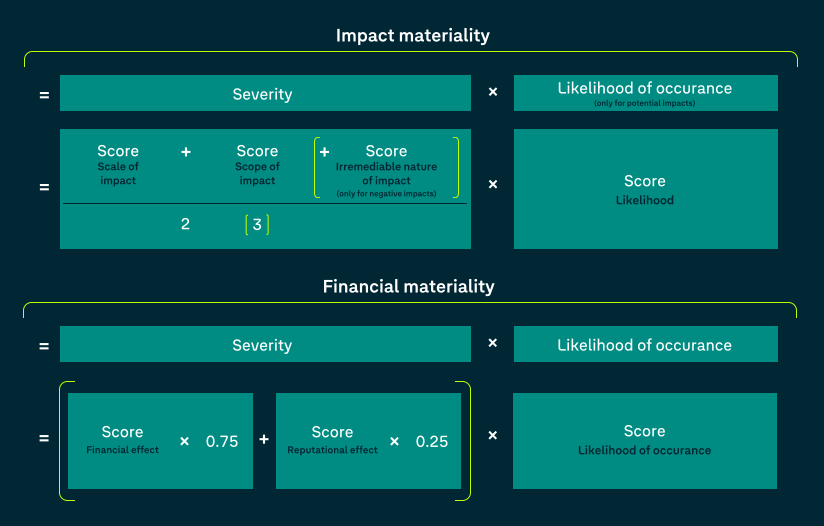
To determine the negative impacts, the parameters of scale, scope and irremediable character were evaluated separately and then consolidated as an average to give the severity of the impact. Scale and scope were assessed to evaluate the positive impacts. Here, too, the average of these two criteria expresses the severity of the impact.
In the case of potential impacts, the likelihood of occurrence was assessed for both positive and negative impacts. A likelihood of occurrence of 100% was assumed for actual impacts.
The impacts were divided into severity categories on the basis of scale and scope, as well as irremediable character in the case of negative impacts. The materiality of the impacts is assessed by multiplying the factors for severity with the likelihood of occurrence. In terms of impact materiality, impacts are classed as material if their risk score is 50 or higher on a scale of 1 to 100.
Financial materiality
The Volkswagen Group’s risk management processes are described in the Report on Risks and Opportunities in the Group management report. The quarterly risk process covers all acute situations irrespective of the type of risk, such as sales risks, environmental risks, or personnel risks. An additional risk and opportunity identification process was created to meet the requirements of the ESRS. The process to identify and assess risks and opportunities for the sustainability report is based on the quarterly risk process already established in the Group. A score is determined for each risk and each opportunity in the area of sustainability on the basis of the ESRS requirements. The score is calculated by multiplying the likelihood of occurrence by the potential severity and makes the risks and opportunities comparable. The severity is calculated by combining the weighted criteria of financial effect and reputational effect. A score of between 0 and 10 is assigned to each of these criteria. The management and control measures taken are included in the assessment on the basis of the ESRS requirements.
The score for the likelihood of occurrence increases as the probability increases until it reaches the highest score of 10 for a likelihood of more than 90% in the period under review. For the criterion of financial effect, the score rises in line with the scale of the loss; the highest score of 10 is reached when the potential loss is upwards of €1 billion. The criterion of reputational effect can have characteristics ranging from the erosion/building of local confidence and loss/gain of trust at local level to loss/gain of reputation at regional or international level.
The assessment is carried out for each risk or opportunity in terms of the financial impact on the operating result in the relevant time horizon in which it may occur. A distinction is made here between short term (< 1 year), medium term (1 – 5 years) and long term (> 5 years). Acute sustainability risks are also identified, assessed, and managed in the quarterly risk process. Sustainability risks are addressed with the same importance as other risk types identified.
Sustainability risks and opportunities are considered to be material in the sense of financial materiality if their risk score is 50 or above or their potential financial effect is €1 billion or more. This approach is analogous to the established reporting requirements for the quarterly risk process.
The assessments were discussed at Group level with the relevant departments in a process based on the materiality assessment.
The RMS and ICS are regularly optimized within the scope of the continuous monitoring and improvement process, with equal consideration being given to both internal and external requirements, particularly the requirements of the ESRS. External experts assist in the continuous enhancement of our RMS and ICS on a case-by-case basis.
Procedure for identifying material information
The relevant disclosure requirements from the ESRS for the report on fiscal year 2025 were identified on the basis of the material impacts, risks and opportunities and are presented in the respective ESRS chapters.
To determine which information should be reported, the Volkswagen Group first allocated the datapoints to one or more of the 38 subtopics. Datapoints relating exclusively to subtopics assessed as not material were then excluded from the reporting process. Voluntary datapoints and datapoints with phased-in disclosure requirements considered to have no relevance for the report were eliminated in a subsequent step. Finally, metrics that were allocated to a material subtopic but were not categorized as relevant were excluded for a variety of reasons.
Results of the materiality assessment
In the context of the double materiality assessment, 28 of the 38 subtopics considered were identified as material, whereby it is sufficient if either an impact or a risk or an opportunity is considered material. A total of 17 positive impacts, 20 negative impacts, 8 risks and no opportunities were categorized as material. Compared with the previous year, a material negative impact was identified in each of the sub-topics “Pollution of soil”, “Equal treatment and opportunities for all (sustainability in the supply chain)”, and “Communities’ economic, social and cultural rights”. These emerged from a comparison with existing supply chain analyses. As a result, the subtopics of “Pollution of soil” and “Communities’ economic, social and cultural rights” were added as new material subtopics. In addition, a more holistic consideration of biodiversity, with a stronger focus on the supply chain and logistics, as well as on the influence of the Volkswagen Group, led to two negative impacts being classified as no longer material. As a result, the subtopics of “Impacts on the state of species” and “Impacts on the extent and condition of ecosystems” are no longer classified as material and are no longer reported on. The subtopic “Management of relationships with suppliers including payment practices” has been renamed “Management of relationships with suppliers”, as payment practices were not assessed as material. Further impacts, risks and opportunities that have not reached the threshold for reporting were also identified in all topical standards. Inherent risks are described in the “Report on Risks and Opportunities” chapter. It was possible to assign the material impacts, risks and opportunities to the subtopics of the ESRS (see chart). Societal impact alone is covered by additional entity-specific disclosures. The option of presenting the material impacts, risks and opportunities under the respective topical standards was applied for the reporting year. Current financial effects – where they are both material and measured – are also described in the chapters on the topical standards.
Environmental Information
| Topical Standard | Subtopic | Impact/Risk/ Opportunity | Actual/Potential Impact | Value Chain | Time Horizon | |||||
|
E1: Climate Change |
Climate Change Mitigation |
|
|
|
||||||
|
|
|
|
||||||||
|
|
|
|
||||||||
|
|
|
|
||||||||
|
Climate Change Adaptation |
|
|
|
|||||||
|
Energy |
|
|
|
|||||||
|
|
|
|
||||||||
|
|
|
|
||||||||
|
E2: Pollution |
Pollution of Air |
|
|
|
||||||
|
|
|
|
||||||||
|
Pollution of Water |
|
|
|
|||||||
|
|
|
|
||||||||
|
Pollution of Soil |
|
|
|
|
||||||
|
Substances of Very High Concern |
|
|
|
|||||||
|
|
|
|
||||||||
|
Microplastics |
|
|
|
|||||||
|
E3: Water |
Water |
|
|
|
||||||
|
E4: Biodiversity and Ecosystems |
Direct Impact Drivers of Biodiversity Loss |
|
|
|
||||||
|
Impacts and Dependencies on Ecosystem Services |
|
|
|
|||||||
|
E5: Resource Use and Circular Economy |
Resource Inflows, including Resource Use |
|
|
|
||||||
|
|
|
|
||||||||
|
|
|
|
||||||||
|
|
|
|
||||||||
|
|
|
|
||||||||
|
|
|
|
||||||||
|
Resource Outflows |
|
|
|
|||||||
|
|
|
|
||||||||
|
|
|
|
||||||||
|
|
|
|
||||||||
|
Waste |
|
|
|
|||||||
|
|
|
|


Social Information
| Topical Standard | Subtopic | Impact/Risk/ Opportunity | Actual/Potential Impact | Value Chain | Time Horizon | |||||
|
S1: Employees and Non-employees |
Working Conditions |
|
|
|
||||||
|
|
|
|
||||||||
|
|
|
|
||||||||
|
Equal Treatment and Equal Opportunities for All |
|
|
|
|||||||
|
|
|
|
||||||||
|
Other Work-Related Rights |
|
|
|
|||||||
|
|
|
|
||||||||
|
S2: Sustainability in the Supply Chain |
Working Conditions |
|
|
|
||||||
|
|
|
|
||||||||
|
|
|
|
||||||||
|
Equal Treatment and Equal Opportunities for All |
|
|
|
|||||||
|
|
|
|
||||||||
|
|
|
|
||||||||
|
Other Work-Related Rights |
|
|
|
|||||||
|
|
|
|
||||||||
|
|
|
|
||||||||
|
|
|
|
||||||||
|
S3: Affected Communities |
Communities' Economic, Social, and Cultural Rights |
|
|
|
||||||
|
|
|
|
||||||||
|
S4: Customers |
Personal safety of customers |
|
|
|
||||||
|
|
|
|
||||||||
|
|
|
|
||||||||
|
|
|
|
||||||||
|
Company-specific Topic |
Societal Impact |
|
|
|
||||||
|
|
|
|


Business Conduct Information
| Topical Standard | Subtopic | Impact/Risk/ Opportunity | Actual/Potential Impact | Value Chain | Time Horizon | |||||
|
G1: Business Conduct |
Corporate Culture |
|
|
|
||||||
|
Protection of Whistle-Blowers |
|
|
|
|||||||
|
|
|
|
||||||||
|
Political Engagement and Lobbying Activities |
|
|
|
|||||||
|
|
|
|
||||||||
|
Management of Relationships with Suppliers |
|
|
|
|||||||
|
|
|
|
||||||||
|
Prevention of Corruption and Bribery |
|
|
|
|||||||
|
|
|
|
|
|
Opportunity |
|
Positive |
|
Actual Impact |
|
Upstream |
|
Short-term |
|||||||||
|
|
Risk |
|
Negative |
|
Potential Impact |
|
Own Operation |
|
Medium-term |
|||||||||
|
|
Downstream |
|
Long-term |
|||||||||||||||

