
Introduction to Environmental Management
The Volkswagen Group is aiming to do more in environmental terms than simply cut emissions. Our vision is to have a positive impact on people and the environment, and to contribute to the restoration and improvement of ecosystems and living conditions by means of regenerative actions.
Overarching policies
Five policies are instrumental in connection with the ESRS environmental standards:
- Decarbonization
- Pollution prevention
- Sustainable water management
- Biodiversity
- Resource use and circular economy
The policies are based on our Group policies on the Environmental Compliance Management System (ECMS) policies, which play a major role in corporate governance. The Code of Conduct, our Group strategy, our Group sustainability strategy regenerate+, the Code of Conduct for Business Partners, our environmental mission statement goTOzero, the environmental policy, our decarbonization strategy and the Biodiversity Commitment are also of importance. They address the environmental compatibility of products, services and processes, as well as the Volkswagen Group’s environmental footprint.
These documents, which are applicable Group-wide, are available internally and, with the exception of the Group policies, also publicly. We set out the relevant content of these documents in the following chapters. Thematic specifications are provided in the relevant “Policy” section in the chapters on Environmental Information.
Environmental protection is embedded as a key corporate principle in the Code of Conduct. As a globally active company, the Volkswagen Group is responsible for the environmental compatibility and sustainability of its products, sites and services. Its mission is to be a global provider of sustainable mobility and a role model in environmental protection. The Volkswagen Group is committed to using environmentally compatible, advanced and efficient technologies and implements them throughout the life cycle of its products. As early as the development and production stage, the Group pays attention to the sustainable use of natural resources, works continuously to mitigate environmental impacts and ensures compliance with environmental legislation and regulations. In addition, the environmental compatibility of products and manufacturing processes is continually assessed and optimized as necessary.
The topics of climate change mitigation and energy are a key element of the Group sustainability strategy relating to the decarbonization of the Group’s business activities. The Group aims to harness its innovative power to reduce its environmental footprint over the entire life cycle of its products and mobility solutions. The innovations are also intended to help customers act in a more environmentally friendly way.
The Volkswagen Group aligns its regenerate+ activities with the principles of environmental protection and enhancement. Decarbonization, establishing a circular economy, and preserving biodiversity are focus topics within this framework. The nature dimension is a material element of the regenerate+ framework program. The Volkswagen Group strives to shape the positive impact of its actions in this area in a way that is quantifiable and transparent. Consequently, one of the core objectives of the nature dimension is to achieve more than just a reduction in emissions. Our vision is to have a positive impact on people and the environment, as well as to contribute to the restoration and improvement of ecosystems and living conditions through regenerative actions.
The Code of Conduct for Business Partners contributes to Group-wide sustainability progress. We also require that suppliers, in order to extend the requirements of the Code of Conduct for Business Partners further down the supply chain, pass the requirements on to their direct business partners. The Volkswagen Group is also committed to being a responsible member of society and a partner to policymakers and the business community. The Company actively seeks dialogue on the mobility concepts of the future and environmentally sustainable development.
Our goTOzero environmental mission statement serves as the framework for all of the Volkswagen Group’s environmental activities. With this mission statement, we strive to reduce the environmental impact throughout the entire life cycle of our products and mobility solutions. As such, compliance with environmental regulations, standards and voluntary commitments is a prerequisite for our actions. The mission statement links our targets, metrics, programs and actions, and places the focus of our activity on four central fields of action and their underlying objectives (see illustration).
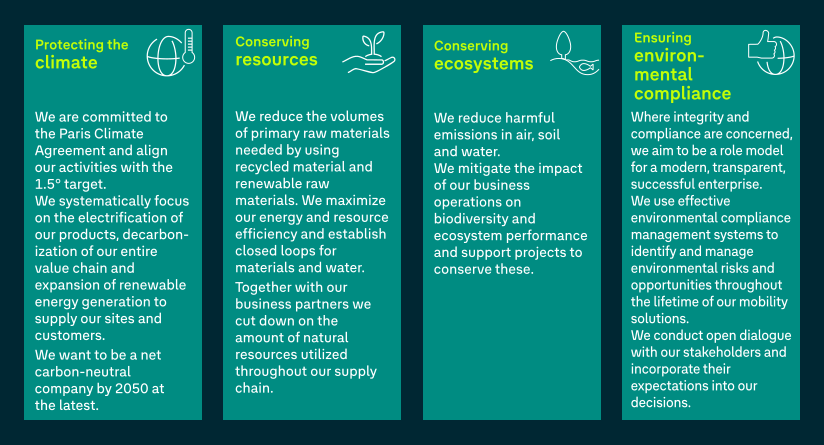
At the time of going to press, the goTOzero environmental mission statement is undergoing a review process that includes revising the statements relating to the 1.5 degree target of the Paris Climate Agreement to reflect current external and internal developments (see also the section on “Commitment to the Paris Climate Agreement and our climate targets” in the “Climate Change” chapter). An updated version of the mission statement will be published on the Volkswagen Group website in the course of fiscal year 2026.
The Volkswagen Group attaches the same high importance to environmental compliance as it does to active commitment to environmental protection. This not only comprises adherence to legislative and internal requirements, but also intensive dialogue and cooperation with stakeholders. The Volkswagen Group deems it vital that employees, customers, business partners, legislators, authorities, neighboring communities and other stakeholders be engaged. It aims to deepen its understanding of their expectations and requirements in relation to the environment. Their suggestions are fed into the ECMS, carefully assessed, and subsequently reflected in the Group’s processes, products and services.
The Volkswagen Group has created an environmental policy that sets out guidelines for environmental decision-making, for the management of projects and for the Group’s environmental stewardship. This policy actualizes the overarching environmental mission statement, goTOzero and sets parameters for the conduct and working methods of management and employees in five areas: management behavior, compliance, environmental protection, collaboration with stakeholders and continuous improvement. The environmental policy highlights, for example, the integration of renewable energies, decarbonization, sustainable supply chains and energy efficiency. The Volkswagen Group also intends to reduce the environmental impacts of its processes, products and services, and to continuously improve its ECMS and environmental performance.
Based on the environmental mission statement and the environmental policy, environmental protection is firmly embedded in the Volkswagen Group divisions, including in Production, Logistics and Sales:
- As part of the strategic vision of the Zero Impact Factory initiative, the Volkswagen Group is developing specific steps towards more sustainable production. The vision describes an idealized factory which employs manufacturing methods that are as climate, resource and environmentally friendly as possible, thereby reducing any adverse environmental impacts of vehicle and component production. The brands and locations have been using the measurement methods and management tools developed for this purpose. Further information on this is provided in the “Overarching targets and metrics” section. The measurement methods and management tools enable the quantitative environmental impact of the production sites to be recorded and reduced, particularly in the action areas of climate change mitigation and energy, emissions, water and waste. In addition, the focus is also on qualitative aspects such as the appearance of the factories, the commitment to biodiversity, protection of the soil, a functioning environmental compliance management system, improvement of resource efficiency, and environmentally friendly mobility management for employee and goods transport.
- Under the goTOzero Impact Logistics initiative, the logistics departments across the Group are working to realize the Volkswagen Group’s environmental mission statement. By optimizing transport networks and logistics processes on an ongoing basis – supported by digital solutions – the Group aims to avoid unnecessary shipments and reduce emissions. In addition, the targeted use of lower-emission technologies and alternative energy sources for transporting production materials and vehicles is being tested, piloted and pursued.
- The Volkswagen Group’s sales network extends globally to more than 150 markets with almost 17,000 dealer and service locations. In addition to the broad range of all-electric vehicles and hybrid models, we kicked off the goTOzero Retail project that is focused on decarbonizing all of our dealer and service locations and increasing their ESG performance, helping our sales partners to move over to a climate-neutral business model.
A Group policy for the ECMS sets out the requirements, tasks and responsibilities with regard to the environment and compliance. It provides the framework for implementing the ECMS across all phases of the business and the entire life cycle of vehicles in the brands and companies. The policy defines the minimum requirements for the companies and gives them the flexibility to implement them in a way that suits their business activities. The systematic implementation of requirements from the Group policy on the ECMS reinforces the effectiveness and robustness of the environmental compliance management systems at the Volkswagen Group sites. Defined roles and responsibilities allow for clear allocation of tasks and competencies. In addition to internal audits, external certifications enable objective assessments of these management systems and aim to ensure their continual enhancement. The ECMS is also used to regularly check the effectiveness of actions. A detailed explanation can be found in the “Actions and resources” section in each of the chapters under Environmental Information. In line with its ECMS, the Volkswagen Group stipulates that the employees of its companies and brands must receive regular training on environmental protection and environmental compliance. In line with the Group policy, all production and development sites in the Group are also requested to have their environmental management systems certified to ISO 14001 or validated by the Eco-Management and Audit Scheme (EMAS).
With the Responsible Supply Chain System (ReSC-System), we have established a comprehensive management system designed to identify human rights and environmental issues in the supply chain at an early stage and address them systematically. It aims to counteract or eliminate negative impacts and risks, enhance positive impacts and potential opportunities, and continuously improve the sustainability performance of suppliers. The Volkswagen Group’s ReSC-System is geared toward respecting and promoting globally valid regulations related to the protection of human rights.
The Volkswagen Group’s environmental responsibilities are clearly defined. The Group-wide management of operational environmental protection is the responsibility of the Chief Executive Officer of the Volkswagen Passenger Cars brand and of the Group Steering Committee Environment and Energy, which is supported by numerous specialist bodies. The Group Steering Committee Environment and Energy regularly informs the Group Board of Management on environmental and energy-related topics. It coordinates Group-wide dialogue and makes decisions on environmental and energy issues. Its tasks include implementing resource efficiency programs and monitoring target achievement. As the highest environmental body in the Volkswagen Group, the Group Steering Committee Environment and Energy plays a key role in decision-making relating to environmental matters. Other bodies are responsible for managing important individual aspects, such as the Group Steering Committee for Fleet Compliance. Climate-related topics are coordinated and managed by regular meetings of the Group steering committees and by continuous communication with the heads of the Group’s and the brands’ various research and development units and other Group functions. Cross-divisional and cross-brand working structures have been developed at Group level to support this coordination process. These structures build on the work of committees such as the Group Steering Committee Environment and Energy, the Group Steering Committee for Product Recycling and the Group Platform Sustainability Product. Group Regulation Management is the key contact for Group policies and monitors the entire Group policy process. Each responsible division must verify at least once a year that the Group policies and annexes it manages are up to date, and revise them if necessary.
Overarching targets and metrics
Reduction of specific environmental impact of production
The 2025 reporting year was the long-term target year for achieving an improvement in the Umweltentlastung Produktion (UEP – environmental improvement production) metric by 45% per vehicle or component as compared with 2010. The UEP metric was developed in-house. It is calculated as the weighted average of five metrics: energy consumption, CO2 emissions, water withdrawal, solvent emissions or volatile organic compounds (VOCs), and waste for disposal.
In base year 2010, energy consumption was 2,519 kWh per vehicle, CO2 emissions 1,096 kg per vehicle, water withdrawal 4.54 m3 per vehicle, production-specific waste for disposal 23.3 kg per vehicle, and VOC emissions 4.13 kg per vehicle.
In 2025, many successfully implemented actions continued to have a positive impact on the development of the specific environmental indicators per vehicle. The UEP improved from 48.5% in 2024 to 53% in 2025. The target of a 45% improvement by 2025 has thus been exceeded by a large margin. The table below shows the changes in specific environmental metrics per vehicle, and illustrates the changes compared to base year 2010.
per vehicle |
|
Unit |
|
2025 |
|
2024 |
||||
|---|---|---|---|---|---|---|---|---|---|---|
|
|
|
|
|
|
|
||||
Environmental improvement production |
|
% |
|
−53.0 |
|
−48.5 |
||||
Specific energy requirement |
|
% |
|
−23.8 |
|
−21.5 |
||||
Specific CO2 emissions |
|
% |
|
−71.0 |
|
−62.8 |
||||
Specific VOC emissions |
|
% |
|
−69.5 |
|
−67.5 |
||||
Specific water withdrawals |
|
% |
|
−33.3 |
|
−27.1 |
||||
Specific waste for disposal* |
|
% |
|
−81.9 |
|
−79.4 |
||||
|
||||||||||
The UEP target is in line with the goTOzero environmental mission statement and supports the achievement of climate targets and improvement of energy and resource efficiency. The target also contributes to the achievement of the United Nations’ Sustainable Development Goals (SDGs), in particular SDG 6 (clean water and sanitation), SDG 7 (affordable and clean energy), SDG 9 (industry, innovation and infrastructure), SDG 12 (responsible consumption and production), SDG 13 (climate action) and SDG 15 (life on land).
The UEP metric is directly connected with the environmental standards ESRS E1, E2, E3 and E5. With regard to Climate change (E1), the UEP takes into consideration the metrics energy consumption and CO2 emissions per vehicle. VOC emissions per vehicle are factored into the UEP with respect to Pollution (E2). Water withdrawal per vehicle is included under Water resources (E3). Finally, the UEP addresses the Circular economy standard (E5) by means of the assessment of waste for disposal.
Reduction of absolute environmental impact of production
The aim of the Volkswagen Group’s Zero Impact Factory strategic vision is to measure and assess the environmental impacts of its production sites worldwide in a uniform and holistic manner. Two independent methods were developed for this purpose: the Site Checklist analyzes qualitative aspects of a site in eleven action areas, while the Impact Points method facilitates a quantitative assessment of the absolute environmental impacts of a site.
The Volkswagen Group’s objective in using the Impact Points method is to gradually reduce the absolute environmental impacts of its production sites for passenger cars and light commercial vehicles and components by 37.5% by 2030, by 68.8% by 2040, and ultimately further towards the Group’s final vision of net neutrality by 2050, all compared with 2018 levels. Progress is reviewed annually and shall be communicated publicly in the future.
The targets for reducing the impact points are in line with the goTOzero environmental mission statement. They support the achievement of internal and external climate targets, improvement of energy and resource efficiency, and reduction of harmful emissions to air and water. The target contributes to the achievement of the overarching SDGs, in particular SDG 6 (clean water and sanitation), SDG 7 (affordable and clean energy), SDG 9 (industry, innovation and infrastructure), SDG 12 (responsible consumption and production), SDG 13 (climate action) and SDG 15 (life on land).
Measuring the environmental impacts of production by means of impact points forms the methodological foundation for achieving our vision of production with minimal effects on the environment. The following graphic illustrates the transition from using the UEP performance indicator to using the Impact Points method.
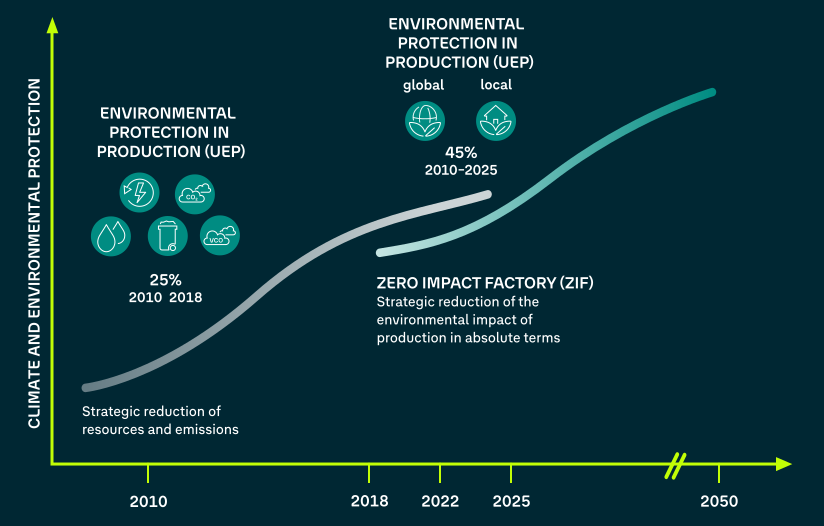
The Impact Points method was developed in close cooperation with partners from the scientific community, primarily the Technical University Berlin, and published in two scientific papers. These are publicly available at https://www.sciencedirect.com/science/article/abs/pii/S0959652622052209 and https://www.mdpi.com/2071-1050/16/7/3011. The Impact Points method is based on the ecological scarcity method, which assesses the environmental impact of pollutant emissions and resource extraction. The method also compares current environmental impacts with impacts considered acceptable from a sociopolitical point of view. These environmental carrying capacities were derived for the Impact Points method from national legislation, international targets and scientific principles. The Impact Points method includes six overarching environmental aspects:
- Primary energy and power plant emissions relate to the provision and transmission of energy through the energy infrastructure, as well as emissions from power plants such as VOCs, nitrogen oxides (NOx) and dust (particulate matter (PM)).
- CO2 emissions comprise greenhouse gas emissions (GHG emissions) emitted directly from the site (Scope 1) and indirectly through the use of energy (Scope 2).
- Air pollutants comprise the local emission of pollutants such as VOCs, nitrogen oxides and dust directly from the site.
- Water withdrawal refers to the local abstraction of water and use of the external freshwater infrastructure.
- Wastewater refers to the discharge of pollutants such as nitrogen (N), phosphorus (P), nickel (Ni) and zinc (Zn) into local water bodies and the use of the external wastewater infrastructure.
- Waste includes both the transportation and the processes for disposal of waste generated in production (e.g. landfill, thermal and material recycling, and use as a substitute raw material).
The first step in determining environmental impacts is to compile a data inventory (life cycle inventory). The environmental impacts of each environmental aspect are then determined by multiplying this by eco-factors (impact assessment). The level of an eco-factor illustrates the relevance of the respective environmental aspect, such as CO2e emissions, as compared with other aspects. The eco-factors take into account both planetary limits and the political objectives of the countries in which the Volkswagen Group’s production sites operate. For instance, water withdrawal at a site with low local water risk generates fewer impact points than at a site with high local water risk. This results in a weighting of environmental aspects.
The following graphic provides a schematic illustration of the impact point calculation method.

The Impact Points metric is directly connected with the environmental standards ESRS E1, E2, E3 and E5. With regard to Climate change (E1), the impact points take into consideration not only the environmental aspects of primary energy and power plant emissions but also CO2 emissions. Air pollutants and wastewater are factored into the Impact Points method with respect to Pollution (E2). The water withdrawal environmental aspect is included under Water (E3). Finally, the impact points address the Circular economy standard (E5) via the environmental aspect of waste.
Addressing qualitative environmental aspects in production
The Site Checklist developed in-house is the second assessment method after the Impact Points method to be used in alignment with the strategic vision of the Zero Impact Factory. The checklist is used to monitor the implementation of defined criteria regarding the environmental characteristics of a factory in eleven action areas. The Volkswagen Group aims to achieve an average compliance rate of at least 60% of the Site Checklist at its production sites by 2030. This is set to increase to 73.4% by 2040 and to 87.2% by 2050. This objective applies to sites producing passenger cars as well as light commercial vehicles and components. The jumping-off point in base year 2022 was a Group-wide average achievement of 44.5% of the Site Checklist. Progress is reviewed annually and shall be communicated publicly in the future.
The targets contribute to the achievement of the overarching SDGs, in particular SDG 6 (clean water and sanitation), SDG 7 (affordable and clean energy), SDG 9 (industry, innovation and infrastructure), SDG 12 (responsible consumption and production), SDG 13 (climate action) and SDG 15 (life on land).
The Site Checklist was developed in cooperation with various Group departments, brands and companies and is based on internal and external requirements, such as the EU Green Deal and the EU BREF documentation for the best available techniques (BAT).
The Site Checklist comprises 11 action areas with a total of over 140 largely qualitative environmental criteria: environmental compliance, architecture and perception, planning, digitalization, water, energy and CO2, materials, soil, biodiversity, pollutants and mobility. The action areas and criteria are regularly evaluated and updated as necessary. The sites assess each criterion as met or not met. Criteria may be assessed as met only if appropriate evidence is provided. The permitted forms of evidence and minimum criteria are defined in an internal manual. Achievement of individual criteria for each of the 11 action areas produces a fulfillment level from 0% (no criteria met) to 100% (all criteria met). The site results are calculated as the average of the fulfillment levels, with each of the action areas weighted equally. The result for the Group is determined as the average of all site results.
The Site Checklist method and its eleven action areas are directly related to the environmental standards ESRS E1 to E5. The energy and CO2 and mobility action areas in particular relate to the Climate change standard (E1). The soil and pollutants action areas have a direct link with the Pollution (E2) standard. With regard to Water (E3), the Site Checklist includes an action area of the same name that incorporates relevant screening criteria. The biodiversity action area relates to the Biodiversity and ecosystems (E4) standard. Finally, the materials action area addresses the Circular economy standard (E5).
Increasing the number of suppliers with environmental certification
The Volkswagen Group is pursuing the aim of improving its environmental impacts in the upstream supply chain. This has involved setting a target as part of regenerate+ of proving by 2040 that, in terms of sales revenue, more than 95% of relevant direct suppliers have established a certified environmental management system (e.g. pursuant to ISO 14001 or EMAS). The target applies to suppliers with production sites that employ more than 100 people and is contractually binding under the Code of Conduct for Business Partners. Evidence has also been required based on the Volkswagen Group sustainability rating (S-Rating) since 2022.
2023 serves as the base year for measuring progress; in that year, 80% of suppliers already had certified environmental management systems. In the reporting year, the proportion was increased to 86%.
Annual progress is monitored by the sustainability management team in Procurement to ensure that the target is reached by 2040. The methodology is based on a standardized self-assessment questionnaire, with the responses and documents reviewed and validated centrally by an external service provider. A risk analysis is also performed using data from external service providers and risk-based audits. This is intended to work towards target achievement and identify any deviations at an early stage.
Uniform collection of environmental data
Environmental data from the sites forms an important basis for determining quantitative metrics that are reported in the sections ESRS E1 to E5. The scope of the sites included is described in the “General Information” chapter. The internal Group standard VW 98000 sets out how these environmental indicators are to be uniformly determined and documented within the Company. A total of around 200 environmental indicators are recorded at site level and reported via the internal Environmental Information System (EIS). Each site is responsible for providing the environmental indicators.
The following are acceptable methods of recording environmental indicators. Direct measurements of physical quantities should be given the highest priority. This includes, for example, measuring wastewater volume by means of a flow meter, establishing waste volumes by means of weighing, or determining energy consumption by procuring readouts of energy meters. If direct measurement is not technically or economically feasible, the environmental indicators can be calculated based on measured variables. This method has a lower priority. This applies, for example, to the volume of CO2e emitted from the use of combustible materials, or emissions of pollutants into wastewater, which are generally extrapolated on the basis of random sample measurements. The permissible method with the lowest priority is an estimation of indicators based on transparent assumptions, such as the proportional dependency between waste volume and the number of manufactured units. All processes used must generally be transparent and verifiable by independent third parties such as certifiers or auditors.
Environmental data is presented in accordance with the ESRS requirements for E1-5 (energy), E1-6 (GHG emissions), E2-4 (emissions to air and water) and E4-SBM3 (biodiversity-sensitive areas) for the Volkswagen Group and companies with operational control (in accordance with the scope of reporting of the “General Information” chapter). Metrics that go beyond these disclosure requirements are reported voluntarily for the companies with operational control.