
Structure and Business Activities
This chapter describes the legal and organizational structure of the Volkswagen Group and explains the material changes in 2025 with respect to equity investments.
Legal structure of the Group
Volkswagen AG is the parent company of the Volkswagen Group. It develops vehicles and components for the Group brands, and also produces and sells vehicles, in particular the passenger cars and light commercial vehicles from the Volkswagen Passenger Cars and Volkswagen Commercial Vehicles brands. In its capacity as parent company, Volkswagen AG holds direct or indirect interests in AUDI AG, SEAT S.A., Škoda Auto a.s., Dr. Ing. h.c. F. Porsche AG, TRATON SE, Volkswagen Financial Services AG, Volkswagen Financial Services Overseas AG and a large number of other companies in Germany and abroad. More detailed disclosures are contained in the list of shareholdings in accordance with sections 285 and 313 of the Handelsgesetzbuch (HGB – German Commercial Code), which can be accessed at https://www.volkswagen-group.com/Financial-Reports and is part of the annual financial statements.
Volkswagen AG is a vertically integrated company as defined by section 3 no. 38 of the Energiewirtschaftsgesetz (EnWG – German Energy Industry Act) and is therefore subject to the provisions of the EnWG. In the electricity sector, Volkswagen AG generates and sells electricity as a group together with subsidiaries. Separate accounts are therefore to be kept for certain activities in the electricity sector in accordance with section 6b(3) of the EnWG (obligation to unbundle accounts). Moreover, the subsidiary VW Kraftwerk GmbH distributes electricity and also operates metering points within the meaning of the Messstellenbetriebsgesetz (MsbG – Metering Point Operation Act).
The Volkswagen AG Board of Management has sole responsibility for managing the Company. The Supervisory Board appoints, monitors and advises the Board of Management; it is consulted directly on decisions that are of fundamental significance for the Company.
Organizational structure of the Group and business model
The Volkswagen Group is one of the leading multibrand groups in the automotive industry, with a global workforce (excluding the Chinese joint ventures) of 602,659 (614,082) as of the end of the reporting year. The company’s business model covers the Automotive and Financial Services divisions. The Volkswagen Group’s significant products include passenger cars and commercial vehicles in the Automotive Division, as well as financial services. Our core brands within the Automotive Division – with the exception of the Volkswagen Passenger Cars and Volkswagen Commercial Vehicles brands – are independent legal entities.
Since fiscal year 2025, the Automotive Division has comprised the two reportable segments Passenger Cars and Light Commercial Vehicles, and Commercial Vehicles.
The Passenger Cars and Light Commercial Vehicles segment primarily consolidates the Volkswagen Group’s passenger car brands and the Volkswagen Commercial Vehicles brand. Activities focus on the development of vehicles, engines, motors, vehicle software and batteries, the production and sale of passenger cars and light commercial vehicles, and the genuine parts business. The product portfolio ranges from compact cars to luxury vehicles and also includes motorcycles. It is supplemented by mobility solutions.
REPORTING STRUCTURE OF THE VOLKSWAGEN GROUP
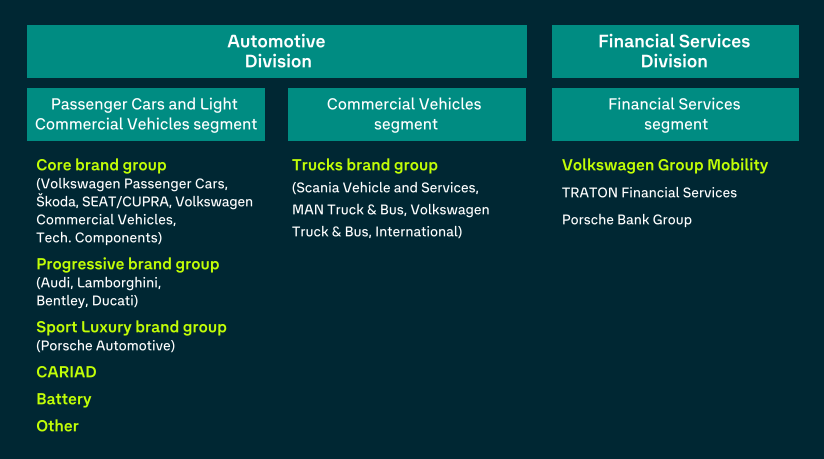
The Commercial Vehicles segment primarily comprises the development of vehicles, engines, motors, the production and sale of trucks and buses, the genuine parts business and related services. The commercial vehicles portfolio ranges from light vans to heavy trucks and buses. The collaboration between the commercial vehicle brands is coordinated within TRATON SE.
The Financial Services Division corresponds to the Financial Services segment. Its activities comprise dealership and customer financing, leasing, direct banking and insurance activities, fleet management and mobility services.
With its brands, the Volkswagen Group mainly serves individual, corporate and fleet customers in all markets around the world that are relevant for the Group, including Europe and Other Markets, North America, South America and Asia-Pacific. In certain markets, there are restrictions for the product portfolio of the Volkswagen Group under export control and sanction law.
Volkswagen AG and the Volkswagen Group are managed by the Volkswagen AG Board of Management in accordance with the Volkswagen AG Articles of Association and the rules of procedure for Volkswagen AG’s Board of Management issued by the Supervisory Board.
Accordingly, responsibilities in the Board of Management are currently divided among ten Board functions. In addition to the “Chair of the Board of Management” function, the other Board functions are “Technology”, “Finance and Operations”, “Human Resources and Trucks brand group”, “Integrity and Legal Affairs”, “Progressive brand group”, “Sport Luxury brand group”, “China”, “IT” and “Core brand group”. The Chair of the Board of Management was also responsible for the “Sport Luxury brand group” Board function until December 31, 2025; as of January 1, 2026, the full Board of Management is responsible for this function until further notice. The Board of Management member responsible for the “Core brand group” function is also responsible for the “Human resources” subdivision of the “Human Resources and Trucks brand group” function until further notice; the full Board of Management is responsible for the “Trucks brand group” subdivision until further notice. Further information on the composition of the Board of Management can be found in the “Members of the Board of Management” section.
Directly attached to the Board are a number of Group Management functions that act as an extension to the Board functions. These comprise the “Group Sales”, “Group Production”, “Group Procurement” and “Group Research and Development” functions.
The allocation of responsibilities on the Board of Management is based on the rules of procedure issued by the Supervisory Board. This is structured in such a way as to help the Board of Management to focus on key tasks such as strategy, central decisions on the Company’s direction, capital allocation and financial requirements. The task of the extended Board-level management functions is to leverage synergies in the Group and to connect the brands and divisions.
Board of Management committees exist at Group level for the following areas: products, technologies, investments, digital transformation, integrity and compliance, risk management and management issues. In addition to the responsible Board of Management members, the committees include representatives of the departments relevant to the subject, and of the brands, brand groups and companies involved.
We are continually revising and optimizing these and other top management committees in the Group in order to verify that they still align with our Group strategy and to further increase the efficiency of their decision making. This reduces complexity and reinforces governance within the Group.
In line with our Group strategy, the Volkswagen Group’s current steering model is based on strong customer orientation, entrepreneurship and team spirit and follows the “value over volume” principle, prioritizing sustainable value creation. This is also reflected in the steering model of the Group’s brand groups. The Core brand group comprises the Volkswagen Passenger Cars, Škoda, SEAT/CUPRA and Volkswagen Commercial Vehicles brands. The Progressive brand group comprises the Audi, Lamborghini, Bentley and Ducati brands. The Sport Luxury brand group consists of the Porsche brand. The company responsible for this brand, Dr. Ing. h.c. F. Porsche AG (Porsche AG), is listed on the stock market. In the Trucks brand group, TRATON SE acts as the umbrella for the Scania, MAN, Volkswagen Truck & Bus and International commercial vehicles brands. TRATON SE is also a listed company.
We are confident that our corporate structure, which connects not only the brand groups but also the technology platforms, will enable us to make better use of existing expertise and economies of scale, leverage synergies more systematically and accelerate decision making. In our view, clear responsibilities and a high degree of business responsibility in the brand groups and technology platforms form the basis for our sustainable success.
Each brand within the Volkswagen Group is managed by a brand board of management, which is responsible for the brand’s independent and self-contained development and business operations. To the extent permitted by law, the board adheres to the Group targets and requirements laid down by the Board of Management of Volkswagen AG, as well as to the agreements in the brand groups. This allows Group-wide interests to be pursued, while at the same time safeguarding and reinforcing each brand’s specific characteristics. Matters that are of importance to the Group as a whole are submitted to the Volkswagen AG Board of Management to enable synergetic implementation, to the extent permitted by law. Group policies decided by the Group Board of Management are an important instrument in this regard. Volkswagen AG employs Group policies as steering instruments to communicate its requirements, such as uniform standards and frameworks for action, to the Group companies. The rights and obligations of the statutory bodies of the relevant brand company remain unaffected by this.
The Volkswagen Group companies are managed independently by their respective managements. The management of each individual company takes into account not only the interests of its own company but also the interests of the Group, the relevant brand group and the individual brands in accordance with the framework laid down by law.
Material changes in equity investments
After reaching technical milestones and obtaining the necessary official approvals, Rivian and Volkswagen Group Technologies, LLC, Palo Alto/USA (Rivian and Volkswagen Group Technologies), a joint venture between the Volkswagen Group (Volkswagen) and US electric vehicle manufacturer Rivian Automotive, Inc., Irvine/USA (Rivian), commenced activities on November 13, 2024. The two partners hold equal shares in the joint venture, which operates as an independent company.
The aim of the partnership is to develop next generation software-defined vehicle (SDV) architectures to be used in the future vehicles of both companies. The joint venture builds on Rivian’s existing software and electrical architecture to facilitate the joint development of best-in-class architectures and software for the SDVs of both partners.
Volkswagen is planning to invest up to USD 5.8 billion in Rivian and the Rivian and Volkswagen Group Technologies joint venture by no later than January 2028. An initial investment in Rivian was made already in June 2024, taking the form of an unsecured convertible note of USD 1 billion, which was converted into ordinary shares of Rivian on December 3, 2024. When the operations of Rivian and Volkswagen Group Technologies commenced, Volkswagen invested an additional approximately USD 1.3 billion in 2024, in particular for the acquisition of the licenses in Rivian’s existing architecture technology and for the 50-percent share of the joint venture. A further investment of USD 1 billion was made in June 2025 in the form of the purchase of ordinary shares of Rivian. As a result, Volkswagen’s equity interest in Rivian rose to 12.3%. When certain technical milestones are reached in 2026 and 2027, Volkswagen expects to make further investments of up to USD 2.5 billion in the form of equity and debt, of which up to USD 1.5 billion is to be for ordinary shares of Rivian.
Legal factors influencing business
Like other international companies, the business of Volkswagen companies is affected by numerous laws in Germany and abroad. In particular, there are legal requirements relating to services, development, products, production and distribution, as well as supervisory, data protection, financial, company, commercial, capital market, anti-trust and tax law regulations and regulations relating to labor, banking, state aid, energy, environmental and insurance law.
Group Corporate Governance Declaration
The Group Corporate Governance Declaration can be found in this annual report and is permanently available on our website at www.volkswagen-group.com/en/corporate-governance.
-
VOLKSWAGEN AG SHAREHOLDINGS
https://www.volkswagen-group.com/Financial-Reports -
GROUP CORPORATE GOVERNANCE DECLARATION
https://www.volkswagen-group.com/en/corporate-governance