
Interests and Views of Stakeholders
As an international company, our business activities impact the lives of many different people. Appropriately aligned stakeholder engagement is therefore essential for determining the material areas for action within the Group sustainability strategy and recognizing stakeholders’ increasing and changing expectations at an early stage. The Volkswagen Group understands its obligations with regard to stakeholder engagement to include systematic and continuous interaction with our key interest and stakeholder groups within society, actively listening to them, and taking account of their input when developing our strategies. The goal is an open, constructive and also critical exchange with the stakeholder groups shown in the chart. We endeavor to understand their requirements and expectations of us, to discuss key topics from the Group sustainability strategy regenerate+ with them and to explain how these tie in with the Group strategy and its implementation.
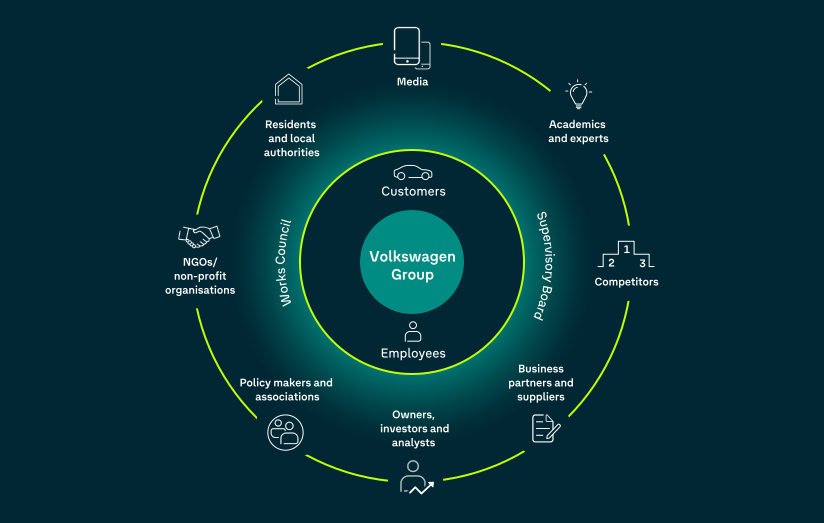
Our stakeholders are defined as individuals, groups or organizations who have an influence on or are influenced by the course or the result of corporate decisions. The Volkswagen Group has identified ten groups as its most important stakeholder groups. Employees and customers are at the center of the stakeholder network. Based on continuous stakeholder analysis, we have also identified eight further groups. Continuous communication between internal and external stakeholder groups is important to the Volkswagen Group. In this context, the Supervisory Board and the Works Council act not only as supervisory and advisory bodies but also as interfaces between internal and external stakeholders. As the supervisory body, the Supervisory Board of the Volkswagen Group is regularly informed of the views and interests of the relevant stakeholders with respect to sustainability-related impacts within the scope of reports required by law or by its own regulations. In particular, it is directly involved in decisions of fundamental importance for the Company due to the fact that its consent is required for these decisions. It has equal numbers of shareholder and employee representatives. Interests, views and rights of the Group’s own workforce are thus represented at the highest level in the Group.
The Volkswagen Group aims to systematically integrate the interests of its stakeholders into the strategic direction and operational implementation of its business activities. This is addressed at brand and regional level as well as at Group level. The brands and regions have their own stakeholder engagement strategies, designed to ensure through various mechanisms such as customer surveys, market research tools and other dialogue-focused formats that products and services meet the expectations of their customers.
The Volkswagen Group’s task is to bring together and coordinate these activities in an integrated framework. This framework covers:
- Stakeholder engagement at a Group level with specific formats and a focus on stakeholders that are relevant across the Group;
- Advising the brands and regions on the implementation of their stakeholder engagement activities and coordinating these;
- Carrying out regular stakeholder analyses and surveys.
Key elements of stakeholder engagement are described in the Group’s stakeholder relationship strategy, which was refined and continued in the current reporting year following its realignment in 2024. The aim of this strategy is to facilitate open and constructive dialogue with our stakeholders and to systematically incorporate their input into the ongoing development of the Group strategy. The principles of the stakeholder engagement strategy are guided primarily by our Group strategy. The key instruments of the strategy are regular communication formats geared toward the interest groups being addressed, annual stakeholder forums on strategic orientation and the Group’s development, and topic-specific dialogue formats.
In addition, stakeholder interests concerning topics relevant to sustainability are taken into account by the corresponding departments at Group level. Further information is provided in the relevant topical standards, particularly in the chapters under Social information.
The implementation of the Group sustainability strategy regenerate+ continued to be accompanied by stakeholder engagement formats in 2025. The aim was to inform all relevant stakeholder groups about the status and progress of implementation of the sustainability strategy and to engage in direct dialogue. Employees were able to obtain details on the progress of the strategy via the regenerate+ progress report, intranet articles, presentations and digital information events. In addition, they were able to ask questions and express interest via a variety of communication channels.
Human rights matters are integrated via the compliance management system for complying with human rights due diligence obligations and via the Responsible Supply Chain System. Further information is provided under Social information in the “Employees and Non-Employees”, “Sustainability in the supply chain” and “Affected communities” chapters. The latter two chapters also explain how the interests and views of workers in the supply chain and affected communities are taken into account.
In accordance with the requirements of the ESRS, a double materiality assessment was again carried out in the reporting year. A detailed description is provided under the section “Procedure for and results of the double materiality assessment”. The resulting content and topics were routinely incorporated into the ongoing development and implementation of the Group strategy and into dialogue formats such as the reputation study. This annual study was conducted between 2017 and 2023 to determine the level of trust that external stakeholders have in the Volkswagen Group and to allow us to present this in the form of a metric. Due to the changing economic, social and regulatory parameters, the conceptual framework of the reputation study was fundamentally revised and refined in 2024 and 2025. The reputation metric is based on an expanded theoretical framework that encompasses the dimensions of trust, appeal and respect and systematically maps the main reputation drivers. The Global Reputation metric determined in this way makes a vital contribution to anchoring stakeholder engagement in the Group’s sustainability strategy and is reported to the Board of Management and Supervisory Board together with other regenerate+ metrics.
In 2025, the study was carried out not only in the core markets – Germany, the USA, and China – but also in other European and American countries for the first time to obtain a comprehensive and differentiated picture of the Group’s reputation in strategically important regions. In addition to Germany, the survey was also carried out in the United Kingdom, Italy, France, Spain, Poland – collectively referred to as Europe – as well as in Mexico and Brazil. The results of the current survey show the following reputation metrics for the individual regions:
- Germany 81%
- Europe (United Kingdom, Italy, France, Spain, Poland) 86%
- USA 73%
- Mexico 100%
- Brazil 96%
- China 98%
Each region’s reputation KPI summarizes how the Group is rated there on the dimensions of trust, appeal, and respect. The percentage of respondents who give a positive rating is determined for each dimension, before combining all three scores to obtain an average. The KPI therefore indicates the proportion of respondents who perceive the company’s reputation as positive overall. The Global Reputation KPI corresponds to the arithmetic average of the regional metrics and total 89%. Because the concept and methodology for the survey have been refined, the current figures are not directly comparable with the results from prior years. However, these results show that the Volkswagen Group has a high level of trust, respect and appeal in the markets surveyed.
The Volkswagen Group Sustainability Forum, which took place for the second time in June 2025, is a central element of our stakeholder engagement. The aim of the event was to facilitate an open and constructive dialogue between external stakeholders from industry, science and NGOs, and internal representatives of the Group and its brands. The focus of the event was to jointly reflect on current challenges, discuss progress and expectations, and develop concrete ideas for the ongoing development of the Group sustainability strategy.
Another key instrument for stakeholder engagement is the independent Sustainability Council, which was realigned in 2024 and continued and further consolidated its work in the 2025 reporting year. The council is organized according to the four strategic dimensions of the Group sustainability strategy regenerate+. A Sustainability Practice Group was established for each dimension; three external experts work with three Volkswagen Group employees in each practice group. These groups provide a forum for regular, topic-specific discussion in which everyone is on an equal footing, and facilitate continuous scrutiny of strategic targets and measures. In the 2025 reporting year, the practice groups provided input on matters including the evolution of the Group-wide KPI system and the design of topic-specific roadmaps. The results of the group work were discussed in regular dialogue formats with the Group Board of Management in order to ensure that the Group sustainability strategy dovetails closely with corporate governance. In the reporting year, the practice groups focused among other things on consulting on and refining strategic initiatives such as the Group strategy, Group megatrends and the theoretical framework for the reputation study.
The council’s twelve external members have been allocated to the four dimensions of regenerate+ as follows:
NATURE
DR. FRAUKE FISCHER
Agentur Auf!
University of Würzburg
Specialist area: Biodiversity
Regional focus: Germany and Africa
REBECCA TAUER
WWF Deutschland
Specialist area: Circular economy
Regional focus: Germany
DR. JULIAN ZUBER
GermanZero e.V.
Specialist area: Climate legislation
Regional focus: Germany
OUR PEOPLE
DR. JOEL HARTTER
Parallel Labs
University of Colorado
Specialist area: Human-centered strategies
Regional focus: USA
CHRISTINA SCHILDMANN
Hans-Böckler Foundation
Specialist area: Work of the future
Regional focus: Germany
HANNAH ZOLLER
University of Labour
Specialist area: Continuing professional development
Regional focus: Germany
SOCIETY
ARON CRAMER
BSR
Specialist area: Corporate responsibility
Regional focus: USA
DR. MAJA GÖPEL
Leuphana University
Mission Value
Specialist area: System transformation
Regional focus: Germany
MARCIN PIERSIAK
Alliance for Responsible Mining
Specialist area: Sustainable procurement
Regional focus: Colombia, Europe and Africa
BUSINESS
ROSALINE MAY LEE
Rensselaer Polytechnic Institute
Specialist area: Transformation and innovation
Regional focus: USA and China
WILLIAM TODTS
Transport & Environment
Specialist area: Sustainable mobility
Regional focus: Belgium and Europe
JEAN-LOUIS WARNHOLZ
Future Inc.
Specialist area: Future strategies and financial technology
Regional focus: USA