
Information on the Board of Management and Supervisory Board
Composition and diversity of the Board of Management
Pursuant to article 6 of the Volkswagen AG Articles of Association, the Board of Management consists of at least three persons. As of December 31, 2025, there were eight members of the Board of Management.
When appointing the Board of Management, the Supervisory Board takes a variety of aspects, including diversity, into account. As an assessment criterion, diversity is understood by the Supervisory Board to mean in particular differing yet complementary specialist profiles, professional and general experience, both in Germany and in the international domain, with all genders being appropriately represented. The Supervisory Board also takes the following aspects into account in this regard, in particular:
- Members of the Board of Management should have many years of management experience.
- Members of the Board of Management should, if possible, have experience based on different training and professional backgrounds.
- The Board of Management as a whole should have technical expertise, especially knowledge of and experience in the manufacture and sale of vehicles, motors and engines of all kinds, as well as other technical products, and should also have experience in the international domain.
- The Board of Management as a whole should have many years of experience in research and development, production, sales, finance and human resources management, as well as legal affairs and compliance.
- The Board of Management should also have a sufficient mix of ages.
- Efforts are made to achieve a higher proportion of women than the statutory minimum. In line with the Gesetz zur Ergänzung und Änderung der Regelungen für die gleichberechtigte Teilhabe von Frauen an Führungspositionen in der Privatwirtschaft und im öffentlichen Dienst (Führungspositionen-Gesetz II, FüPoG II – Second Act on Equal Participation of Women and Men in Leadership Positions in the Private and Public Sectors), Volkswagen AG is subject to a mandatory participation requirement under which there must be at least one woman and at least one man on the Board of Management. The proportion of women on the Board of Management is currently 12.5%.
The aim of the diversity concept is for the Board of Management members to embody a range of expertise, experience, perspectives, gender and age. This diversity promotes a good understanding of Volkswagen AG’s organizational and business affairs. In particular, it enables the members of the Board of Management to be open to new ideas by avoiding groupthink. It thus contributes to the successful management of the company. The reasoning behind the aforementioned requirements for the composition of the Board of Management is to ensure that it has experience relevant for the divisions, products, and geographical locations of the Volkswagen Group.
Composition and diversity of the Supervisory Board
The Supervisory Board of Volkswagen AG consists of 20 members, half of whom are shareholder representatives. In accordance with Article 11(1) of the Articles of Association of Volkswagen AG, the State of Lower Saxony is entitled to appoint two of these shareholder representatives for as long as it directly or indirectly holds at least 15% of the Company’s ordinary shares. The remaining shareholder representatives on the Supervisory Board are elected by the Annual General Meeting. The other half of the Supervisory Board consists of employee representatives. These are elected by the employees in accordance with the Mitbestimmungsgesetz (MitbestG – German Codetermination Act). A total of seven of these employee representatives are employees elected by the workforce. The other three employee representatives are trade union representatives elected by the workforce.
To properly perform its supervisory and advisory duties, the Supervisory Board as a whole must collectively have the necessary expertise, i.e. knowledge, skills and professional experience. For this, the members of the Supervisory Board must collectively be familiar with the sector in which the Company operates – i.e. the automotive industry – and be able to assess the business conducted by the Company. This includes in particular knowledge, skills and professional experience relating to the transformation of the automotive sector, for example where e-mobility and mobility services are concerned. In addition, the Supervisory Board members as a whole must collectively have expertise relating to sustainability issues relevant to the Company. This encompasses, for instance, knowledge, skills and professional experience in connection with resources, supply chains, energy supply, corporate social responsibility, sustainable technologies and corresponding business models. The Supervisory Board and its committees may decide to call upon experts and other appropriate individuals to advise on individual matters and also on ESG issues as needed. Further information on the qualification of the Supervisory Board can be found in the qualification matrix in the “Group Corporate Governance Declaration”. The allocation of competencies is based on a self-evaluation by the respective Supervisory Board member.
Attention is paid to diversity when seeking qualified individuals to best strengthen the specialist and managerial expertise of the Supervisory Board as a whole. This applies particularly to the Supervisory Board and Nomination Committee within the context of which shareholder representatives they propose as candidates to the Annual General Meeting. When preparing such proposals, the extent to which the work of the Supervisory Board will benefit from a diversity of expertise and perspectives among its members, from professional profiles, professional and general experience that complement one another (including in the international domain) and from an appropriate gender balance should be considered for each case. A wide range of experience and specialist knowledge should be represented on the Supervisory Board. In addition, the Supervisory Board as a whole should have an extensive diversity of opinions and knowledge so as to enable it to develop a good understanding of the status quo and the longer-term opportunities and risks in connection with the company’s business activities. The Supervisory Board also recommends that the employee representatives and unions (which have the right to submit proposals in employee representative elections) and the State of Lower Saxony (which has a right to appoint Supervisory Board members) take into account the requirements of the Supervisory Board regarding its composition. The same applies to individuals entitled to make proposals should a court-appointed replacement be necessary. The aforementioned requirements for the composition of the Supervisory Board are intended to ensure that the full Board has relevant experience in the business activities and the geographical locations of the Volkswagen Group. Attention is also paid to members’ independence when appointments are made to the Supervisory Board. According to the definition under the ESRS, all ten workers’ representatives and five of the shareholder representatives on the current Supervisory Board are independent, which is equivalent to 75%.
The statutory quota of at least 30% women and at least 30% men applies to the Supervisory Board under the Gesetz für die gleichberechtigte Teilhabe von Frauen und Männern an Führungspositionen in der Privatwirtschaft und im öffentlichen Dienst (Führungspositionen-Gesetz, FüPoG – German Act on the Equal Participation of Women and Men in Leadership Positions in the Private and Public Sectors). In total, 45% of the members of the Supervisory Board of Volkswagen AG are currently women.
Sustainability-related aspects of the remuneration system for members of the Board of Management of Volkswagen AG
The remuneration of the Board of Management is based on the remuneration system adopted by the Supervisory Board on December 14, 2020 with effect from January 1, 2021, which the Supervisory Board most recently revised in December 2023 and April 2024 with effect from January 1, 2024 in order to better reflect the interests of the capital market in particular. The remuneration system for the members of the Board of Management is clear and transparent. It implements the requirements of the AktG as amended by the Gesetz zur Umsetzung der zweiten Aktionärsrechterichtlinie (ARUG II – German Act on the Implementation of the Second Shareholder Rights Directive) and takes into account the recommendations of the German Corporate Governance Code.
The remuneration of the members of the Board of Management comprises fixed and variable components. The fixed components are the base salary, fringe benefits and occupational retirement provision. The variable components are the annual bonus with a one-year assessment period, and the performance share plan with a four-year assessment period (long-term incentive). The remuneration of the Board of Management and Supervisory Board members appointed in fiscal year 2025 can be found in the "Remuneration report".
The long-term incentive serves to align the remuneration of the Board of Management members with the Company’s long-term performance. The aim of the financial performance target of earnings per share in conjunction with share price performance and the dividends paid, measured over four years, is to ensure the long-term effect of the behavioral incentives and to support the strategic target of achieving competitive profitability.
The annual bonus is tied to the financial performance targets of net cash flow in the Automotive Division (Net cash flow in the Automotive Division) and operating return on sales of the Volkswagen Group (RoS) and also to achievement of sustainability objectives (environmental, social, governance, or ESG), each of which is taken into account using a multiplier (the ESG factor). The integration of the ESG factor highlights the importance of the sustainability targets. The various sustainability aspects are covered by the decarbonization index, the sentiment and diversity index and the governance factor.
For fiscal year 2025, the Supervisory Board used the option provided to apply the diversity index only for the social subtarget and to suspend the employee satisfaction index as an ESG criterion. Beginning in fiscal year 2026, the employee satisfaction index will be replaced by the engagement index The engagement index, together with the diversity index, will serve as a social subtarget of the ESG factor for the annual bonus from fiscal year 2026 onwards. The decarbonization index measures the emissions of CO2 and CO2 equivalents by the brands producing passenger cars and light commercial vehicles over the entire life cycle and documents the progress made in improving our carbon footprint. The decarbonization index operationalizes the Volkswagen Group’s climate change mitigation targets and is therefore the core parameter for climate change mitigation in the Group. Further information on the greenhouse gas emission reduction targets (Scopes 1, 2 and 3) is provided in the “Climate change” chapter. The diversity index is used worldwide to measure developments in the proportion of women in management and the internationalization of top management. The indicator provides incentives for exemplary leadership and corporate culture. Due to the regulatory framework in the United States, employees of Volkswagen AG’s US subsidiaries and their non-US subsidiaries, as well as other employees in the United States, are excluded from the measurement of the proportion of women using the diversity index. Employees of Volkswagen AG’s US subsidiaries and other employees in the United States are also excluded from the determination of the internationalization of top management. The governance factor is a means for the Supervisory Board to express its satisfaction with the expected and actual conduct of the Board of Management with regard to the criteria of integrity and compliance.
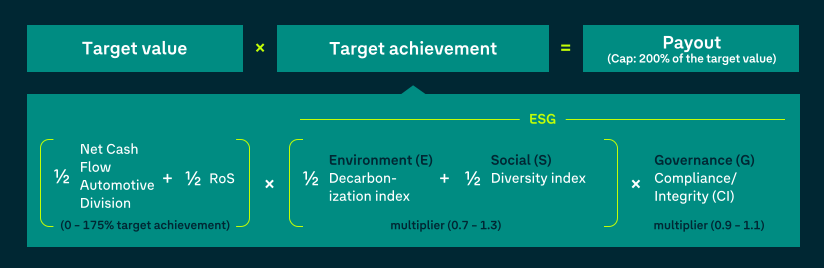
The ESG factors underlying the remuneration system are described in the Group management report within the 2025 Annual Report. They are classed as strategic non-financial key performance indicators and allocated to the topics identified as material in the double materiality assessment of the Volkswagen Group.
The following overview shows the minimum values, target values and maximum values set by the Supervisory Board for fiscal year 2025 for the environmental (decarbonization index) and social (diversity index) subtargets along with the actual figures and target achievement levels in fiscal year 2025.
|
|
ENVIRONMENT |
|
|
|
SOCIAL |
|---|---|---|---|---|---|---|
|
|
Decarbonization index |
|
|
|
Diversity index |
in tonnes of CO2e/vehicle |
|
2025 |
|
Points |
|
2025 |
|
|
|
|
|
|
|
Maximum value |
|
47.5 |
|
Maximum value |
|
158.0 |
100% target level |
|
48.5 |
|
100% target level |
|
154.0 |
Minimum value |
|
50.5 |
|
Minimum value |
|
150.0 |
Actual |
|
46.3 |
|
Actual |
|
168.0 |
As a rule, the governance factor should be 1.0 and may only be reduced to 0.9 or raised to 1.1 in exceptional circumstances based on the professional judgment of the Supervisory Board. For fiscal year 2025, the Supervisory Board set the governance factor at the standard value of 1.0 for all members of the Board of Management; this takes into account and assesses the collective performance of the Board of Management as a whole and the performance of each Management Board member individually.
The remuneration of the members of the Supervisory Board consists of fixed remuneration and the meeting attendance fee, and if applicable, fixed remuneration for work in the committees.