
Shares and Bonds
The price of Volkswagen AG’s ordinary and preferred shares developed encouragingly in the reporting year.
Equity markets and the price performance of Volkswagen’s shares
Share prices on the international stock markets turned in a mixed performance in the 2025 reporting year. While the European markets initially outperformed those in the USA, geopolitical uncertainties led to increased volatility. On the US exchanges in particular, concerns arose that the US administration’s trade policy could spark a recession in their domestic economy. Combined with the emergence of new competitors from China, this put the stocks of US companies, particularly those in the artificial intelligence and autonomous driving sectors, under pressure in the opening months of the year. Trading activity was also impacted by the escalation of the conflict in the Middle East. Later in the year, expectations of falling interest rates and the positive performance of technology securities initially fuelled a considerable rally in the stock prices in the USA.
The German stock index (DAX) initially got off to a subdued start in 2025 before beginning to climb in mid-January, hitting new all-time highs in quick succession. The German stock market barometer benefited in particular from market participants’ hopes that the European Central Bank would cut interest rates. Reports of talks to broker peace in Ukraine and the prospect of economic recovery thanks to the planned investment package of the German government also had a positive impact, as did the European Commission’s announcement of a flexibility measure to help the automotive industry comply with emissions regulations. The severe tariff hikes announced by the USA in early April 2025 led to great uncertainty, causing share prices to tumble. The DAX subsequently recouped its losses owing to hopes of advances in the global trade dispute and the decision to temporarily suspend tariff increases. The escalation in the Middle East conflict resulted in falling share prices in June 2025. Early in the third quarter of 2025, the DAX then scaled to a fresh high, due in part to the movement of capital from the USA to Germany as a consequence of the US tariff policy. Towards the end of the reporting year, the benchmark index exhibited a sideways shift but on December 31, 2025 was still 23.0% higher than the level reported at the end of 2024. As a performance index, the DAX takes into account the reinvestment of dividend payments. In the reporting period, the difficult market environment for the automotive industry continued to drag on the pure price index EURO STOXX Automobiles & Parts, which was down 4.3% on year-end 2024.
PRICE DEVELOPMENT FROM DECEMBER 2024 TO DECEMBER 2025
Index based on month-end prices: December 31, 2024 = 100
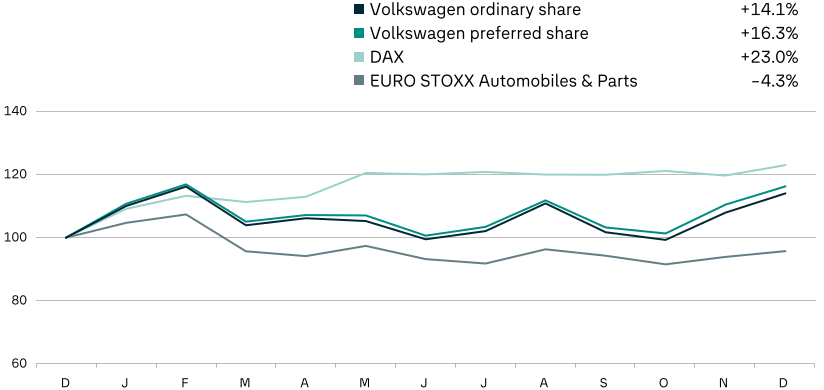
The prices of Volkswagen AG’s preferred and ordinary shares initially developed very positively from the beginning of the reporting period until mid-March. The market reacted favourably to the Zukunft Volkswagen collective bargaining agreement reached at the end of 2024, which provides for structural measures and cost savings at Volkswagen sites in Germany. In addition, share price performance benefited from the European Commission’s announcement that it will make emissions regulations more flexible, as well as from the Volkswagen Group’s figures for fiscal year 2024 and what investors perceived to be a solid outlook for 2025. Starting in mid-March 2025, prices increasingly came under pressure. Deterioration in the industry and trade environment was primarily due to heightened trade policy tensions precipitated by the United States’ announcement of considerable tariff increases and the resulting high levels of uncertainty surrounding future earnings performance. Later in the period, solid sales figures initially boosted the share prices until the escalation of the Middle East conflict once again took its toll. At the beginning of the third quarter of 2025, investors rated the Volkswagen Group’s advances in its performance programs positively. Though the forecast for 2025 had been revised with the publication of the results for the first half-year, the share prices initially increased. However, a further revision of the 2025 forecast for the Volkswagen Group in September 2025 in light of the impacts from changes in product planning and the medium-term plans of Dr. Ing. h.c. F. Porsche AG initially put downward pressure on share prices. An upward trend was evident at the end of the reporting year, taking preferred shares up 16.3% and ordinary shares up 14.1% year-on-year as of year-end 2025. Both thus outperformed the DAX, and in particular the EURO STOXX Automobiles & Parts benchmark index. Assuming that the dividend paid out in May 2025 (before deduction of taxes) was reinvested in Volkswagen shares at the time of distribution, the total return on the preferred shares was 23.9% and the total return on the ordinary shares was 21.2%.
|
|
|
|
High |
|
Low |
|
Closing |
|---|---|---|---|---|---|---|---|---|
|
|
|
|
|
|
|
|
|
Ordinary share |
|
Price (€) |
|
112.80 |
|
86.35 |
|
105.10 |
|
|
Date |
|
Mar. 10 |
|
Apr. 9 |
|
Dec. 31 |
Preferred share |
|
Price (€) |
|
110.15 |
|
83.84 |
|
103.55 |
|
|
Date |
|
Mar. 10 |
|
Apr. 9 |
|
Dec. 31 |
DAX |
|
Price |
|
24,611 |
|
19,671 |
|
24,490 |
|
|
Date |
|
Oct. 9 |
|
Apr. 9 |
|
Dec. 31 |
ESTX Auto & Parts |
|
Price |
|
593 |
|
448 |
|
510 |
|
|
Date |
|
Feb. 26 |
|
Apr. 9 |
|
Dec. 31 |