
Business Development
The world economy recorded positive growth in 2025. Global demand for vehicles was slightly higher than in the previous year. Amid a challenging market environment, the Volkswagen Group delivered 9.0 million vehicles to customers.
Developments in the global economy
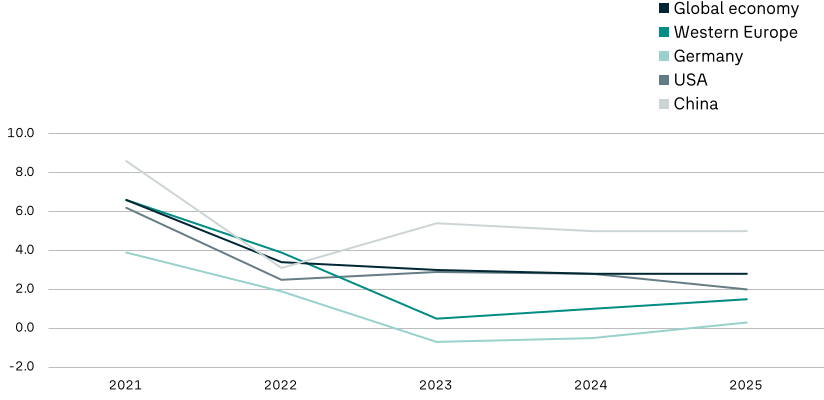
The global economy continued to grow in 2025 at a pace similar to the previous year. In this context, the pace of growth picked up slightly in the emerging markets, while momentum in the advanced economies remained roughly at the prior-year level. While inflation rates fell in many countries, they remained elevated in some cases. Due to these differing conditions, central banks reduced key policy rates to varying degrees. Overall, geopolitical uncertainties, particularly those related to the economic policy stance of the USA and the increase in geo-economic measures, placed a strain on the global economic environment.
Europe/Other Markets
In the reporting year, the economy in Western Europe exhibited positive growth overall, higher than the prior-year level. Development in the individual countries in Northern and Southern Europe was mixed. In response to falling inflation rates, the European Central Bank lowered its key interest rate in eight rate cuts, beginning in June 2024. In 2025, the economies of Central Europe grew overall at a slightly higher pace on average than in the same period of the previous year, while Eastern Europe recorded a smaller increase.
Germany
German gross domestic product stagnated at the prior-year level in 2025 after having fallen in the two preceding years. Compared with 2024, the unemployment rate rose somewhat on average over the year. The harmonized rate of inflation in the reporting year was somewhat lower than the prior-year level.
North America
In the USA, gross domestic product in the reporting year grew at a somewhat slower pace than in the previous year. The Federal Reserve had cut its key interest rates in several steps in the previous year but broke with this easing stance in the reporting year due to uncertainty surrounding the impact of the US administration’s economic policy actions, and only resumed its monetary policy easing in September 2025. In Canada and Mexico, economic growth was down somewhat year-on-year.
South America
In Brazil, economic output grew at a somewhat slower pace, while economic growth in Argentina picked up considerably following a negative trend over two consecutive years.
Asia-Pacific
Growth in China’s economic output was above the global average and hovered around the prior-year level in the reporting year. India’s economy grew at a similarly strong rate as in 2024. Japan’s economic output increased.
ECONOMIC GROWTH
Percentage change in GDP
Exchange rate trends
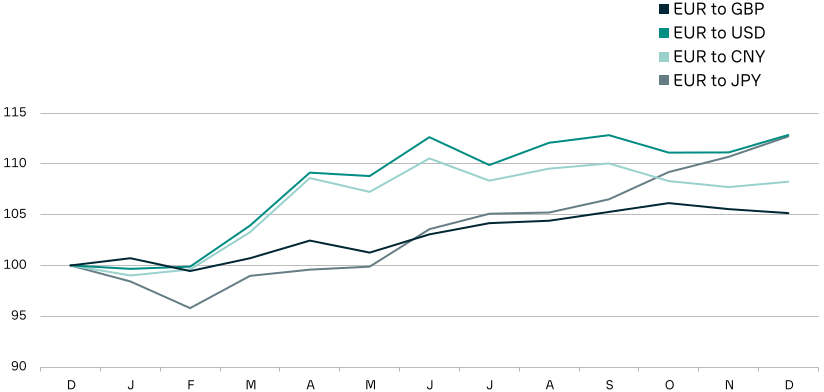
The euro appreciated against the US dollar, pound sterling and the currencies of several emerging markets on an annual average in 2025. In particular, the Argentinian peso and Turkish lira lost value against the European single currency due to the persistent extremely high rates of inflation. The Mexican peso, the Brazilian real and the South African rand were also weaker than the euro on average compared with 2024. Similarly, the Chinese renminbi and the currencies of several emerging markets in Asia depreciated against the euro year-on-year.
EXCHANGE RATE MOVEMENTS FROM DECEMBER 2024 TO DECEMBER 2025
Index based on month-end prices: as of December 31, 2024 = 100
Interest rate trends
The ongoing trend of falling inflation rates allowed central banks in many countries to cut their key interest rates in the reporting year. On a global average, interest rates in the reporting year were therefore at a somewhat lower level than in the previous year. National central banks in nearly all of the major Western industrialized nations made corresponding adjustments to their key interest rates to differing extents. Key interest rate cuts were also recorded in many emerging markets.
Commodity price trends
The commodity markets turned in a mixed performance in the reporting year, with price trends for individual groups of commodities sometimes moving in opposite directions. The fourth quarter of 2025 saw an acceleration in price rises for some industrial metals, battery materials and precious metals. Compared with the previous year as a whole, the average prices for the commodities lithium, crude oil, coking coal, nickel, iron ore, and lead fell significantly in most cases. By contrast, prices for cobalt, aluminum and copper rose. The price of natural rubber remained virtually unchanged. Averaged over the year, the prices of the precious metals rhodium and platinum recorded a strong increase, while the price increase for palladium was significant.