
Business model, value chain and strategy
Business model and Group structure
The commentary on the business model and Group structure is provided in the “Structure and Business Activities” chapter.
The Volkswagen Group value chain
The Volkswagen Group’s business is based on a broadly distributed and complex value chain. Both the upstream and the downstream process steps in this value chain are being vertically integrated into the Group’s own business activities to an ever increasing degree.

Upstream value chain
The upstream segment of the value chain comprises the extraction of raw materials and the production of components and parts. The Volkswagen Group maintains close relationships with a large number of suppliers that provide raw materials and intermediates.
The Group also operates its own production facilities and plants in which key components such as engines, motors, transmissions and suspensions are made. By controlling these key production steps, high quality standards are guaranteed and at the same time innovative technologies and processes can be implemented directly.
This is also aided by our close cooperation with many suppliers who provide specialized components and services.
Core business
The core business comprises the following central activities: the development of vehicles, engines, motors, vehicle software and vehicle batteries, the production and sale of passenger cars, light commercial vehicles, trucks, buses and motorcycles, and trading with genuine parts and components. The employees and the Works Council have particular relevance as stakeholders in this area.
In the development phase, the Volkswagen Group invests in advanced technologies and innovative designs with the aim of producing state-of-the-art and environmentally friendly vehicles. Production takes place in production facilities located around the world, which focus on efficiency and quality. Efficient logistics processes are designed to ensure the seamless integration of all stages from production to delivery, while at the same time helping to reduce emissions and costs. Distribution takes place via a global network of dealers and distributors whose remit is to promptly and reliably make the vehicles available to customers.
This is where the value chain of the Financial Services Division comes in, with its range of services including vehicle leasing and financing, insurance and other vehicle-related mobility products – for private and individual commercial buyers, as well as for fleet customers. In addition, the dealers and business partners also offer maintenance contracts.
Downstream value chain
The downstream segment of the value chain covers the vehicle’s use phase and end-of-life management. The use of the vehicles and associated services play a key role in this phase. The dealers and service partners offer comprehensive servicing and repair services. Their remit is to ensure that customers always have access to high-quality replacement parts. On top of this, the growing mobility services segment addresses the customer’s need for flexibility and comfort. This includes offering vehicles to end customers as needed, such as through leasing, rental and car subscriptions. In addition, MOIA – an autonomous mobility services provider – has a turnkey platform that will support operators of future autonomous ridepooling fleets. It provides all necessary services, from fleet management and booking systems to software integration and all the way to operational support and training.
The rapid expansion of the charging infrastructure is and remains an important prerequisite for ramping up e-mobility. In light of this, the Volkswagen Group is driving the expansion of the charging infrastructure with its partners Elli in Europe, CAMS in China and Electrify America in North America. Elli is also active within the energy sector with the aim of transitioning from a provider of charging infrastructure into a full energy service provider.
End-of-life management is an integral part of the Volkswagen Group’s sustainability strategy. The focus here is on product and battery recycling. In addition, within the context of circular materials, it facilitates access to our raw materials from used vehicles.
Group strategy
CORE TOPICS AND IMPERATIVES OF THE GROUP STRATEGY
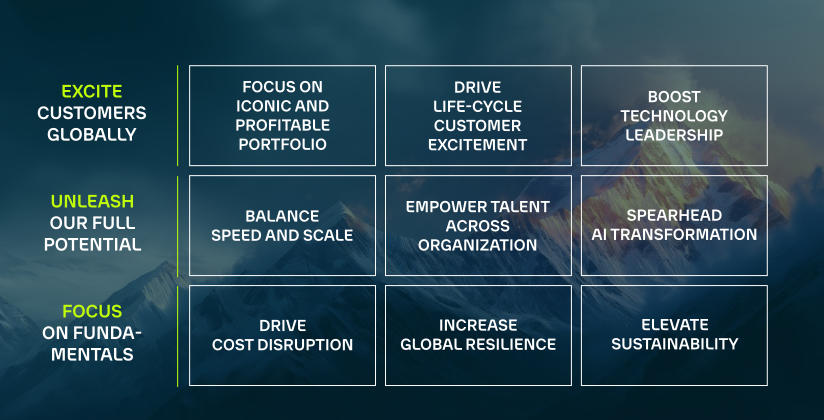
Sustainability is rooted in the Volkswagen Group and is an integral part of our Group strategy, which is presented in the “Goals and Strategies” chapter of the Group management report. Our Group sustainability strategy regenerate+ is enshrined in the Group strategy through the “Elevate sustainability” imperative within the core topic “Focus on Fundamentals”.
Group sustainability strategy
The Group’s sustainability strategy regenerate+ provides important stimuli that are aligned with our objectives. Society requires engagement that generates positive added value in order to help our planet to regenerate and to shape a future worth living in for current and future generations. We wish to contribute to this, and take a broad and comprehensive approach to sustainability – environmentally, socially and economically. Our vision is to become a mobility provider with positive added value for nature and society. To this end, we continue to work in partnership and maintain constructive communication with our stakeholders in order to learn and further improve.
The regenerate+ sustainability strategy applies to the entire Volkswagen Group – i.e. to the Group departments, to all brands and companies. As such, it encompasses our products, services and stakeholders, including our customers. Our goal is to use regenerate+ to distinguish ourselves as the Volkswagen Group and, at the same time, enable our brands to position themselves in their specific market environment.
Together, we are pursuing a vision for the Volkswagen Group and driving sustainable value creation. Transforming ourselves into a business that operates sustainably is a process, and we are constantly in motion. We review our targets on a regular basis and continuously adapt them. Our regenerate+ Group sustainability strategy features measures in four dimensions: nature, our people, society, and business.
The dimensions of regenerate+
Nature
The Volkswagen Group’s core aim in its Group sustainability strategy is to do more than simply reduce emissions. Our vision is to have a positive impact on people and the environment, and to contribute to the restoration and improvement of ecosystems and living conditions by means of regenerative actions.
Climate change mitigation: The Volkswagen Group wishes to achieve net carbon neutrality
The Volkswagen Group is committed to the Paris Climate Agreement. We aim to achieve net carbon neutrality by 2050. Our intermediate target is to reduce the carbon footprint per customer-kilometer traveled during the use phase of our passenger cars and light commercial vehicles by 30% by 2030 (compared to 2018).
A further goal is for our global production sites to achieve net carbon neutrality by 2040 – ten years earlier than originally planned. To this end, we aim to reduce greenhouse gas emissions by 90% by 2040 compared to 2018, among other measures. In order to achieve this, the Volkswagen Group intends, for example, to adapt its energy supply and increase energy efficiency. The objective is to be procuring 100% of external electricity from carbon-neutral sources at all sites by 2030. The European sites are already currently obtaining 100% of their external electricity from renewable sources.
Our objective in the context of the Zero Impact Factory strategic vision is to gradually reduce the absolute environmental impacts of our production sites for passenger cars, light commercial vehicles and components by 37.5% by 2030, by 68.8% by 2040, and ultimately towards achieving net neutrality by 2050, all compared to 2018 levels. Further information on the climate change mitigation focus area is provided in the “Climate Change” chapter under Environmental Information.
Resources: The Volkswagen Group is working to continuously reduce its demand for primary raw materials
The finite nature of natural resources and the social and environmental consequences of mining raw materials make the development of a circular economy a key sustainability topic. The focus here is primarily on conserving resources. In this context, the Volkswagen Group has formulated Group-wide ambitions: we aim to achieve a circular materials use rate of 40% in our passenger cars and light commercial vehicles by 2040. This applies to vehicle projects for which start of production is planned from 2040 onward (excluding China). The Group defines circular materials as materials from technical or natural cycles, i.e. not only recycled materials, but also bio-based and carbon-based materials. Throughout the entire ID. family, headliners, fabrics, carpets, seats, door trims and decorative panels are already made of recycled materials, examples being seat covers made with yarn from ocean plastics and recycled PET bottles. Further information on the resources focus area is provided in the “Resource Use and Circular Economy” chapter under Environmental Information.
Ecosystem: The Volkswagen Group promotes biodiversity
The production of our vehicles, and their use by our customers, impact biodiversity through emissions, land use and transportation. We wish to minimize this impact by working to reduce our land use and thus create added value for nature and achieve an improvement in species diversity. We aim not only to maintain biodiversity, but to promote it throughout the value chain, from raw material extraction to production and recycling. The Volkswagen Group is aware of its responsibility. We support conservation projects worldwide and have been involved in protecting and preserving biodiversity since 2007. As a founding member of the Biodiversity in Good Company e.V. initiative, we acknowledge the three goals of the international Convention on Biological Diversity (CBD). Moreover, we have defined corresponding action areas that will allow us to contribute to achieving these goals within the framework of our business activities. We report on this every two years in our progress report.
To promote biodiversity beyond its own value chain, the Volkswagen Group launched a biodiversity fund for external nature and biodiversity projects in 2025. The fund has an annual allocation of up to €25 million and a planned term of five years (2025 – 2029). The aim is to facilitate effective measures to protect and promote biodiversity beyond the Group’s sites and supply chain. Further information on the ecosystem focus area is provided in the “Biodiversity and Ecosystems” chapter under Environmental Information.
Our people
The Volkswagen Group is a socially responsible employer. We stand for a diverse, inclusive, and non-discriminatory culture. By paying fair wages, we help to secure our employees’ standard of living at our locations. We invest extensively in the qualification, safety and health of our employees.
Culture: The Volkswagen Group promotes a diverse, inclusive, and non-discriminatory culture
At the Volkswagen Group, we reject discrimination in any form. We promote cooperative behavior in the workplace and are committed to inclusion. We are convinced that integrity and compliance can only be practiced in a culture free of fear, and we create the conditions for this. We are particularly focused on increasing the proportion of women at all levels of the workforce. As a company traditionally dominated by engineers and technical workers, we face special challenges, as do all automotive companies.
Diversity is also important to us with regard to culture, origin, and native language. Every year, we use the diversity index to measure the degree of internationalization in the top management of the Volkswagen Group and our goal is to continuously increase this. For 2025 it was planned to increase the diversity index to 154. This target value for 2025 was exceeded with a score of 168. Further information on the design of the diversity index is provided under the heading “Targets related to equal treatment and equal opportunities” in the “Employees and Non-Employees” chapter under Social Information.
People: The Volkswagen Group wishes to be a unique employer and lead teams to success
The transformation of the automotive industry is making work at a company like the Volkswagen Group more diverse and interesting. Coding is taking its place alongside traditional engineering, artificial intelligence is relieving employees of routine tasks, and digital business models are increasingly taking their place alongside physical products. At the Volkswagen Group, we wish to capitalize on these advantages to provide the employees with a unique working experience. It is important to us that our employees can keep pace with change, and we therefore invest heavily in training. Further information is provided in the “Working conditions” section of the “Employees and Non-Employees” chapter under Social Information.
Health and safety in the workplace: The Volkswagen Group is known for its holistic approach to occupational health and safety
Ensuring a safe and healthy working environment is a not only a key component of sustainable corporate management but also an important factor in employer attractiveness. It is also an effective way of reducing risks related to occupational health and safety and guarding against process disruptions. We plan to further expand our prevention programs for employees in the coming years. The Volkswagen Group favors preventive approaches to promote the physical and mental health and well-being of its employees. In the area of accident statistics, our goal is also to establish a lead in the accident frequency rate at all brands and companies. All Volkswagen Group production sites with more than 1,000 employees are to be certified in accordance with ISO 45001 by the end of 2026 to facilitate the systematic management and quality assurance of our health and safety activities.
Society
As one of the world’s largest automotive manufacturers, the Volkswagen Group bears great responsibility toward its partners, stakeholders and society. The aim is not only to live up to this responsibility and role but to have a positive impact above and beyond this. The holistic approach of regenerate+ provides the basis for advancing sustainability together with our partners and stakeholders.
Supply chain: The Volkswagen Group creates responsible and sustainable supply chains
The Volkswagen Group is committed to enabling sustainable mobility for future generations. This entails meeting our legal, social, and environmental responsibilities not only within the Group but also in our supply chain, which includes more than 63 thousand supplier locations in 93 countries around the world. The aim is to organize the Volkswagen Group’s supply chain responsibly by identifying, mitigating and minimizing risks to the people who are potentially affected. Where possible, and going over and above statutory requirements, positive impacts are also achievable.
Our aim is to be able to show by 2040 that over 95% of the relevant direct suppliers have a positive sustainability rating (S-Rating) in terms of sales revenue. Further information on the supply chain focus area is provided in the “Sustainability in the supply chain” chapter under “Social Information”.
Stakeholders: The Volkswagen Group is a reliable partner
The Volkswagen Group prides itself on being a trustworthy partner and wishes to remain so in future. The basis for this comes not only from our rich heritage but above all from our clear commitment to sustainable mobility and social responsibility.
As a globally active company, our business activities impact the lives of many people. This means that we have a responsibility to actively shape the framework for our business activities in cooperation with our stakeholders. We therefore consider an ongoing dialogue with our stakeholders to be of paramount importance. The aim of this constructive and critical dialogue is to understand our stakeholders’ needs, build trust and establish long-term partnerships. Further information on the stakeholders focus area is provided in the section on “Interests and views of stakeholders”.
Social engagement: The Volkswagen Group is enhancing its positive societal impact
Society and the Volkswagen Group are inextricably linked, each shaping and influencing the other. With this interconnectedness comes a profound responsibility to promote positive change – at our own sites and beyond. To achieve this goal, the Volkswagen Group supports a variety of projects through donations. Our employees’ direct involvement in voluntary work also contributes to this goal. Through the Group sustainability strategy regenerate+, we consolidate and harmonize these efforts under the banner of societal impact, integrating them into our holistic approach to sustainability.
At the heart of our societal impact efforts is the promotion of corporate citizenship projects in the form of forward-looking initiatives that prioritize environmental protection, education and community development at many of our sites around the world. In addition to donations made by the Group, our companies and our employees, the Volkswagen Group established a new Sustainability Impact Fund in 2025 with an annual allocation of up to €20 million. This fund is specifically dedicated to sustainability projects aimed at improving our societal impact. Further information on the societal impact focus area is provided in the “Societal Impact” chapter under Social Information.
Business
The Volkswagen Group is advancing its business model through the holistic approach of regenerate+. New business areas, new products, services and financing models are expanding and strengthening the core business and supporting its transformation. In aligning its business activities with sustainability, the Volkswagen Group also takes account of investor requirements and feedback as well as insights from relevant ratings.
Sales revenue: The Volkswagen Group is engaged in and promotes sustainability-oriented business areas
Sustainability remains fundamental for our business. The increasingly perceptible impact of climate change, growing consumer awareness of sustainable living and not least voluntary frameworks such as the Paris Agreement are key drivers in this context.
Electric mobility plays a key role in reducing emissions from road traffic. In 2025, the share of BEVs in Volkswagen Group deliveries was 10.9% (8.2)%.
In addition, the Volkswagen Group has been investing in decarbonization efforts through the Leitmotif venture capital fund since 2023. Launched with an initial anchor investment of USD 300 million, Leitmotif aims to promote innovative technologies and solutions throughout the entire mobility value chain and beyond, accelerating their market readiness.
Further information on the revenue focus area is provided under Environmental Information in the “EU Taxonomy” chapter.
Financing: The Volkswagen Group is strengthening and intensifying its sustainable financing.
Sustainability and climate-friendly business practices are of central strategic and operational importance to the Volkswagen Group and represent a key pillar of its Group sustainability strategy as well as a major factor in investment decisions. Accordingly, our goal is to actively shape sustainability-oriented financing.
By 2030, the Volkswagen Group aims to finance at least 30% of its outstanding bond volume through green bonds. The Volkswagen Group wants to increase this proportion to 50% by 2040. In order to achieve these goals, the majority of our annual euro bond issues are already structured as green bonds or comply with the EU taxonomy classification system. Further information on the financing focus area is provided under Environmental Information in the “EU Taxonomy” chapter.