
Production
Our international production network covers a large number of process steps from the supplier to the factories and assembly lines, to the dealerships and our customers. The long-term efficiency of this network is key to our competitiveness. In order to meet the challenges of the future, we rely on comprehensive optimizations, pioneering innovations, stable supply chains and flexible structures. The Volkswagen Group, including the Chinese joint ventures, produced 8.9 million vehicles worldwide in fiscal year 2025. This was a year-on-year decline of 1.0%. Productivity (vehicles per employee and per year), including in the Chinese joint ventures, rose by 4.3% compared with the prior year. Excluding the Chinese joint ventures, the Volkswagen Group produced 6.2 million vehicles worldwide, an increase of 0.6% year-on-year. Productivity climbed by 4.6% versus the previous year.
Production Strategy
Group production is focusing squarely on future viability, efficiency and sustainability with PULSE 2035. This is in response to the far-reaching changes in the automotive industry shaped by technological innovations, geopolitical developments and increasing environmental requirements. PULSE 2035 gives shape to a specific vision for 2035 based on five main targets: factory costs per vehicle; productivity; plant capacity utilization; innovative technologies and processes; and reduction of environmental impacts. These targets make the strategic orientation tangible and provide a clear direction.
The vision of PULSE 2035 describes a production and logistics that is resource-efficient, optimized for maximum performance and driven by innovation – and is to be realized by 2035. So that this vision can be implemented in a structured manner, the strategy is based on a stable organizational framework comprised of seven categories: product and production processes; production network; supply chain; people; environment and energy; digitalization; operations and governance. This framework will provide the basis for implementation and facilitate consistent internal management of the transformation across all of the sites.
Global Production Network
At the end of the reporting year, the Group’s production network encompassed over 111 production sites, including our Chinese joint ventures. Of these sites, 67 are vehicle production plants, including trucks, buses and motorcycles. Standardizing production with uniform product concepts, plants, operating equipment and production processes within a product family is a key factor in our forward-looking production. We are constantly enhancing our production concepts and aligning them with new technologies to achieve ambitious targets in the individual projects. In a challenging environment, the Volkswagen Group succeeded in starting up 46 vehicle projects in 2025, of which 26 were new products or successor products and 20 were product upgrades or derivatives.
VOLKSWAGEN GROUP VEHICLE PRODUCTION SITES
as share of total production in 2025 in percent
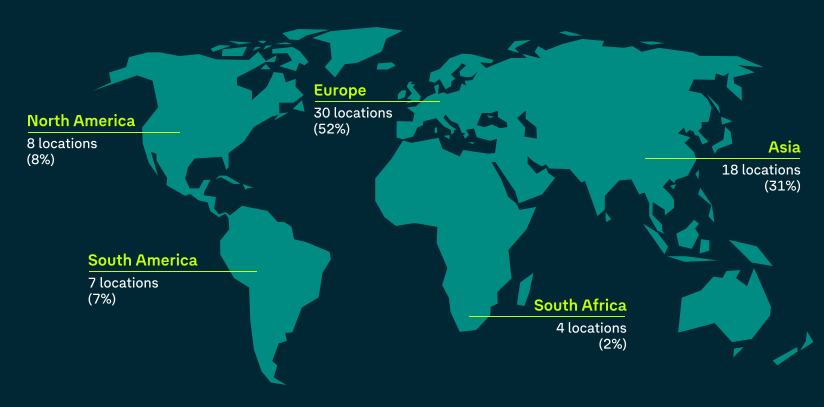
The flexible production capacities provided by our platforms allow us to respond to changing market requirements, make needs-based use of the production network and leverage synergies across brands through multibrand sites. Of the vehicle production plants for passenger cars and light commercial vehicles, almost half are already multibrand sites. Models for this approach within the Group are the Bratislava and Zwickau sites. In Bratislava, vehicles of the Volkswagen Passenger Cars, Škoda, Audi and Porsche brands are produced on the joint Modular Longitudinal Toolkit (MLB) and MQB platforms. At present, we manufacture Volkswagen Passenger Cars, Audi and CUPRA brand vehicles on the joint MEB platforms in Zwickau.
The transformation of the Volkswagen Group is focused on mobility solutions that are innovative, efficient, sustainable and customer-oriented, as well as geared towards profitable growth. The introduction of the MEB served as a basis for this, followed by the all-electric PPE for the premium and sports brands, thus leveraging synergies in production across the brands. As of the end of 2025, electric vehicles were manufactured at 19 sites across the global production network for passenger cars and light commercial vehicles.
New Technologies and Digitalization
Focus was placed on speed and the added value of IT products and on the use of AI as part of the Group’s Top 10 program, which formed the strategic basis for new technologies and the digitalization of production in fiscal year 2025. The digital transformation is shaping the future development of our process landscape. The reorganization this involves includes a switch to value-stream- and product-oriented software development within the Group. Overall, more than 110 new applications are already available for use in the production and logistics processes. Examples range from virtual training courses for new vehicle start-ups, to identifying and implementing potential energy savings, to the use of AI in support of launching vehicles. The applications are being rolled out via the Digital Production Platform (DPP) developed jointly with our reaffirmed strategic partner Amazon Web Services (AWS). The DPP’s capabilities are being continuously expanded in conjunction with AWS. There was a strong focus on data management services in the reporting year.
In the Volkswagen Group, our objective is to systematically validate digital and innovative technologies and to pilot and roll out the usage thereof for production and logistics; the aim is to reduce costs in the value chain and achieve more flexible implementation options, as well as to improve quality. In effecting the digital transformation in production and logistics, our goal is to simplify the entire process chain and make the best possible use of new technologies. In 2025, Volkswagen continued, amongst other points, the expansion of the ONE Log project, a logistics system based on SAP S/4 HANA. Using ONE Log, the Volkswagen Passenger Cars brand aims to shape the future of digital logistics worldwide together with other brands including Audi and Škoda, and Volkswagen Group Components. The goal of this is uniform information processing and the standardization of logistical processes, whereby optimizations are to be made scalable and innovative technologies to be powered centrally. The project includes various processes such as scheduling, shipping and materials management, from goods received to the production line. The targeted digitalization campaign is intended to make our plants more robust.
Innovation activities in 2025 focused on AI, such as for AI robotics and in generative AI. In generative AI, Volkswagen developed prioritized fields of application in 2025 and is using the first cross-brand applications to improve the efficiency of knowledge management in planning and maintenance. Other applications are being used in change and requirements management and directly in production. In using generative AI, Volkswagen aims to leverage cost savings in the context of information generation and processing in production.